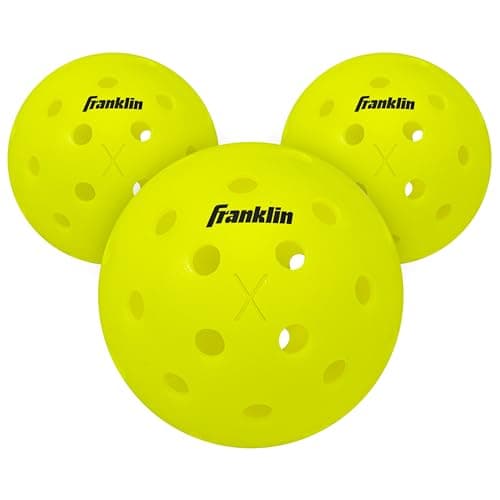
Buy Franklin's balls without thinking about it. The X-40 is the official ball of USA Pickleball and of the US Open Pickleball Championships, and the X-26 is its indoor equivalent — in this one category Franklin is not a competitor, it is the standard everyone else is measured against. Buy the 22 ft net and the court marker kit on merit; both already top their own categories on this site.
Be more careful with the paddles. All three we rank are competent, legal and brand-backed, and all three have a published spec that will catch a reader who does not check it — one has the largest grip sold, one has the thinnest core Franklin makes, and the tour paddle is heavy enough that a beginner should not be near it.
Our standing disclosure: we have not tested any of this. We do not run a lab, we have not bounced a ball or set up a net. Every hole count, gram, ounce, dimension, circumference and inclusion below was read off the live Amazon listing for the exact ASIN our buy button points at, checked on October 16, 2026, with every listing named in Sources. Court geometry comes from the official dimensions we already publish on pickleball court dimensions. Where Franklin publishes nothing we say so; where its own copy rounds a number, we say that too. The scores are judgments from that research against our published rubric, weighted for a beginner.
03The buyer's guide
First, the only criterion that matters: what is Franklin actually best at?
Brand pages usually pretend a company is equally good at everything it sells. Franklin is a general sporting-goods manufacturer — its own copy dates the company to 1946 — and it shows up in pickleball across five categories with five different levels of authority. Sorting that honestly is the single most useful thing this page can do:
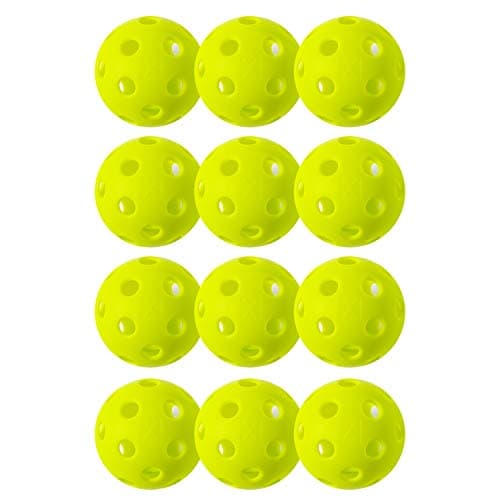
- Balls — the category standard. Not an opinion. The X-40 listing names it the official ball of USA Pickleball, the US Open Pickleball Championships and the APP Tour. If your league plays outdoors, there is a strong chance this is the ball in the tube.
- Nets and court marking — competitive, and our current rank 1. The 22 ft net tops best pickleball nets and the marker kit tops best court marking kits, both on published spec rather than brand loyalty.
- Starter sets — fine, beaten on contents.The Pilot set is a real brand's set, and other sets bundle more for the money. It sits mid-table on best starter sets.
- Paddles — competent, not class-leading.Franklin's paddles are honest, USA Pickleball certified and well documented. They are not where the brand's reputation comes from, and the specialists out-spec them at the same money.
- Ball machines — a credible first machine with an asterisk. Covered below, because the asterisk is money.
The balls: four numbers that explain the whole category
This is the comparison most people searching for pickleballs actually need, and both sets of figures are Franklin's own:
| Spec | X-40 (outdoor) | X-26 (indoor) |
|---|
| Holes | 40, machine-drilled | 26 |
| Published weight | 26 g | 24 g |
| Published diameter | 74 mm | 74 mm |
| Construction | Single-piece, seamless | Two-piece |
| Approval | USA Pickleball approved | USA Pickleball approved |
Read across those rows and the indoor/outdoor split stops being mysterious. Same diameter, two grams apart, fourteen holes apart. The outdoor ball is heavier with more and smaller holes so it carries through wind; the indoor ball is lighter with fewer, larger holes so it flies slower and more controllably in still air — and it is quieter, which matters if you share a gym. Our indoor vs outdoor pickleballs page covers the decision in full, and types of pickleball balls covers the rest of the shelf.
The construction row is the one nobody mentions and the one that decides durability. The X-40 is one seamless piece; the X-26 is two pieces, which means a seam, which is a failure point the outdoor ball does not have. That is not a knock on the X-26 — two-piece construction is normal for indoor balls, and indoor floors are far kinder than concrete. It does mean you should not buy indoor balls to save money and then take them outside. Our how long pickleballs last page has the realistic lifespans, and X-40 vs Dura Fast 40 is the head-to-head if you want the outdoor ball argument settled.
One honest limit on the X-40, from Franklin's own copy: the balls "perform best on authentic pickleball courts and in average temperatures." That is a polite way of saying hard plastic cracks in the cold, which is true of every outdoor ball and is why we keep a separate best balls for wind and cold list.
The paddles: one spec table, three different traps
Credit where it is due — Franklin publishes more about its paddles than most brands do, including figures nobody else prints. Here is all of it:
| Paddle | Core | Face | Dimensions | Weight | Grip |
|---|
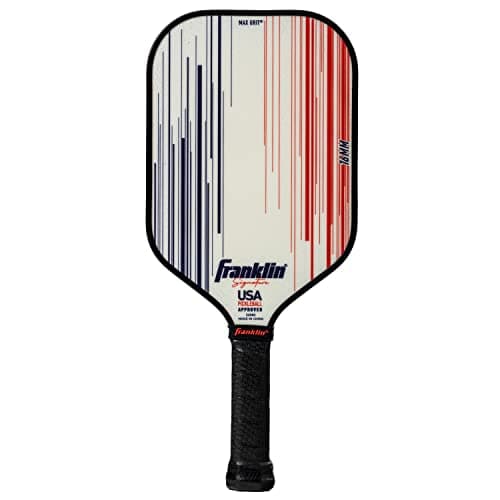
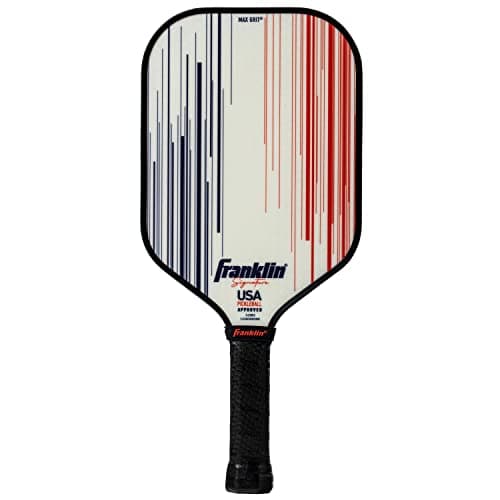
| Signature Series Pro 16mm | 16mm polypropylene | MaxGrit fiberglass | 16.5 x 7.5 in | 7.9–8.3 oz | 5.6 in long, 4.5 in around |
| Signature Pro 13mm | 13mm polypropylene | MaxGrit fiberglass | 16.5 x 7.5 in | 7.5–8 oz | 5.6 in long, 4.25 in around |
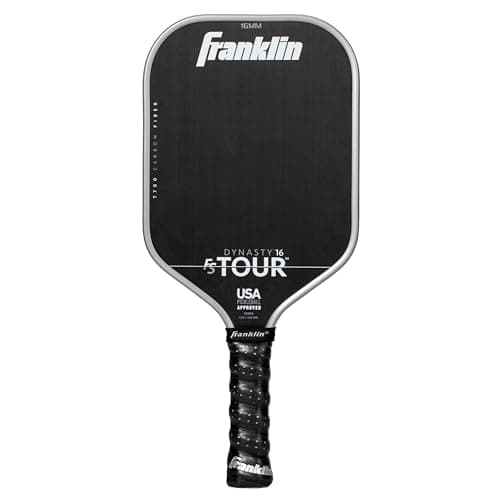
| FS Tour Dynasty Pro 16mm | 16mm polymer, foam-injected perimeter | T700 raw carbon fiber | Not published | 8.5–8.8 oz | 5.6 in long, 4.3 in around |
Trap one: the 16mm Signature has a 4.5 in grip, the largest circumference commonly sold. The cheaper 13mm version is 4.25 in. That is backwards from what a shopper expects — you normally pick a paddle and then its grip, not a grip and then your core thickness. If your hand measures average or small, the 16mm Signature will make you squeeze, and squeezing is where forearm pain starts. Take the twenty-second ruler test in our grip size guide before you choose between these two, because a grip can be built up with an overgrip and can never be shaved down.
Trap two: the Tour paddle is heavy. A published 8.5–8.8 oz puts the Dynasty Pro at the top of the midweight band and above every paddle we recommend to a new player. Extra mass is genuine free power and genuine extra load on the elbow; our paddle weight guide sets out the bands, and our paddles for tennis elbow page explains why this is the wrong direction if your arm is already complaining.
Trap three: fiberglass is not carbon, and the names hide it. Both Signature paddles use a MaxGrit fiberglass face; only the Dynasty Pro uses T700 raw carbon fiber. Fiberglass is forgiving and cheap and produces average spin; a raw carbon face is grittier and holds the ball longer for a player who can already brush it. Neither is better in the abstract — graphite vs fiberglass is the full argument — but you should know which one you are buying, and "MaxGrit" does not tell you.
Two things genuinely to Franklin's credit. The 13mm listing publishes a swing weight and a twist weight— 116 and 6.95, in units the listing prints oddly — and almost no brand at that price publishes either. And the Dynasty Pro's one-piece construction with a foam-injected perimeter is the modern premium-paddle recipe, described in our thermoformed paddles guide. If you want the whole brand-versus-brand view, our best paddle brands page places Franklin against the specialists, and best JOOLA paddles does this same single-brand read for the range at the other end of the shelf.
The net: 22 feet, wheels, and what "3 feet high" means
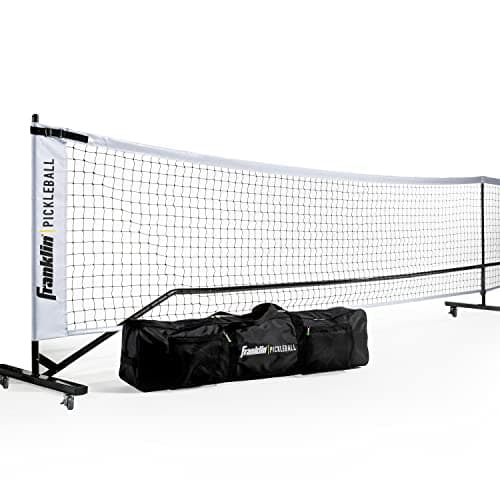
Franklin's net publishes the figures that matter: 22 ft long, which covers the 20 ft court width with 12 in spare on each side, on powder-coated steel posts with wheels, tool-free assembly and a travel bag included.
One clarification, because the listing rounds it. Franklin says the net "stands 3 feet high to adhere to official USA Pickleball net standards." The official standard is 36 in at the sidelines, sagging to 34 in at center — so 3 ft is the post height, not a flat 36 in across the whole net, and a correctly tensioned net is supposed to dip in the middle. If that distinction matters to you, our what size pickleball net do you need page has the numbers, and how to set up a portable net covers getting the tension right.
The wheels are the feature worth paying for and the reason this net ranks where it does: a regulation net is heavy, and wheels turn a two-person lift into a one-person push. Against its closest rival, read Franklin net vs A11N Pro net. If you are building a home court rather than buying one net, the whole list lives on backyard pickleball court setup.
The court marker kit: twelve pieces, twelve junctions
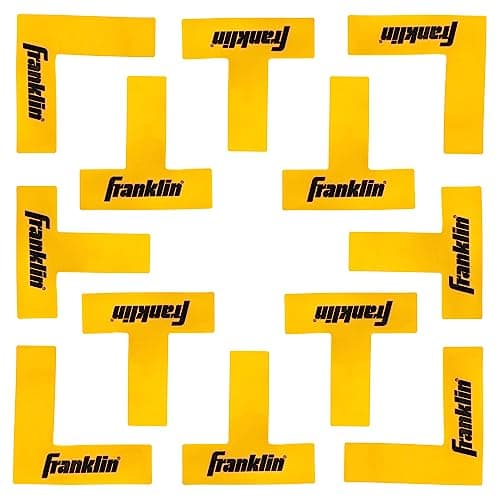
The marker kit is 4 L-shaped and 8 T-shaped pieces, wipe-clean, with nothing adhesive. Those twelve pieces map exactly onto a pickleball court's four corners and eight line junctions, which is a tidier piece of design than the listing bothers to explain.
Set your expectations correctly, though: a regulation court is 198 feet of 2-inch line, and twelve plastic markers are not covering 198 feet of anything. You get the geometry, not the lines, so you judge a 44 ft sideline by eye between two markers. For a social game on a surface you have to hand back — a park court, a school gym, a rented driveway — that is genuinely the right answer, and nothing sticks to the ground for anyone to object to. For anything scored, buy tape or adhesive lines instead; our court marking kits page ranks all five options.
The set and the launcher: the two listings with hidden costs
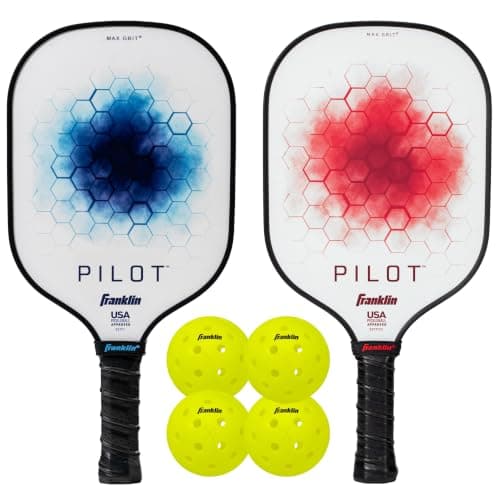
The Pilot set is two MaxGrit fiberglass paddles on a 10mm polypropylene core plus 4 X-40 outdoor balls, with the paddles USA Pickleball certified. Two notes. First, a 10mm core is thinner than anything else on this page, which means poppy and lively rather than controlled — fine for a first week, limiting after that (see core thickness guide). Second, and more practically, this listing's bullets do not mention a bag. Several competing sets include one, so check the configuration you are ordering rather than assuming; our best starter sets page compares contents side by side, and starter set vs buying separately does the arithmetic on whether a set is the right shape of purchase at all.
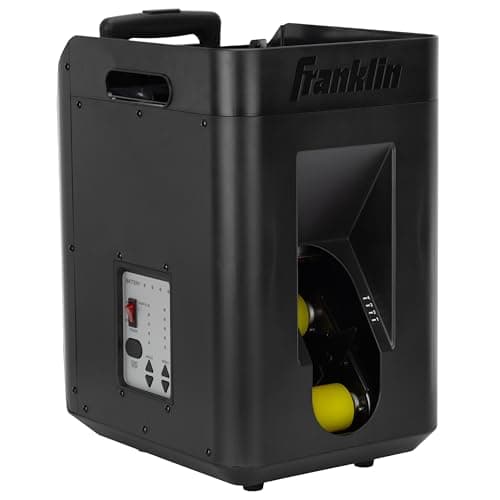
The launcher is the real asterisk on this page, and it is the clearest example of why we read listings instead of summarizing them. It publishes 5 speeds, 4 launch angles and a shuffle mode that varies the angle automatically, which is a genuinely useful feature set for solo drilling and a fraction of club-machine money. But the listing also says, in its own words, that the battery is not included — it recommends a specific third-party 18V 6.0Ah lithium pack.
If you do not already own that battery system, the real cost of this machine is the machine plus a battery and charger, which changes the comparison against machines that ship ready to use. Our best pickleball ball machines page ranks it with that cost in mind, and if you are not sure a machine is the right purchase at all, how to practice pickleball alone and rebounder vs wall cover the cheaper routes to the same practice.
The one Franklin product we will not point you at
Franklin also sells a sling-style paddle bag that we have ranked in the past. At our last price check it had no buyable offer, so it does not appear on this page. We will not feature a product we cannot confirm you can actually buy today, which is the same rule that keeps several no-price items off our other lists. If you need a bag, our best pickleball bags and best backpacks pages rank what is in stock.
So what should you actually buy from Franklin?
- Everyone, outdoors: X-40 balls. Cheapest decision on this page and the least likely to be wrong. Full write-up in our X-40 review.
- Everyone, indoors: X-26 balls — reviewed here — and read how many pickleballs you need before you buy a single tube.
- Anyone building a court: the 22 ft net if the court is permanent-ish, the marker kit if it is not.
- A paddle buyer with large hands: the 16mm Signature Series Pro, whose 4.5 in grip is a feature rather than a problem for you. Everyone else should measure first, and most beginners are better served by the cross-brand picks on best paddles for beginners.
- Nobody who is still deciding whether they like pickleball: not the Tour paddle, and not the launcher. Both are commitment purchases — see how much to spend and what pickleball equipment really costs.
A closing note on brand loyalty, which is the trap a page like this one can set. Franklin earns its position in the ball aisle outright, and nothing about that makes its paddles the best paddles or its launcher the best launcher. Buy the ball because it is the standard; buy everything else because the published specs say so. And since Franklin makes no court shoe at all, the footwear half of your kit is a separate decision entirely — start at best pickleball shoes, or the Selkirk CourtStrike Pro 3.0 review if you are the player who wears outsoles out.