PPost & Paddle
04Gear

The best pickleball court marking kits

A regulation court is 198 feet of 2-inch line. Some of these kits give you all of it, some give you twelve plastic corners, and the right answer depends entirely on whose driveway it is.

By Stephen V.Editor, Post & PaddleUpdated

Heads up: Post & Paddle is reader-funded. If you buy through our links we may earn a commission, at no extra cost to you. It never changes which product we recommend. How this works.

For most people the answer is the Franklin Sports Court Marker Kit: twelve throw-down pieces, nothing sticks to the ground, and it goes back in the bag when you leave. If the surface is yours and you want lines you can call a ball out on, the CourtKit pre-measured lines are the best version of that, and the SONICTOP court tape is the cheap version of the same idea. Only buy the PROGOAL stencils if you own the concrete and the court is never coming up.

That split is the whole decision, and it is not the one the listings are written around. Every product in this category photographs the same way — a bright yellow court on gray concrete — but they are answering three different questions. Throw-down markers tell you where the lines would be. Tape and adhesive strips are the lines. Paint is the lines, forever. Buy across that boundary by accident and you either end up arguing about a sideline all afternoon, or explaining a painted rectangle to whoever owns the parking lot.

Our standing disclosure, because this is a category where it matters more than usual: we have not laid any of these kits out ourselves. Every piece count, length, material and claim below was read off the live Amazon listing for the exact ASIN our buy button points at, checked on October 9, 2026, and the court geometry comes from the official dimensions we already publish on pickleball court dimensions. The arithmetic is ours and we show it. Where a maker does not publish a number, we say the number is missing rather than inventing one — see our methodology.

01The short answer

Quick picks

#ProductBest forScorePrice
01
Franklin Sports Franklin Sports Pickleball Court Marker Kit
Franklin Sports Pickleball Court Marker Kit

Twelve throw-down pieces that mark the twelve places a pickleball court's lines actually cross. The cheapest honest way to get a playable court on a surface you don't own.

Marking a court you have to hand back
8.6
$19.99Amazon
02
CourtKit CourtKit Pickleball Court Marking Kit
CourtKit Pickleball Court Marking Kit

Pre-measured peel-and-stick lines for every boundary a regulation court needs, including the kitchen and the net hash marks. The one that produces a court you can call lines on.

A proper court that stays put for a season
7.2
$59.95Amazon
03
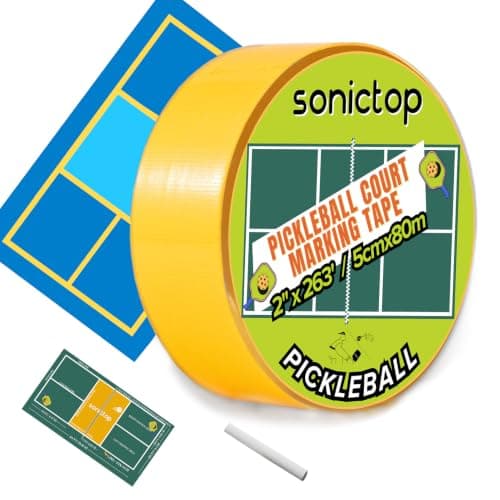
SONICTOP SONICTOP Pickleball Court Tape Kit
SONICTOP Pickleball Court Tape Kit

Three rolls of 2-inch tape and a sizing card. The cheapest route to genuinely continuous, regulation-width lines — if you have an afternoon and a clean surface.

Continuous regulation lines on a budget
6.6
$18.99Amazon
04
Eco Walker Eco Walker Court Marker Kit (18-piece)
Eco Walker Court Marker Kit (18-piece)

The kit that publishes its own dimensions: 12 strips, 4 corners, 2 spots and a bag. Built for drills and a half-court at home rather than a regulation layout.

Drills, kids and a mini court
8.2
$21.99Amazon
05
PROGOAL PROGOAL Pickleball Court Stencil Kit (46-piece)
PROGOAL Pickleball Court Stencil Kit (46-piece)

Forty-six reusable templates for spraying a permanent 44 x 20 ft court onto concrete. The right answer only if the slab is yours and the court is staying.

Painting a permanent court on your own concrete
5.8
$159.00Amazon

#ad · Live prices from the Amazon Product API, as of October 9, 2026. Where we have no verified live price, we show none — we would rather leave a gap than print a number that has rotted.

02In detail

The picks, in full

01
Franklin Sports Franklin Sports Pickleball Court Marker Kit

Marking a court you have to hand back

Franklin Sports Pickleball Court Marker Kit

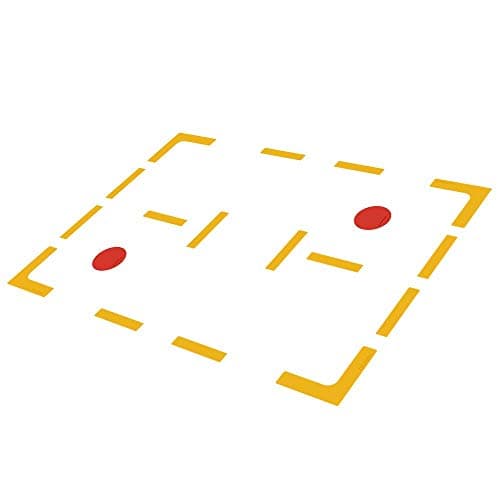
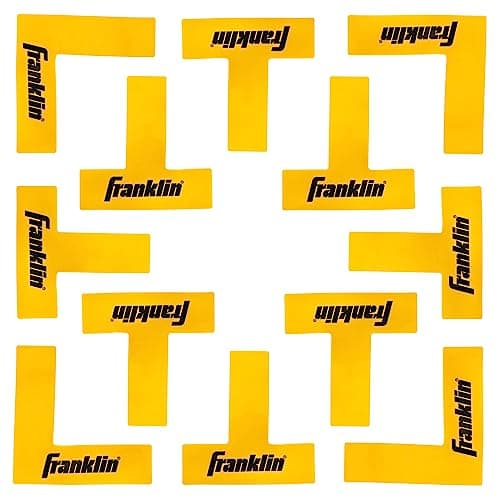
4 L-style corner pieces8 T-style junction piecesWipe-clean material12 x 9 x 9 in packed, about 2 lb
8.6/10

Twelve throw-down pieces that mark the twelve places a pickleball court's lines actually cross. The cheapest honest way to get a playable court on a surface you don't own.

Full court
6
Setup speed
9
Reusability
9
Surface safety
10
Value
9

Pros

  • The 4 L and 8 T pieces map exactly onto a pickleball court's four corners and eight line junctions
  • Nothing sticks to the ground, so a park, gym or tennis club has nothing to object to
  • Franklin has made pickleball equipment for decades — this is not a drop-shipper's kit

Cons

  • It marks the corners and junctions, not continuous lines — you read the boundary between markers
  • Franklin publishes no per-piece dimensions, so you cannot check how visible each marker is before it arrives
  • You still have to measure and square the court yourself; the kit carries no tape or guide

Don't buy this if…

…you want lines you can call a ball out on at the sideline. Markers at the junctions leave you judging a 44 ft edge by eye between two pieces of plastic — buy tape or adhesive lines instead.

$19.99View on Amazon

$29.9933% off

Price as of October 9, 2026. Prices change — Amazon's is the one that counts.

#ad · we may earn a commission from this link to Franklin Sports Pickleball Court Marker Kit

02
CourtKit CourtKit Pickleball Court Marking Kit

A proper court that stays put for a season

CourtKit Pickleball Court Marking Kit

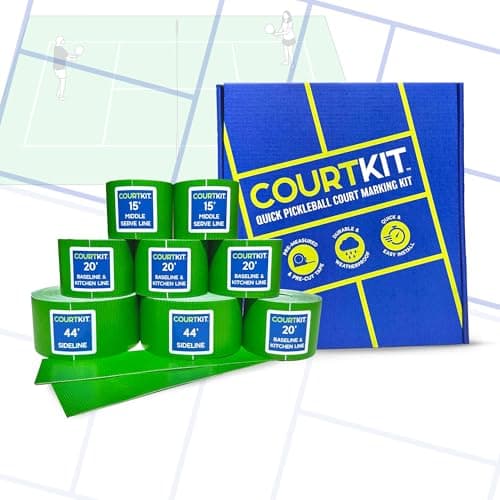
2 sidelines, 2 baselines, 2 center service lines, 2 kitchen linesNet hash marks includedPeel-and-stick adhesive backingIllustrated step-by-step instructions
7.2/10

Pre-measured peel-and-stick lines for every boundary a regulation court needs, including the kitchen and the net hash marks. The one that produces a court you can call lines on.

Full court
9
Setup speed
8
Reusability
5
Surface safety
7
Value
7

Pros

  • Pre-cut and pre-measured, so squaring the court stops being a tape-measure problem
  • The only kit here that marks the non-volley-zone line and the center service lines as continuous lines
  • CourtKit publishes waterproof, windproof, non-reflective and non-slip claims, and says the lines are removable if needed

Cons

  • Roughly three times the price of court tape for the same job
  • CourtKit does not publish the length or width of the individual lines, so you cannot verify the fit before buying
  • An adhesive designed to stay put is a commitment on a surface you share with other sports

Don't buy this if…

…you need the lines gone at the end of the session. This is built to stay; a throw-down marker kit is the right tool for a borrowed court.

$59.95View on Amazon

Price as of October 9, 2026. Prices change — Amazon's is the one that counts.

#ad · we may earn a commission from this link to CourtKit Pickleball Court Marking Kit

03
SONICTOP SONICTOP Pickleball Court Tape Kit

Continuous regulation lines on a budget

SONICTOP Pickleball Court Tape Kit

2 in wide — the official line width263 ft across the 3-roll setNo-residue removal claimCourt size cards included
6.6/10

Three rolls of 2-inch tape and a sizing card. The cheapest route to genuinely continuous, regulation-width lines — if you have an afternoon and a clean surface.

Full court
9
Setup speed
4
Reusability
3
Surface safety
8
Value
9

Pros

  • 2 inches is exactly the line width the official court dimensions specify, so the court looks and plays right
  • 263 ft against the 198 ft of line a regulation court needs leaves real margin for mistakes
  • SONICTOP publishes a no-residue removal claim and lists concrete, asphalt, hardwood and polyurethane as supported surfaces

Cons

  • Tape is single-use: lifting it to store it is not the plan, so each new venue costs another set
  • Needs a clean, dry, swept surface — it will not stick to dusty asphalt or a damp driveway
  • Laying 198 ft of tape square is an afternoon the first time, measuring included

Don't buy this if…

…you are marking a court you have to hand back in an hour. Tape is for a surface you control for weeks, not for a park court shared with tennis players.

$18.99View on Amazon

$19.995% off

Price as of October 9, 2026. Prices change — Amazon's is the one that counts.

#ad · we may earn a commission from this link to SONICTOP Pickleball Court Tape Kit

04
Eco Walker Eco Walker Court Marker Kit (18-piece)

Drills, kids and a mini court

Eco Walker Court Marker Kit (18-piece)

12 strip lines, 14.6 in each4 L-shaped corners, 10.6 in2 round spot markers, 8 inFlat TPE, drawstring carry bag
8.2/10

The kit that publishes its own dimensions: 12 strips, 4 corners, 2 spots and a bag. Built for drills and a half-court at home rather than a regulation layout.

Full court
5
Setup speed
9
Reusability
9
Surface safety
10
Value
8

Pros

  • The only marker kit here that publishes the size of every piece, so you know what you are getting
  • Flat TPE lies dead flat, which is the difference between a line marker and a trip hazard
  • The 2 spot markers make it a drills kit as well as a court kit — useful for footwork and target work

Cons

  • The 12 strips total about 14.6 ft of line against the 198 ft a full court needs — these are markers, not lines
  • 18 pieces spread across a regulation 20 x 44 ft court leaves big gaps you judge by eye
  • Bright flat plastic on a breezy outdoor court is a question no listing in this category answers honestly

Don't buy this if…

…you want a regulation court for real games. This is a practice and mini-court kit; a tape or adhesive-line kit is what a scored match needs.

$21.99View on Amazon

Price as of October 9, 2026. Prices change — Amazon's is the one that counts.

#ad · we may earn a commission from this link to Eco Walker Court Marker Kit (18-piece)

05
PROGOAL PROGOAL Pickleball Court Stencil Kit (46-piece)

Painting a permanent court on your own concrete

PROGOAL Pickleball Court Stencil Kit (46-piece)

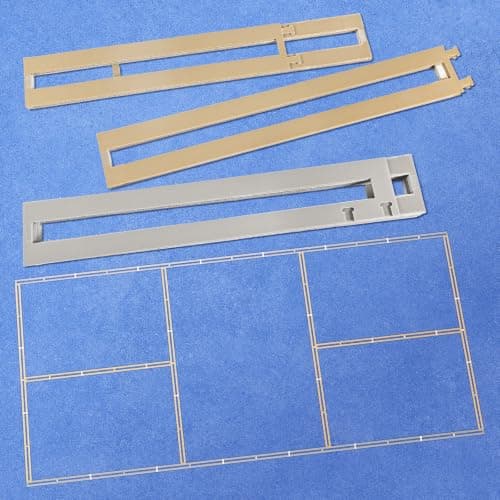
46 stencil piecesFull 44 x 20 ft regulation layoutA-F labeled for storageCalcium phosphate hollow board
5.8/10

Forty-six reusable templates for spraying a permanent 44 x 20 ft court onto concrete. The right answer only if the slab is yours and the court is staying.

Full court
10
Setup speed
3
Reusability
8
Surface safety
2
Value
6

Pros

  • Templates mean the lines come out straight and the court comes out square without a string line
  • Reusable and labeled A-F, so repainting a faded court in two years is a morning rather than a re-measure
  • Rigid board sits flat on rough concrete, which is what stops spray paint bleeding under the edge

Cons

  • The most expensive option here by a wide margin, and spray paint is an additional cost on top
  • Painted lines are permanent — on a shared driveway or an HOA slab that is a decision, not a session
  • Stock on this listing has been thin; the buy button falls back to a tagged search if it sells out

Don't buy this if…

…you do not own the surface outright. Everything else on this page comes back up; paint does not, and a park, school or HOA will treat a painted court as damage.

$159.00View on Amazon

Price as of October 9, 2026. Prices change — Amazon's is the one that counts.

#ad · we may earn a commission from this link to PROGOAL Pickleball Court Stencil Kit (46-piece)

03The buyer's guide

First, the number that decides everything: 198 feet

A regulation pickleball court is 20 feet wide by 44 feet long, the non-volley zone extends 7 feet from the net on each side, and every line is 2 inches wide. Add the line work up and you get a number worth carrying into this purchase:

  • Two sidelines at 44 ft — 88 ft
  • Two baselines at 20 ft — 40 ft
  • Two non-volley-zone (kitchen) lines at 20 ft — 40 ft
  • Two center service lines at 15 ft — 30 ft

198 feet of line in total, which is why the tape kits in this category sell in rolls of two hundred and sixty feet rather than fifty. It is also the number that sorts the shelf instantly. A marker kit with twelve pieces is not covering 198 feet of anything, and a kit that claims a "full court" while shipping eighteen fourteen-inch strips is covering about seven percent of it. Neither is dishonest. Both are sold with photographs that let you assume otherwise.

The five criteria, in the order they should decide your purchase

1. Whose surface is it?

This comes first because it eliminates most of the shelf before you compare a single spec. A park tennis court, a school gym, a church hall, an HOA sport court and a rented driveway are all surfaces where nothing adhesive and nothing permanent is your option — which leaves throw-down markers, full stop. Your own concrete driveway opens up tape, adhesive lines and paint. A shared driveway sits in between: tape and adhesive come up, paint does not.

The specific trap is the gym floor. Several kits in this category list hardwood and polyurethane among their supported surfaces, and that is a materials claim, not permission. Most indoor venues have a standing rule about what may touch the floor, and the person who enforces it is not reading the Amazon listing. Ask first.

2. Lines, or marks?

A continuous line lets you call a ball in or out at the point it lands. Corner and junction markers let you infer where the line would be, which works fine for a social game and stops working the moment the score matters. If you only ever play rec doubles with friends, markers are genuinely enough, and most of this category is built for exactly that buyer. If you are running a ladder, a club night or anything scored, buy line.

There is one line it is worth spending more to get right either way: the kitchen line. The non-volley-zone boundary is the only line in pickleball where touching it is a fault, which is explained in full in the kitchen rule. A court marked only at the corners has no kitchen line at all, and the kitchen is where the entire game is played. That is the strongest single argument for the pre-measured and tape kits over the marker kits.

3. An hour, a season, or forever?

Match the permanence to the use, not to the budget:

  • An hour or two, then gone — throw-down markers. Down in a couple of minutes, up in one, and they travel.
  • A season on a surface you control — court tape or pre-measured adhesive lines. Both are a one-afternoon job and both come up again.
  • Forever — paint, with stencils to keep it straight. Cheapest per year by a long way, and completely irreversible.

4. Will anyone trip on it?

Everything you put on a court surface is something a player can catch a toe on while backpedaling, which is already the most common way to fall in this sport. Flat, flexible and wide beats thick, rigid and narrow. Eco Walker is the one maker here that puts a material name to it — flexible flat TPE that "lies dead flat" — and that is a genuine point in its favor rather than marketing. Tape is the flattest option available by definition. Rigid plastic corner pieces are the ones to look at skeptically if you play with anyone unsteady on their feet.

5. How much measuring are you signing up for?

The work in this job is not laying the line. It is squaring a 20 by 44 foot rectangle on a surface with no reference edges. Pre-measured kits remove most of that; tape removes none of it; stencils remove it from the paint stage but not from the layout stage. Budget an afternoon the first time regardless of which you buy, and see the step order below.

What each kit actually includes

Every cell below is published by the maker on the live listing, or marked as missing. Nothing here is estimated, and the coverage column is our arithmetic against the 198 ft figure above rather than anyone's marketing.

KitWhat's in the boxLine coverageComes back up?
Franklin Sports Court Marker Kit4 L-style, 8 T-style pieces. Per-piece size not published12 junction markers, no continuous lineYes — nothing adheres
CourtKit pre-measured lines2 sidelines, 2 baselines, 2 center service lines, 2 kitchen lines, net hash marks. Lengths not publishedEvery regulation line, as continuous line"Removable if needed" — designed to stay
SONICTOP court tape3 rolls, 2 in wide, 263 ft total, plus court size cards263 ft against 198 ft needed — 1.33 courtsYes, once — no-residue removal claimed
Eco Walker 18-piece kit12 strips at 14.6 in, 4 corners at 10.6 in, 2 spots at 8 in, carry bagAbout 14.6 ft of strip — roughly 7% of a courtYes — nothing adheres
PROGOAL stencil kit46 stencil pieces, A-F labeled, full 44 x 20 ft layoutComplete court, in paint you supplyNo. The stencils are reusable; the paint is not

Two things that table makes obvious. First, SONICTOP's own math checks out: their listing says a standard court needs 198 feet, which is exactly what we calculated independently above, and 263 feet gives you a third more than you need. Their "1.36 courts" claim is a shade generous — 263 divided by 198 is 1.33 — but the margin is real and it is the right amount to have when you are cutting tape for the first time. Second, the two most useful specs in the category are the two nobody publishes: how long CourtKit's lines are, and how big a single Franklin marker is.

Lay it out in this order

This is the sequence that saves the afternoon, and it applies to every kit on the page.

  1. Find the net line first, not a corner. Set the net position, then measure 22 ft out to each baseline. Working outward from the middle keeps any error symmetrical instead of piling it all into one end.
  2. Square the rectangle with the diagonals. A 20 by 44 ft court has diagonals of 48 ft 4 in (the square root of 20² + 44², which is 48.33 ft). If your two diagonals match that figure and each other, the court is square. This is the single most useful measurement in this whole job, and no kit in the category prints it on the box.
  3. Mark the kitchen before the service lines. 7 ft from the net on each side. It is the line that decides the most points.
  4. Then the center service lines. 15 ft from each baseline to the kitchen line, splitting each half into two 10 ft wide boxes.
  5. Sweep before anything sticks. Tape and adhesive lines fail on dust, not on surface type. A broom is the cheapest part of this purchase.

If you are converting a tennis court — far and away the most common case — the net height and sharing etiquette are covered separately in can you play pickleball on a tennis court, and that page is worth reading before you buy anything here.

Before you mark a court you do not own

Ask. It takes one message to a parks department, a facility manager or an HOA board, and the answer is usually yes for throw-down markers and usually no for anything that sticks. Tennis clubs in particular have strong opinions about pickleball lines on their courts, and arriving with tape is a faster way to lose court access than any of us want to admit. Painting a court on a surface you do not own is damage, regardless of how good the lines look.

The flip side: a lot of venues are far more willing than players assume, because a temporary pickleball setup fills courts that sit empty on weekday mornings. Lead with "throw-down markers, nothing adhesive, we take it with us" and you will get a yes more often than not.

What else the court needs

Lines are half a court. The other half is a net at the right height, and a portable net is a bigger purchase than anything on this page — our best portable pickleball nets roundup ranks them, and what size pickleball net do you need explains why a 22 ft net is the one that actually covers a 20 ft court. When it arrives, how to set up a portable net covers the ten-minute version.

After that: outdoor balls if the court is concrete or asphalt, since indoor balls do not survive it — and if you are choosing between the two tournament balls, Franklin X-40 vs Dura Fast 40 settles it on published specs. Then outdoor court shoes, because a driveway is more abrasive than any club surface. Total damage for lines, net, balls and a pair of paddles is laid out in how much pickleball equipment costs.

And if the court is going down mainly so one person can practice, read rebounder vs wall first. A full marked court is not what solo practice needs, and the two spot markers in the Eco Walker kit plus our beginner drills will do more for your dinking than 198 feet of tape.
How we picked

We do not run a testing lab

Everyone in this category says they tested twenty paddles. We haven't tested these in a lab, and we say so. Instead we compile the published manufacturer specs, do the math, weight everything toward what a beginner actually needs — forgiveness, a large sweet spot, sane weight and a fair price — and score each product against a published rubric. The scores are judgments from that research, not measurements we took. Where a fact came from someone else, we name it in Sources.

04Questions

Frequently asked

What is the best way to mark a temporary pickleball court?

Throw-down corner and junction markers, if the surface is not yours. They take minutes, leave nothing behind and travel between venues — our pick is the Franklin Sports Court Marker Kit. If you control the surface and want lines you can make a line call on, 2-inch court tape or a pre-measured adhesive line kit is the better buy.

How much line does a pickleball court need?

About 198 feet. That is two 44 ft sidelines, two 20 ft baselines, two 20 ft non-volley-zone lines and two 15 ft center service lines, all 2 inches wide, from the official dimensions in our court dimensions guide. It is the number to check any kit's coverage claim against.

Will court tape damage my driveway or a gym floor?

The tape kits in this category publish no-residue removal claims and list concrete, asphalt, hardwood and polyurethane as supported surfaces — but that is a materials claim from the maker, not a guarantee for your particular sealant or finish, and we have not tested it. Two sensible precautions: test a short strip in a corner and leave it a week before you commit to 198 feet, and ask the venue before you put anything adhesive on a floor you do not own.

Can you mark a pickleball court on a tennis court?

Physically, easily — a tennis court holds four pickleball courts. Practically it depends entirely on the venue's rules, and tape or paint on a club's court without permission is the fastest way to lose access. Throw-down markers are the answer that almost nobody objects to. The net height difference and the rest of the conversion are in can you play pickleball on a tennis court.

How do I make sure the court is square?

Measure the diagonals. On a regulation 20 by 44 ft court each diagonal is 48 ft 4 in. If both diagonals match that figure, the corners are right angles and the court is square. Set the net line first and measure 22 ft out to each baseline, so any error ends up split between the two halves instead of concentrated at one end.

Do I need the center service line and the kitchen line?

The kitchen line, yes — it is the only line in pickleball where touching it is a fault, and it is where most of the game is played. The center service line matters for serving and is easy to live without in a social game; several marker kits leave it out entirely. If you are keeping score properly, mark both. See pickleball serving rules for what the service boxes are actually doing.

06Read next
05Sources

Where our facts come from