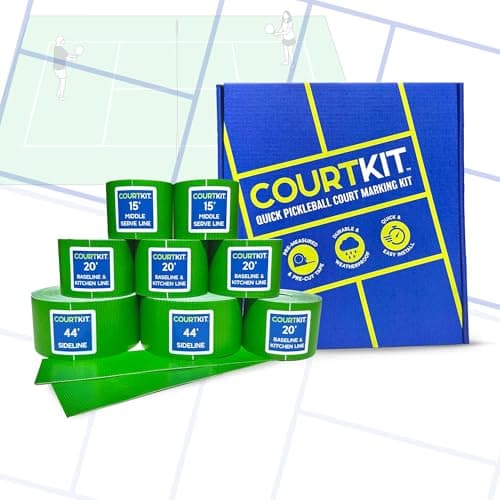
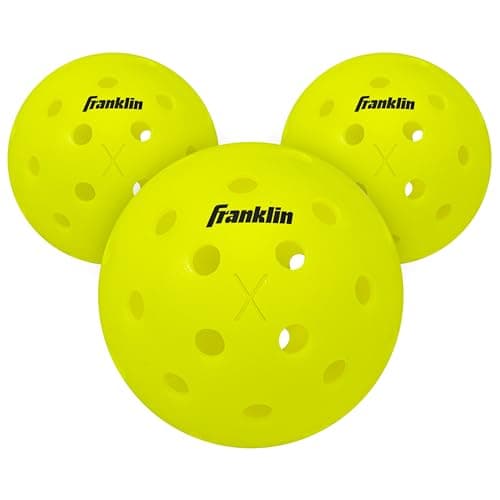
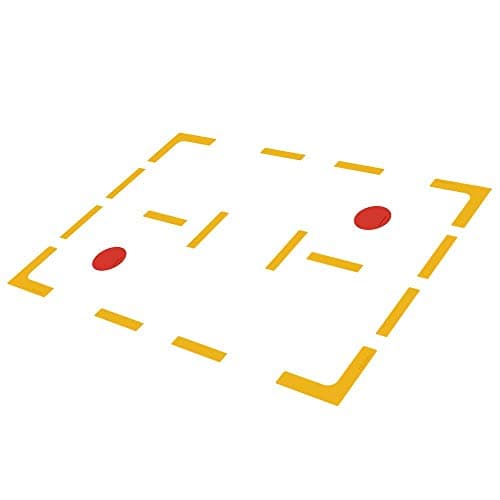
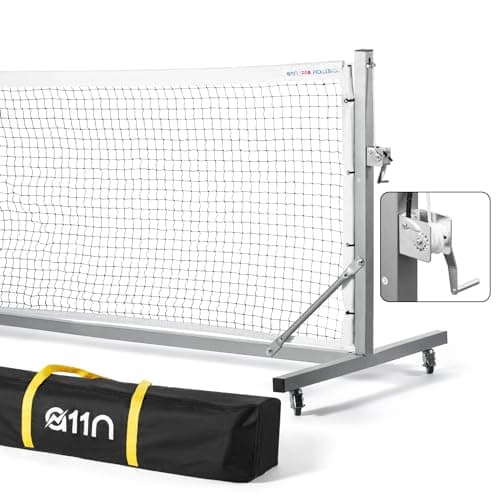
If you have a flat 20 x 44 ft rectangle with room to walk around it, two purchases give you a court: the A11N Pro Net for the net and the CourtKit pre-measured line kit for the boundaries. That is the setup for someone whose court is staying up. If the surface is a shared driveway you need back by Monday, swap the adhesive lines for the Eco Walker throw-down markers and you lose nothing but the sharp white edges. Either way add a tube of Franklin X-40 outdoor balls, because an indoor ball outdoors is a different and worse game.
Starting from nothing — no paddles in the garage — the A11N Premium Starter Set is the shortcut: two paddles, balls and a light net in one box. It is the cheapest way to find out whether a home court actually gets used before you spend real money on a frame that weighs as much as a bicycle.
Before any of it, measure. This is the step people skip and then regret, and it is the only part of a home court you cannot fix later by buying something else.
03The buyer's guide
01. Measure before you buy anything
A regulation pickleball court is 20 ft wide by 44 ft long — the same footprint for singles and doubles. That is the playing surface. What catches people out is the space aroundit: you cannot chase a lob with a fence six inches behind the baseline. USA Pickleball's recommended minimum total playing area is 30 x 60 ft, and 34 x 64 ft is the figure used for tournament play. Our full breakdown, including the kitchen and the service boxes, is in pickleball court dimensions.
If your driveway is 18 ft wide you do not have a regulation court, and that is fine — you have a practice court. Mark what fits, play to the lines you drew, and know that your dinks will feel different on a full court. The thing worth being strict about is flatness. A surface with a drainage slope plays unevenly end to end, and a crack wide enough to catch a ball will decide points for you.
02. The net is the one thing worth over-buying
Everything else on a home court can be replaced in an afternoon. The net gets put up, tensioned, rained on and then left alone for a season, which is why the specs that matter are frame weight and how the net is tensioned rather than the headline price. Both wheeled nets we rank publish a 22 ftwidth, which is the court's 20 ft plus a foot of overhang each side. The difference shows up in month two: the A11N frame carries a manual hand winch that pulls the net tight and true the way a club net is tight, while a net held by its own clips develops a soft middle over time.
If the net has to travel — park, holiday, a friend's cul-de-sac — none of that matters and weight becomes the only spec that counts. We rank all four nets in best portable pickleball nets, size them against your space in what size net you need, and put the two wheeled frames directly against each other in Franklin Portable Net vs A11N Pro Net.
03. Lines: how permanent is your surface?
This is the whole decision and it has almost nothing to do with quality. Ask one question: do you control this surface for weeks, or do you hand it back?
| Kit | What it marks | Published contents | Right when |
|---|
| CourtKit pre-measured lines | Continuous lines, kitchen and center service lines included | 2 sidelines, 2 baselines, 2 center service lines, 2 kitchen lines, net hash marks | The surface is yours for a season |
| Eco Walker 18-piece markers | Junctions and corners; you judge the boundary between pieces | 12 strips at 14.6 in, 4 L corners at 10.6 in, 2 spot markers at 8 in | Shared driveway, gym, kids, drills |
| Court tape | Continuous 2 in lines, single use | 3 rolls, 2 in x 263 ft total | Cheapest route to real lines on a clean surface you control |
A number worth knowing before you order: a regulation court needs roughly 198 ft of lineonce you total both sidelines, both baselines, the two kitchen lines and the center service lines. That is our own arithmetic from the official dimensions, and it happens to match the figure SONICTOP prints on its own tape listing. Set it against the Eco Walker kit's 12 strips at 14.6 in each — about 14.6 ft of line in total — and you can see at once that a marker kit is a set of reference points, not a boundary. Full comparison in best pickleball court marking kits.
04. Balls, paddles and the costs nobody budgets for
Outdoor courts take outdoor balls. The 40-hole outdoor ball is harder, heavier and noticeably louder than the 26-hole indoor ball, and that extra mass is what keeps it flying straight in a breeze. Put an indoor ball on a driveway in any wind and it will wander, then wear out quickly on the rough surface. The reasoning is in indoor vs outdoor pickleballs and the ranking is in best outdoor pickleballs. Buy more than you think you need — how many pickleballs you actually need does the arithmetic on cracking and losses.
Three costs people forget. Something to keep balls in, because a home court generates a scatter of balls in the hedge. A stiff brush: grit on concrete is slippery underfoot and it is the main reason adhesive lines lift early. Lighting, if you want to play past dusk in autumn, which is a bigger project than anything else on this page. Noise is the fourth, and it is a neighbor problem rather than a shopping problem: an outdoor ball off a paddle is a hard, carrying sound, and a court near a property line is a conversation worth having before you lay lines.
Where the money actually goes
Of the four purchases the net is the big one and everything else is comparatively small. That is the right shape for the spending, because the net is also the only item whose failure ends the game. Lines are cheap, balls are consumable, and paddles can start at set quality and improve later. If the total still looks like a lot, the staged version works fine: net and markers first, proper lines in month two once you know the court gets used. We cost out the whole category in how much pickleball equipment costs.