If you are playing actual games, you need a 22-foot net that stands 36 inches at the sidelines and 34 inches at the centre — that is the regulation shape, and our pick for it is the Franklin Net System with Wheels. If you are practising dinks in a garage or a short driveway, you do not need 22 feet of anything and a compact net like the JOOLA Compact at 5.5 feet wide does the job for a third of the money. The sizes in between — and the Boulder at 14 feet is the one most people buy by accident — are a real compromise worth understanding before you order.
The confusion is the category's fault, not yours. Net listings advertise "regulation" freely, and the word is doing different work each time: it can mean regulation height on a net that is a quarter of the regulation width, or regulation width on a net whose height you have to set yourself. Below is what each of our three picks actually publishes, read off the live listing, so you can match the number to your space rather than to the adjective.
A note on what this page is not: the dimensions of the court itself, the kitchen and the service boxes live on our court dimensions page. This one is only about buying the net.
03The buyer's guide
The numbers that are fixed
A pickleball court is 20 feet wide, which is why the regulation net is 22 feet: it spans the court with roughly twelve inches spare on each side to anchor the posts outside the playing area. Franklin's own listing states exactly that — 22 feet "to cover the length of the court with 12 inches on either side". Height is the other fixed number, and it is not one number: the net is 36 inches high at the sidelines and dips to 34 inches at the centre, which is why a net that is a flat 36 inches across its whole width is not quite the real thing. A11N publishes both figures for its wheeled net; Franklin publishes the 36.
Everything else — frame material, wheels, winches, bag, assembly time — is a convenience decision, and it is where the price differences on this page actually come from.
What the three sizes actually get you
22 feet — a real game
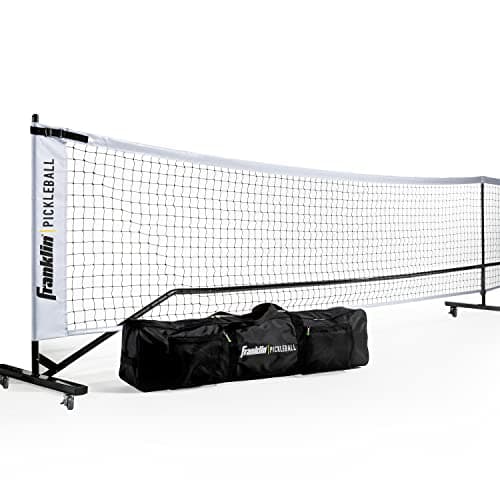
This is the only size on which a game plays the way a game is supposed to. The Franklin net system is 22' x 36", measures 264 inches long, weighs 27 pounds in alloy steel, and goes up tool-free. That weight is the honest cost of the category: a 27-pound steel frame is the thing that stops the net sagging, and it is also the thing you have to move. Both of the full-size nets we rank put wheels under it for that reason. If the net is going to live on a driveway and get rolled into a garage after each session, a wheeled full-size frame is the right buy and our portable net roundup ranks them properly.
14 feet — the one to understand before you buy
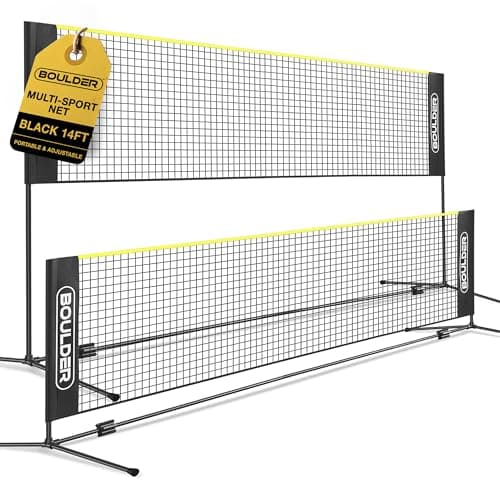
The Boulder is the cheapest net we rank and it is 14 feet wide, not 22. Its listing says it can set up "a half-court or regulation-sized pickleball court", which is loose: 14 feet is eight feet short of regulation width, so a doubles rally will pass outside the net posts. Its height is adjustable from 34 to 60 inches because it is a multi-sport net (badminton, tennis, soccer tennis), which means you have to set the pickleball height yourself rather than being given it. In exchange it weighs 3 pounds and is nylon rather than steel. For a family driveway game, singles practice, or a net you throw in a car boot, that trade is excellent. For a competitive doubles game it is the wrong tool, and we would rather say so than let the word "regulation" on the listing do the talking.
5.5 feet — practice, honestly labelled
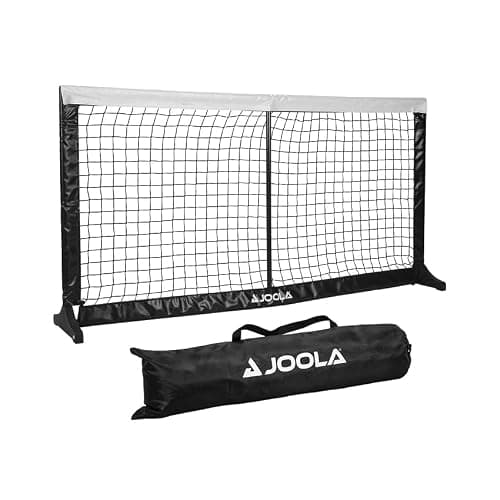
The JOOLA Compact is 5.5 feet wide and 36 inches tall. It is sold as a practice net and that is exactly what it is: dinks, drops, resets, solo work in a garage. The useful detail most people miss is the magnetic base connection, which lets you link two of them together — JOOLA's listing says to combine two for full-court play, which also means two of these cost more than one full-size net, so buy the full-size one if a full court is the goal.
Published dimensions, side by side
| Net | Width | Height | Weight | Frame | Assembly |
|---|
| Franklin Net System (wheels) | 22 ft (264 in) | 36 in | 27 lb | Alloy steel | Tool-free |
| A11N Pro Net (wheels + winch) | 22 ft | 36 in sidelines, 34 in centre | Not published | Steel square tube | Tools required |
| Boulder Portable | 14 ft (168 in) | Adjustable 34-60 in | 3 lb | Nylon net, foldable poles | Tool-free |
| JOOLA Compact Practice | 5.5 ft | 36 in | Not published | Lightweight frame | Tool-free, magnetic base link |
Measure your space before you measure the net
A 22-foot net needs more than 22 feet. A doubles court is 20 by 44 feet, and you want run-off behind the baselines, so a two-car driveway usually takes a full-size net across its width but not a full-length court along it. That is fine — most driveway pickleball is played on a short court by agreement. What does not work is discovering after delivery that the posts do not fit between the garage door and the kerb. Our can you play on a tennis court guide covers the other common surface, where the net is already there and the lines are the problem.
One more thing worth checking: what the frame will sit on. A 27-pound steel base on wheels concentrates real weight on a few small contact points, which matters on a resin sport court, a finished garage floor or a sealed gym surface more than it does on asphalt. If the surface is precious, put something under the feet.
Once you have the size settled, our net setup guide walks through getting the height right with a tape measure, and the best portable nets is the full ranked list.