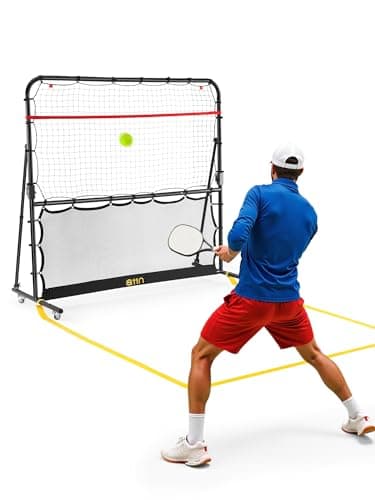
Start with the wall. It is free, it is already there, and for grooving a clean contact point and hundreds of repetitions it is genuinely hard to beat. Buy a rebounder when you want to practise the soft game — dinks, drops, resets — because that is the thing a flat vertical wall cannot give you. If you get there, the A11N Sports rebounder is our pick: four angle settings, a marked kitchen zone and target line, and a steel frame with dual support poles.
The honest comparison is not "which is better". It is that they train different balls. A wall returns the ball at the angle you hit it, fast and flat, from a vertical surface at point-blank range. A pickleball rally — the part of it that decides points — is slow, arcing and played from below the net line. An adjustable rebounder tilts the return surface so the ball comes back up at you rather than straight at you, which is the entire reason to spend money here.
03The buyer's guide
What a wall is actually good at
Volume. You can hit a thousand balls in half an hour with nothing but a wall, a ball and a paddle. Nothing on this page beats that for building a repeatable contact point.
Hand speed. Stand close and a wall is a hands-battle simulator. The ball comes back faster than any human will give it to you, which is useful once a week and counterproductive every day.
Reset under pressure. A wall is unforgiving about a paddle face that is even slightly open or closed, so it teaches you quickly.
And the price. Free. If your garage has a flat wall and you do not mind the noise, start here and spend the money on a paddle. Our beginner drills page includes wall work.
The three things a wall cannot do
It cannot give you an arc. A dink crosses the net on an upward arc and lands short. A vertical wall returns the ball along the line you sent it, so dinking into a wall trains a shot shape that does not exist in a game. Angled rebounders exist to fix exactly this, which is why angle adjustment is the first spec to check.
It has no kitchen line. Most of what separates a 3.0 from a 3.5 is where the ball lands relative to the non-volley zone, and a wall gives you no target. The A11N rebounder has a marked kitchen zone and target line printed on it, which is the single most useful thing on the product.
It is wherever your wall is. A rebounder goes on a driveway, a court or a lawn, and a 360-degree wheeled frame can be repositioned mid-session. A wall cannot.
If you buy one: the three specs that matter
1. Angle adjustment
This is the whole reason you are spending money rather than using a wall. The A11N publishes four angle settings, which covers a flat drive return through to an upward dink return. A rebounder with no angle adjustment is a portable wall — fine, if portability is what you wanted, and not worth a premium.
2. Footprint versus what you can actually fit
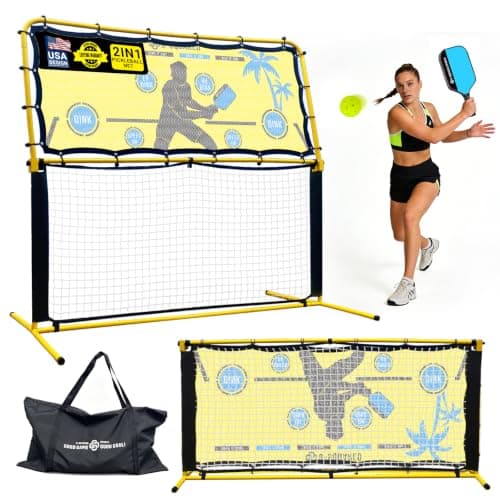
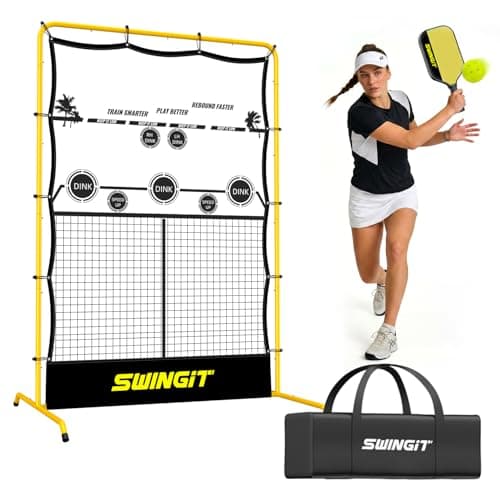
Frames in this category run from about 4 x 6 feet up to 6 x 6 feet, and the difference matters more in a garage than the price does. The Mini rebounder is a 4 x 6 ft frame built for short driveways and garages; the G-SQUARED is 6 x 6 ft and doubles as a game net, which is a genuinely different proposition — one frame, two uses. Measure before you choose.
3. Frame and tension
A rebounder is a tensioned surface on a frame, and both halves decide whether the return is consistent in month six. The A11N uses a steel frame with dual support poles and 360-degree wheels; the G-SQUARED uses a heavy-duty iron frame with a tensioned rope system. A slack surface returns the ball differently every time, which is worse than a wall.
Compared
| Option | Cost | Angle | Trains the soft game? | Footprint |
|---|
| A garage or gym wall | Free | Vertical only | No | None |
| A11N Sports rebounder | See live price above | 4 settings | Yes, with a marked kitchen zone | Steel frame, 360° wheels |
| G-SQUARED 2-in-1 | See live price above | Rebounder + game net | Yes | 6 x 6 ft |
| Mini rebounder | See live price above | Fixed | Limited | 4 x 6 ft |
The cheapest middle ground
If a wall is not available and a rebounder is more than you want to spend, a suction wall trainer with a tethered ball is the sub-$25 option — it trains contact and timing, not shot shape. It sits on our training aids roundup alongside the rebounders and the accuracy targets, and at the other end of the scale, ball machines are the version of this that feeds you a real arc and costs ten times as much. If you are deciding how to allocate a first budget across all of it, see what pickleball equipment costs.
Whatever you practise on, practise the right shot. Our how to dink guide describes the arc you are trying to reproduce, and common beginner mistakes covers the habits solo practice can quietly reinforce.