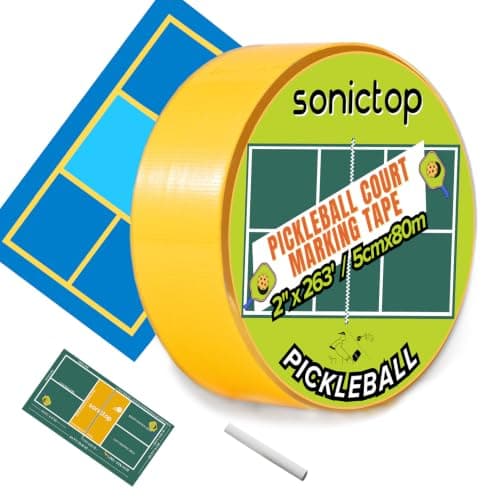
Buy the SONICTOP Court Tape Kit — three rolls totalling a published 263 ft at 2 in wide, which is the official line width, so it is the only kit under $25 that can lay a complete, continuous regulation court. It is for a driveway, a garage or any surface you can leave marked for a while. The budget pick is the Eco Walker 18-piece marker kit, the cheapest set of flat TPE pieces here, for a mini court, kids or drill work. Live prices and the date each was checked are in the Quick picks table below.
Start with the arithmetic, because it is what separates these three. A regulation pickleball court is 44 ft long by 20 ft wide, and marking it completely — sidelines, baselines, non-volley zone lines and center service lines — takes roughly 198 ft of line at the official 2 in width. That is our own sum from the official court dimensions, and it is the number every kit on this page should be measured against. One of the three can cover it. Two of them are not trying to, and say so.
So the real question is not which kit is best, it is which of two completely different approaches you want. Tape gives you continuous lines at the right width and takes an hour or more to lay carefully. Marker pieces give you corners, junctions and spots in about five minutes and leave your eye to join them up. On a court you own, tape. On a tennis court, a gym floor or a car park you have to hand back, markers. Our full court marking roundup ranks all five kits we track, including the two above this line.
What each pick is for, in one line:
- SONICTOP Court Tape Kit — a complete court: 263 ft of 2 in tape across three rolls, with a no-residue removal claim and court size cards in the box.
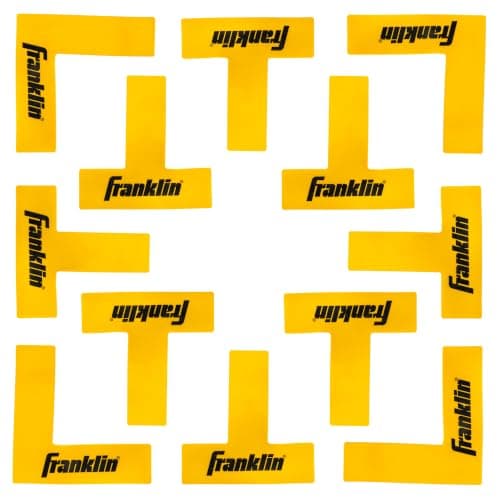
- Franklin Court Marker Kit — a court you must hand back: four L-style corners and eight T-style junctions in wipe-clean material, about 2 lb packed.
- Eco Walker 18-piece marker kit — the budget pick: twelve 14.6 in strip lines, four 10.6 in corners and two 8 in spot markers in flat TPE, with a carry bag.
Our standing disclosure: we have not laid any of these kits out ourselves. Every piece count, length, width and material claim below is published by the maker on its own listing and named in Sources. The 198 ft line total and the 44 x 20 ft court are the official dimensions and our own arithmetic from them, and we say which is which.
03The buyer's guide
What each kit publishes
Live prices with their check date sit in the Quick picks table above, where every row carries its own buy button.
| Kit | Type | Published contents | Line width | Covers a full court? | Under $25? |
|---|
| SONICTOP Court Tape Kit | Tape, 3 rolls | 263 ft total, no-residue removal claim, court size cards | 2 in — the official width | Yes, with tape to spare | Yes |
| Franklin Court Marker Kit | Pieces, 12 | 4 L-style corners, 8 T-style junctions, wipe-clean, 12 x 9 x 9 in packed, about 2 lb | Not published | No — corners and junctions only | Yes |
| Eco Walker Marker Kit | Pieces, 18 | 12 strip lines at 14.6 in, 4 L corners at 10.6 in, 2 round spot markers at 8 in, flat TPE, drawstring bag | Not published | No — about 18 ft of strip in total | Yes |
| CourtKit Marking Kit | Peel-and-stick lines | 2 sidelines, 2 baselines, 2 center service lines, 2 kitchen lines, net hash marks | Not published | Yes, as a complete layout | No — above the line |
| PROGOAL Stencil Kit | Paint stencils, 46 pieces | Full 44 x 20 ft regulation layout, A-F labeled storage, calcium phosphate board | Stencil, you supply paint | Yes, permanently | No |
One kit under $25 publishes a line width, and it is the only one that matches the official 2 in. The two marker kits publish piece counts and lengths instead, which add up to far less than a court on purpose. Eighteen feet of strip line is not a failure of the Eco Walker kit; it is what a kit of twelve 14.6 in strips is. Buy it knowing that.
Tape or markers: the honest split
Buy tape if the surface is yours
Tape at the official width gives you a court that looks and plays like a court, and it is the only option under $25 that does. The costs are time and commitment: laying 198 ft of straight line on a driveway takes an hour or more with a chalk line and a tape measure, and you will not be lifting it between games. The SONICTOP kit publishes a no-residue removal claim and lists polyurethane, hardwood, concrete, asphalt and marble as surfaces, which is a broader claim than most tape makes. Our backyard court setup guide covers the whole project including the net and the run-off space.
Buy markers if you have to hand the surface back
Markers are the answer to a specific real problem: a shared tennis court, a school gym, a community hall, a car park. Twelve or eighteen pieces go down in five minutes, come up in two, and leave nothing behind — and the court they describe is good enough for rec play because everyone can see where the kitchen is. The Franklin kit publishes L-style corners and T-style junctions specifically, which is the pattern you want for marking a kitchen line across a court that already has other lines on it. The Eco Walker kit publishes flat TPE that lies dead flat, which matters because anything that stands proud of the surface is a trip hazard in the one place you sprint.
What neither of them does
Neither marker kit will give you a sideline you can call a ball out on with confidence, and neither publishes a line width. If you want a complete layout that stays put for a season without being painted, the peel-and-stick kit above this line is the product that does it — it publishes two sidelines, two baselines, two center service lines, two kitchen lines and net hash marks as a set, and its own listing describes it as designed to stay in place yet removable if needed. And if you are painting concrete permanently, the 46-piece stencil kit publishes the full regulation layout. Both are ranked in the main court marking roundup.
Before you buy any of them: measure the space
The mistake that wastes the money is not the kit, it is the slab. A 44 x 20 ft court needs more than 44 x 20 ft of surface, because players run through the baseline and reach past the sideline; official recommendations for a total playing area are considerably larger than the court itself. A standard two-car driveway is usually wide enough for a court and short of the full length, which is why so many home courts are marked a little under size and why the marker kits have a real use case. Check our court dimensions page for the official figures and net sizing for the other half of the setup. If you only mark one line, mark the kitchen.