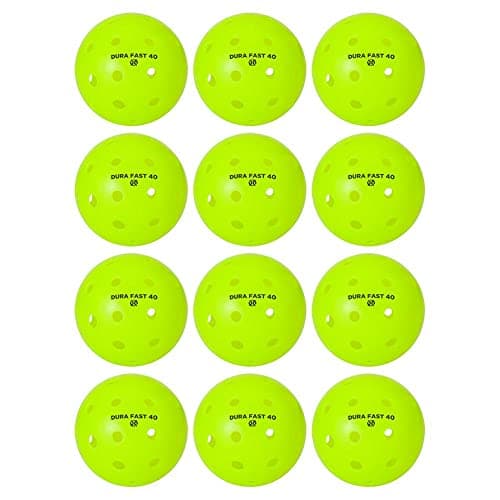
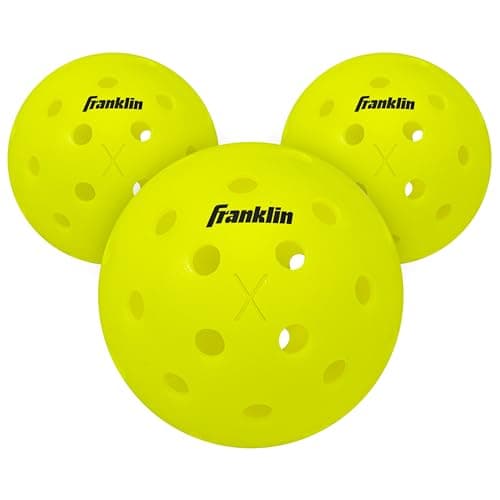
The short answer is not a brand. Play whatever the courts you play on play with, because a ball you have to re-learn every Saturday costs you more than any spec difference gains you. If nobody has told you what that is, buy the Franklin X-40: it is the ball we rank first on best outdoor pickleballs, it is sold in small packs so trying it costs very little, and it is the one most rec courts in the United States have in a bag somewhere.
Buy the Dura Fast 40 if your league, club or event uses it, or if you are preparing for one that does. That is a real reason and it outranks everything below.
Now the interesting part: these two balls are much more alike on paper than the internet implies. Both have 40 machine-drilled holes. Both are one-piece, seamless construction. Their published weights are within a gram of each other and their published diameters within about six tenths of a millimeter. Most of what people argue about here is feel, and feel is the part nobody has measured — including us.
Our standing disclosure: we have not instrumented either ball. We do not run a lab. Every number below was read off the live Amazon listing for the exact ASIN our buy button points at, or off a retailer or independent spec sheet we name in Sources, all checked on October 9, 2026. Where we offer an opinion about how a ball plays, we label it as an opinion — see our methodology.
03The buyer's guide
What each maker actually publishes
Every figure in this table is the maker's own, or a named retailer's spec sheet. Blanks are real blanks — a figure one brand publishes and the other does not is itself useful information.
| Spec | Franklin X-40 | Dura Fast 40 |
|---|
| Holes | 40, machine-drilled | 40, precisely drilled |
| Published weight | 26 g ("official weight") | 0.92 oz (26.1 g) |
| Published diameter | 74 mm (2.91 in) | 2.9375 in (74.6 mm) |
| Construction | Seamless single-piece | Rotationally molded, one piece |
| Bounce | Not published | About 32 in average |
| Stated ball life | Not published | "3-10 games in harsh conditions" |
| Weather caveat on the listing | "Perform best... in average temperatures" | "Durability is affected by weather, play style & court surface" |
| Approval | USAP approved | Meets USAPA/IFP regulations, approved for sanctioned play |
| Pack our link points at | 3-pack | Dozen |
The three differences that are real
1. The Dura is a slightly bigger ball
Franklin publishes 74 mm. Dura publishes 2.9375 inches, which is 74.6 mm. That is a difference of roughly six tenths of a millimeter — small enough that you will never see it, large enough that it is a genuine published difference rather than marketing. A fractionally larger ball of the same weight carries slightly more drag, which in principle means a touch less speed through the air.
We are not going to dress that up into a playing claim. Nobody has shown us a flight test of these two balls side by side at the same temperature, and at this scale the difference between two balls out of the same bag is probably comparable. File it as a fact, not an argument.
2. Only one of them tells you how long it lasts
Dura's listing states, unprompted, that performance balls do not last forever and to "anticipate life of 3-10 games in harsh conditions." Franklin publishes no equivalent figure at all.
Read that two ways at once, because both are true. It is unusually honest — most ball listings in this category talk only about durability in the abstract, and a brand that volunteers a floor of three games is not overselling. It is also an admission: a hard outdoor ball is a consumable, and anybody budgeting for outdoor play should assume they are buying balls regularly rather than once. Our how long do pickleballs last guide covers what actually kills them, and how much pickleball equipment costs puts balls in the running-costs column where they belong.
3. Each brand quietly names its own weakness
Franklin's listing says the X-40 is "designed for durability" and then that the balls "perform best on authentic pickleball courts and in average temperatures." Dura's says durability "is affected by weather, play style and court surface." Those are the same disclosure written by two marketing departments: hard outdoor balls crack in the cold and wear fast on rough surfaces. Franklin's phrasing carries a second warning worth hearing if the court is one you are building yourself — a rough driveway is not an "authentic pickleball court," and it will go through balls faster than an acrylic surface will. Surface and line options for a home court are in our court marking kit roundup.
Which is the practical reason this page is not the whole decision. If you are playing through a cold snap or in a steady wind, the ball choice changes — and it changes to a third option, not to either of these. See best pickleballs for wind and cold, where the crack-resistant Selkirk Pro S1 outranks both of these balls on exactly that criterion and Dura's weight earns it second place.
The tournament claim, read carefully
Both listings lead with sponsorship. Franklin says the X-40 was "chosen as the official ball of the US Open Pickleball Championships, USA Pickleball, and the APP Tour." Dura says it is the "Official Ball of the US Open Pickleball Championships & the USAPA Pickleball National Championships."
Both cannot be the current official ball of the same event, and neither claim carries a date. Official-ball contracts move between brands from season to season, so what you are reading on each listing is a true-at-some-point sponsorship record rather than a statement about this year. We are not going to guess which year each refers to, and you should not buy on either sentence.
What approval does mean, as opposed to sponsorship: both balls are approved for sanctioned play, which is a dimensional and construction test, not a quality rating. The same distinction we make about paddles in USA Pickleball approved paddles applies here. If you are entering a tournament, the thing to check is the event's own ball, not the brand's marketing.
Our judgment, labeled as judgment
Everything above is published fact. This section is not, and we would rather flag it than blur the line. From aggregated owner reports and the rest of this category's reporting, our standing read is that the X-40 plays a touch calmer and holds its shape longer, and that the Dura is livelier and faster off the face but goes out of round sooner. That is why our ball rankings put the X-40 first for a beginner and keep the Dura as the competitive pick.
We have not measured either claim. If you want the fuller treatment of each ball on its own terms, both have their own pages: the Franklin X-40 review and the Dura Fast 40 review.
Pack size decides cost per ball, not brand
This is the practical trap in this comparison. The Franklin listing our buy button points at is the 3-pack; the same listing also sells 6, 9, 12, 36, 50, 100 and 400 ball configurations, each as a separate price. The Dura listing we link is a dozen. Comparing a three-pack price against a twelve-pack price tells you nothing about which ball is cheaper.
So: check the variant selector before you pay, and compare at the same pack size. The three-pack is the right buy exactly once — when you are trying a ball you have never played with. After that, outdoor balls are a by-the-dozen purchase, because you will go through them.
Which one to buy
- Brand new to outdoor play: the X-40 in the smallest pack you can find. It is our default outdoor ball and the cheapest way to find out whether you even notice the difference.
- Playing in a league or entering an event: whichever ball they use. Ask first; it is one message and it saves re-learning your bounce the morning of.
- Cold, windy, or rough asphalt: neither, as a first choice. Read best balls for wind and cold.
- Playing indoors on a gym floor: neither at all — indoor balls are softer with larger holes. See indoor vs outdoor balls and best indoor pickleballs.
One last note for beginners, because it is the most common mistake in this category: a worn ball is a bigger handicap than the wrong brand. An out-of-round outdoor ball that still looks fine will knuckle, sit up, and quietly teach you bad habits. If a ball has done a dozen hard sessions on concrete, it owes you nothing. Retire it to the practice bag and open a new one.