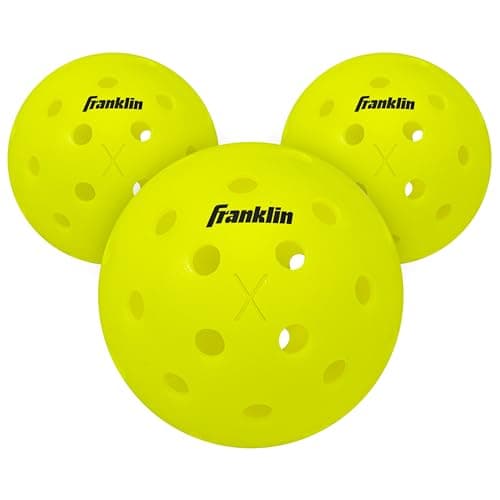
Balls are the easiest purchase in pickleball, which is exactly why people over-think them. You are choosing a consumable that costs a couple of dollars each and lasts a few weeks. The only real decision is outdoor or indoor, and after that you want durability, visibility and a price that lets you buy a dozen without flinching.
If you play outside — and most beginners do — start with the Franklin X-40. It is the USA Pickleball national championship ball and the one most rec groups already have in the bag, which means you are practicing on the ball you will actually play with. If your first sessions are in a gym, jump to the Franklin X-26.
03The buyer's guide
What a beginner should actually optimize for
| Priority | Why it matters more for a beginner |
|---|
| Durability | New players mis-hit into fences and pavement more often; balls die faster |
| Visibility | Tracking the ball is a learned skill — do not make it harder than it needs to be |
| Price per ball | You will lose some, and you should be relaxed about it |
| Matching your group | Practicing on the ball your court already uses is free consistency |
| Tournament pedigree | Genuinely irrelevant right now |
Buy the ball your court already uses
This is the single most useful piece of advice on this page and it costs nothing. Turn up, look in someone's bag, and buy that. Balls differ subtly in flight and bounce, and while those differences are small, they are exactly the kind of small that a new player misreads as their own inconsistency. Consistency of equipment removes one variable while you are trying to eliminate several others.
In practice, for outdoor rec play in the United States, the answer is very often the Franklin X-40. That is why it leads this list rather than because it is dramatically better than the alternatives.
Outdoor or indoor: get this right and the rest is easy
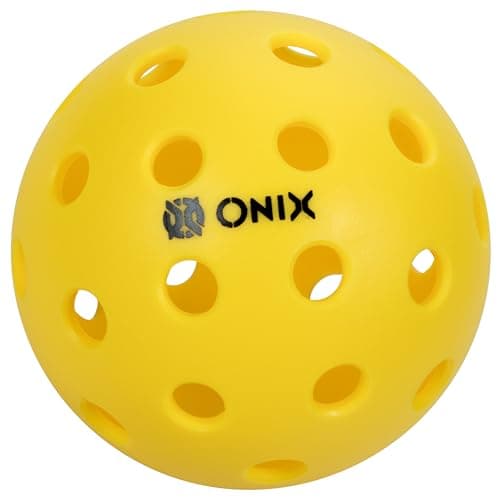
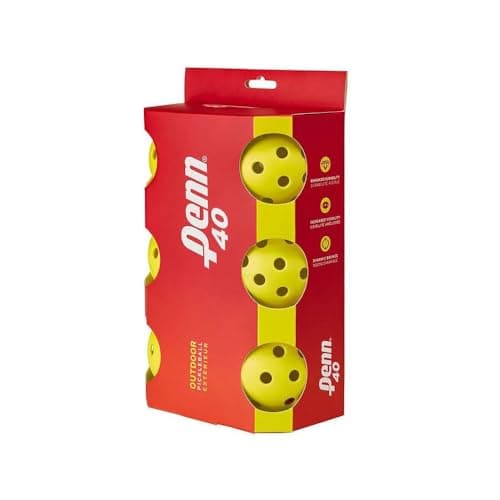
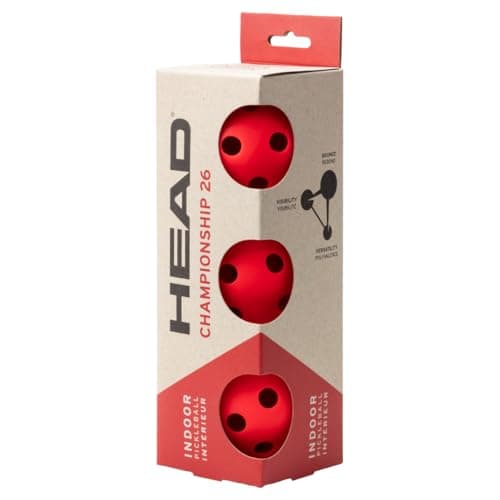
Outdoor balls are harder and heavier with forty small holes so they hold a line in wind. Indoor balls are softer and lighter with about twenty-six larger holes for a slower, more controllable flight in still air. They do not substitute for one another: an indoor ball outside floats away on the first breeze, and an outdoor ball indoors is fast, hard and loud. Full detail in indoor vs outdoor pickleball balls and the wider ball taxonomy.
Buy more than you think you need
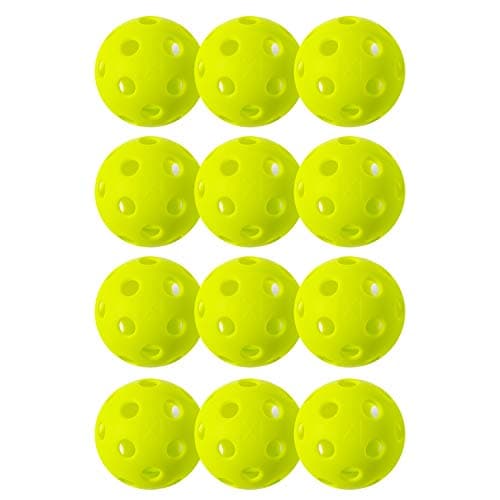
A sleeve of three is enough for exactly one session and then you are back online ordering. Buy a dozen. Balls crack, get stepped on, disappear under hedges, and end up in the neighbor's yard, and every one of those events is much less annoying when there are nine more in the bag. The per-ball price also drops sharply at bulk quantities.
Softer balls are kinder to a new elbow
Pickleball elbow is real and it usually shows up in the first few months, when technique is still forming and people grip the paddle too tight. A softer outdoor ball transmits less shock than the hardest tournament balls, and for a beginner that is a reasonable trade — you are not chasing the last few percent of flight consistency yet. Both the Onix Pure 2 and the Penn 40 above sit on the softer side for exactly this reason. If your arm is already complaining, our elbow support picks and core thickness guide address the other two causes.
When to throw a ball away
Outdoor balls crack, usually along a seam, and a cracked ball is finished immediately — it will not bounce true and it can split further mid-rally. Indoor balls rarely crack; instead they go soft and slightly out of round, which shows as an unpredictable bounce with no visible damage. The test for both is simple: if you find yourself surprised by the bounce, replace it. Our ball lifespan guide covers the timeline.
Approval, and when it starts to matter
Every ball on this list is USA Pickleball approved. That does not matter in a driveway and does matter the moment you join a league, because leagues specify balls far more often than they specify paddles. Buying approved from the start costs nothing extra and removes a future problem. More on what the certification covers in our approval guide.
How we picked
Everyone in this category says they tested twenty paddles. We haven't tested these in a lab, and we say so. Instead we compile the published manufacturer specs, do the math, weight everything toward what a beginner actually needs — forgiveness, a large sweet spot, sane weight and a fair price — and score each product against a published rubric. The scores are judgments from that research, not measurements we took. Where a fact came from someone else, we name it in Sources.