03The buyer's guide
The full ball taxonomy
| Type | Holes | Built for | Approved for play? |
|---|
| Outdoor | 40 small | Wind, concrete, exposed courts | Yes, when on the approved list |
| Indoor | About 26 large | Still air, gym floors | Yes, when on the approved list |
| Foam / soft training | None | Indoors at home, kids, very confined spaces | No |
| Slow / oversized training | Varies | Deliberately slower flight for drilling | No |
| Quiet / low-noise | Varies | Noise-sensitive neighborhoods and shared facilities | Usually not — check the listing |
Outdoor balls: harder, heavier, forty holes
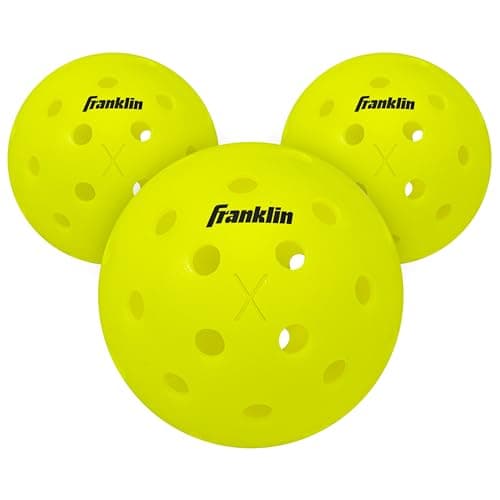
The outdoor ball is the default for most players in the United States, because most pickleball is played outside. It uses a harder, heavier plastic and forty smaller holes, and both of those choices exist to fight wind. A heavier ball carries through a breeze; smaller holes reduce the drag that would otherwise push a light ball off line.
The cost is noise and harshness. Outdoor balls are noticeably louder off the paddle and transmit more shock to the arm, and in cold weather the hard plastic cracks rather than deforming. If a ball on your court split cleanly along a seam, that is an outdoor ball behaving normally at the end of its life. Our how long pickleballs last guide covers the lifespan in detail, and best outdoor pickleballs ranks the field.
Indoor balls: softer, lighter, twenty-six holes
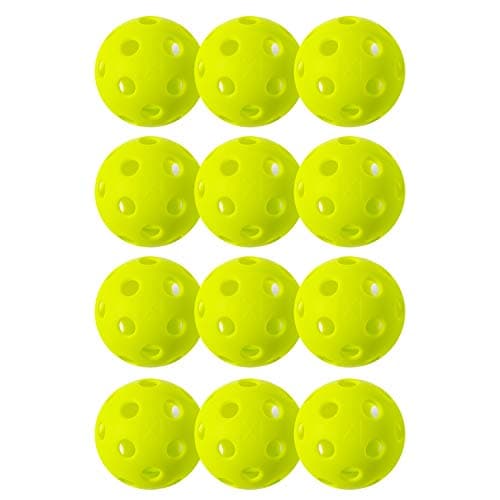
Indoor balls have around twenty-six larger holes and a softer, lighter plastic. In still gym air there is no wind to fight, so the design optimizes for a slower, more controllable flight instead. They are quieter, easier on the elbow, and better suited to the touch-heavy game that indoor play tends toward.
They also fail differently. Instead of cracking, an indoor ball softens and goes slightly out of round, which shows up as an unpredictable bounce long before there is any visible damage. If the ball is behaving oddly and looks fine, that is usually why. See best indoor pickleballs for the ranked list.
Foam and soft training balls
Foam balls are not pickleballs and are not legal for play. What they are good for is practice in a space where a real ball would break something — a basement, a garage, a hallway with kids in it. They fly far slower and hit far softer, which makes them genuinely useful for teaching a child to make contact, and useless for learning how a real ball behaves.
Slow and oversized training balls sit between the two. They are real plastic balls tuned to fly slower so a drill lasts longer, and they can be helpful for grooving a dink rhythm. Treat them as a practice tool, not a substitute — you cannot learn the timing of a real ball on a ball that flies at a different speed. If you are looking at practice equipment more broadly, our training aids roundup covers the rest.
Quiet balls, and why they are complicated
Pickleball noise is a real issue in residential areas, and several products claim to reduce it. The physics is unavoidable: the sharp crack comes from a hard plastic ball meeting a stiff paddle face, so a quieter ball must be softer, and a softer ball flies differently. Most low-noise balls are consequently not on the approved list, and some facilities that require quiet equipment specify their own. If noise is your constraint, ask your facility what they allow before buying anything.
What USA Pickleball approval means for a ball
Approved balls have been submitted and tested against published standards for size, weight, bounce, hardness and hole pattern. Unlike paddles — where recreational players rarely need approval — leagues routinely do specify an approved ball for match play, so the badge matters more here. If you are joining a league, ask which ball they use and buy that one; the differences between approved outdoor balls are small but real, and practicing on the ball you will compete with is free. Our guide to USA Pickleball approval explains how to check the live list.
Color is a real spec, not a cosmetic one
Balls come in yellow, neon green, orange, white and more. The rule that matters is contrast against your background: a yellow ball on a green court in dappled shade is genuinely hard to pick up, and a white ball outdoors against a bright sky is worse. Buy the color that stands out where you actually play, and if you play in more than one place, own two colors. It costs a few dollars and it removes a frustration you would otherwise blame on your reflexes.
So which do you buy?
Answer one question: where do you play most? Outside, buy an approved outdoor ball. Inside in a gym, buy an approved indoor ball. Both, buy a sleeve of each — there is no do-it-all ball, and the sleeves are cheap. The two picks above are the defaults in each category. For the full ranked field, see best pickleball balls, and if you are assembling a first kit, what you need to start covers everything else.