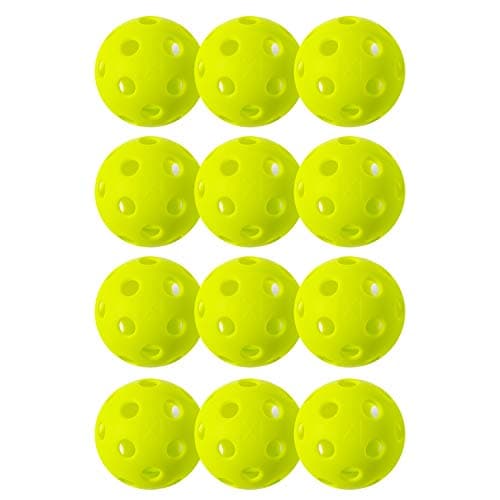
The X-26 is the ball we put first on best indoor pickleballs and third overall on best pickleball balls. If you play on a gym floor and want to stop thinking about balls, this is the one. It is not, however, quite the ball its own listing describes — two of its published specs contradict each other — so this is the version with the paperwork checked.
Our standing disclosure: we have not bounce-tested these in a lab.We don't run one. Every figure below was read off a page we name in Sources, and where two of those pages disagree we say so rather than quietly picking the flattering number. Judgments are labeled as judgments; that is the whole of our method.
What the X-26 actually is
Franklin's indoor pickleball, and the sibling of the X-40 the same company sells for outdoor play. It has 26 larger, beveled holesrather than the outdoor ball's 40 small ones, a softer shell, and Franklin publishes it as USA Pickleball approved for indoor tournament play.
It is sold in 3, 6, 12 and 100 packs, in four colors — blue, lime green, peach and yellow — though not every color exists in every pack size, and the combinations move in and out of stock constantly. The listing our buy button points at is the lime green 12-pack, which is the size that suits two people playing weekly. If you are one person finding out whether you like indoor play, buy three; if you are stocking a club, read the pack-size section below.
The published specs, and the two places they disagree
26 holes, beveled rather than drilled
The hole count is what makes this an indoor ball. Fewer, larger holes give a slower ball that stays controllable in the dead-still air of a gym, which is the entire reason the indoor category exists — the mechanism is in indoor vs outdoor pickleballs.
The detail worth having is that Franklin describes the holes as beveled, not drilled, and claims a balanced flight pattern and ball-to-ball spin consistency from it. We cannot verify a flight claim without a lab. What we can say is that the beveling is visible on the ball, and the independent reviewer who did handle a set described the holes as smooth and cleanly molded. Treat it as a real manufacturing difference from a no-name bulk ball, not as a performance guarantee.
74 mm across, about 26 grams — and the listing says something else
Here is the first contradiction. Pickleball Central's spec sheet publishes the X-26 at 26 grams and 74 mm. The independent Pickleball Union review publishes 0.92 oz— the same figure — and reports weighing the ball at 0.90 oz. But the bullet on the Amazon 12-pack listing, the one our buy button points at, reads "official size 24g, 74mm diameter."
Two grams is not much ball, but it is not nothing, and we are not going to average two published numbers to make the page tidy. Our read: 26 g has two independent sources behind it, one of which put the ball on a scale, so that is the figure to work from. The useful lesson is the duller one — a listing bullet is marketing copy, not a spec sheet, and on this product it is wrong about something you could check at home with a kitchen scale.
The part that corrects the rule of thumb: it is not lighter than the X-40
Everyone, this site included, tells beginners that indoor balls are lighter than outdoor balls. As a description of the category that is fair. As a description of these two balls it does not hold: Pickleball Central publishes the X-40 at 26 grams and 2.91 inches, and 2.91 inches is 74 mm. Same published weight, same published diameter, completely different ball.
So if you have been picturing the indoor ball as the light one, adjust. The difference between Franklin's indoor and outdoor balls lives in hole size, plastic hardness and how the ball is assembled — not in mass. That has a practical consequence: you cannot reliably tell the two apart by feel once they are loose in a bag. Count the holes.
Two-piece and seamed — the trade that is not on the front of the box
Franklin's own listing copy says the X-26 is "constructed with a two-piece design." Pickleball Central calls it "injection molded, seamed construction." The independent review calls it a two-piece seamed design. Three sources, one answer: this ball has a seam.
The second contradiction lives here. Pickleball Warehouse's product page for the X-26 describes a "no seam, one-piece design." That is wrong, and we name it because it is exactly the kind of retailer copy that gets quoted onward until it starts to look like a fact.
Why it matters: on our X-40 reviewwe call that ball's one-piece rotational molding a genuine construction advantage, because there is no seam to lift or separate. The X-26 does not get that advantage. Most indoor balls are two-piece, so this is normal rather than a scandal — but it is the honest reason the ball scores a 7 for durability rather than higher, and it is the first thing to check on a new one. Run a fingernail around the seam: a ridge you can catch means a ball that will curve oddly and fail early. The fuller version of that test is in how long do pickleballs last?
The material is genuinely unclear, and it does not change your decision
Pickleball Central says the ball uses "high quality EVA material." The independent review says polyethylene. Franklin's listing bullets name no material at all. We cannot reconcile that and we are not going to guess, so here is the honest version: the shell is a soft plastic, softer than the X-40's, and which family of plastic it belongs to is not something you will feel on a gym floor. We flag it because the rule here is to say when a spec is unverified rather than publish the confident-sounding one.
What it does well
Touch. The softer shell spends longer on the paddle face than an outdoor ball does, and that dwell time is what makes a dink land where you aimed it. If you are learning the soft game — see how to dink — this is the ball that rewards the practice.
Noise, or the lack of it. Not a nicety. Pickleball noise is the most common reason shared venues restrict court hours, and a soft indoor ball is meaningfully quieter off the paddle than a hard outdoor one. If your gym shares a wall with anything, this is the ball that keeps you welcome in it.
Consistency between balls.Franklin's claim, and the one we are most inclined to credit, because ball-to-ball repeatability is exactly what an established brand's tooling buys you. You learn how the ball behaves and the next one out of the pack behaves the same way, which is worth more than any single ball's performance.
It is everywhere. Prosaic, but restocking never involves a hunt, and the pack ladder runs from three balls to a hundred without leaving the same product.
What it does badly
Soft spots, sometimes straight out of the pack. The most consistent theme in owner feedback is balls that arrive already soft, occasionally more than one in a pack. We have not counted them and we will not publish a failure rate we did not measure — but it is common enough that you should squeeze-check a new pack before a session rather than discovering it mid-game. A soft ball feels dead off the paddle and flies unpredictably.
The seam is a real failure point. Covered above, and it is the one spec where this ball is behind its own outdoor sibling. Indoor balls rarely crack the way outdoor balls do; they go soft and out of round, and a rough seam gets them there sooner.
It is not the cheapest way to buy indoor balls. This is a branded ball at a branded price. The A11N S26 twelve-pack on our indoor roundup is also an approved 26-hole ball at a fraction of the per-ball cost, and for pure drilling that is the smarter buy. We still rank the X-26 first, on consistency — but if budget is the binding constraint, we would rather you knew the cheaper option exists.
It is the wrong ball outdoors. Any breeze pushes a 26-hole ball off line, because the design assumes there is no breeze to fight. Outdoor play wants a 40-hole ball, and the outdoor picks are a separate list for that reason.
Color: buy for your gym floor, not your taste
Franklin sells the X-26 in blue, lime green, peach and yellow, and says plainly that the colors exist to give contrast against indoor surfaces. That framing is right and more useful than it sounds, so here is our judgment rather than Franklin's: the floor you play on decides this.
Most indoor pickleball happens on blond hardwood or a pale synthetic. Against that, blue is the highest-contrast option Franklin offers and the safest default. Yellow and peach are the two most likely to disappear on a pale floor under warm gym lighting — that does not make them bad balls, it makes them balls for a darker court. Lime green sits in between and reads well in most halls.
If your group keeps losing sight of the ball, change the color before you change anything else. It costs a few dollars and works better than squinting harder. One caveat: buy a batch in one color. Mixing colors inside a session makes the eye re-adapt every few rallies.
Pack size is the only real decision
Indoor balls are consumables, so the question is not which X-26 to buy but how many of them. Franklin's ladder runs 3, 6, 12 and 100.
- 3 balls — the find-out-if-you-like-it pack. Cheap enough to be a rounding error, and enough for one session with a spare.
- 6 or 12 balls — the right answer for a pair or a foursome playing weekly. Our buy link points at the 12 because the per-ball price is much better than the 3-pack and you will get through them.
- 100 balls — a club, a clinic, a coach, or a ball machine. Not a household purchase.
Each pack size is a separate listing at its own price, and prices move constantly, so we show the live figure for the pack we link and no number at all when we cannot verify one. If you are stocking a group rather than a gym bag, the bulk options on best indoor pickleballs are the cheaper route.
X-26 vs X-40, in one table
These are the two balls most people are actually choosing between, because Franklin makes both and they look similar loose in a bag. Every figure here is published, and the two rows that are identical are the interesting ones.
| Spec | X-26 (indoor) | X-40 (outdoor) |
|---|
| Holes | 26, larger, beveled | 40, smaller |
| Published weight | 26 g (its listing bullet says 24 g) | 26 g |
| Published diameter | 74 mm | 74 mm (2.91 in) |
| Construction | Two-piece, seamed | One-piece, rotationally molded |
| Shell | Softer, more dwell time | Harder, faster |
| Noise | Quieter | Loud |
| Usually fails by | Going soft and out of round | Cracking, sooner in cold weather |
| Built for | Gym floors and indoor courts | Wind and rough outdoor courts |
The short version: if the ball will live on a wooden floor, buy the X-26. If it will live outside, buy the X-40. If you split your time, buy both — they are cheap and no single ball does both jobs well. The full argument is in indoor vs outdoor pickleballs.
Who should buy something else
- Anyone playing outdoors. Wrong tool entirely. A 26-hole ball wanders in any wind; buy a 40-hole outdoor ball and keep the X-26 for the gym.
- Anyone buying volume for drilling. If the balls exist to be hit at a wall or fed through a machine, consistency matters less than count. A cheap approved 26-hole bulk pack does that job for a fraction of the per-ball price.
- Clubs, clinics and coaches. Go straight to a bulk pack — either the X-26 hundred or one of the bulk indoor options on our indoor list. Buying 12-packs repeatedly is the expensive way to stock a program.
- Anyone in a league that specifies a ball. Ask before you stock up. Approved balls genuinely play differently from each other, and practicing with one while competing with another is a small, avoidable handicap.
The verdict
The X-26 is the correct default indoor ball and it stays first on our list. It is consistent, quiet, soft enough to reward touch, published as approved, and stocked everywhere in whatever pack size fits what you are doing. What it is not is the ball its own paperwork describes: the weight bullet on the listing is wrong, a widely-copied retailer spec sheet is wrong about the construction, and the seam that sheet denies is the real reason this ball does not match the X-40 for durability. None of that is a reason to buy a different indoor ball. All of it is a reason to squeeze-check a new pack, buy the color your floor can cope with, and treat the ball as the consumable it is.