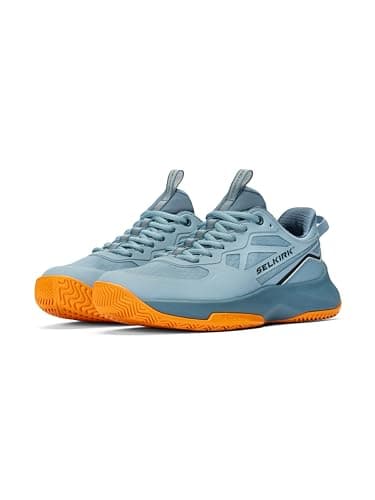
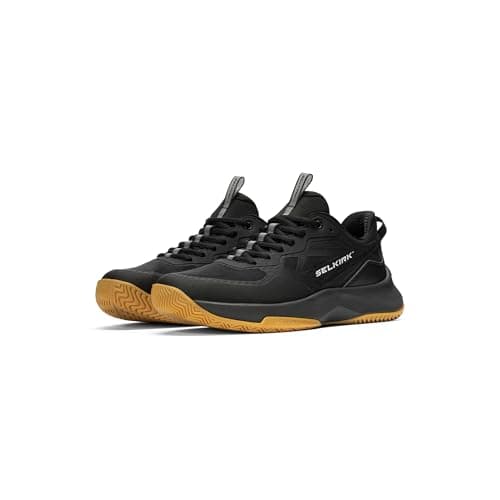
The CourtStrike Pro 3.0 is a premium-priced court shoe with one argument that no other shoe we rank makes: Selkirk publishes a 6-month outsole warrantyon it. Not "durable," not "built to last" — a component, a period, in writing. If you are the player who grinds the tread off a pair of shoes in a season, that sentence is the whole review and you can stop reading.
If you play once or twice a week, it is the wrong shoe, and we would rather say that on the page than take the click. A warranty against outsole wear only pays back if you actually wear outsoles out, and most rec players do not — they replace shoes because the cushioning has gone flat instead. That is a different failure, and this shoe does not solve it.
Our standing disclosure: we have not worn these shoes.We do not run a wear-test program and we are not going to invent one for a durability claim, which is the one claim a review cannot fake. Every material, component and warranty term below was read off the live Amazon listings for the exact two ASINs our buy buttons point at and off Pickleball Central's independently published spec sheet for the same shoe, both checked on October 16, 2026 and both named in Sources. The two sources agree on every line. Where Selkirk publishes no figure — and there are four important ones — we say the figure is missing rather than estimating it. The scores are judgments from that research against our published rubric.
03The buyer's guide
The spec sheet, exactly as published
Both sources print the same list, so this is what the shoe is, in the maker's own words:
| Component | Published spec |
|---|
| Upper | Lightweight mesh weave with supportive overlays |
| Midsole | EVA PureFoam, with a removable supercritical foam insole |
| Insole board | Lighter die-cut board |
| Support | TPU shank |
| Outsole | Selkirk pickleball outsole, 4-way grip design, stability outrigger |
| Closure | Nylon laces |
| Warranty | 6-month outsole warranty |
| Skill level | Beginner to Pro |
| Care | Remove insoles, wash on a delicate cycle, air dry |
| Weight / stack height / drop / widths | Not published |
The warranty is the product
Start with what fails. On a pickleball shoe the outsole goes first, and it goes fastest on the surface most people play on — abrasive outdoor concrete, with a lateral push-off on every third shot. Our how long pickleball shoes last page is built around that specific wear pattern, and it is the reason a shoe sold on grip can be finished while the upper still looks new.
A 6-month outsole warranty is Selkirk putting its name against exactly that failure. Two honest caveats before you treat it as a free pair of shoes:
- It covers the outsole, not the shoe. Flattened cushioning, a blown upper, a failed eyelet or a shoe that simply does not fit are not outsole problems.
- Neither listing publishes the claim process.We read both the brand-side spec sheet and the retailer's, and both give the length and the component and nothing about how you claim, what counts as excessive wear, or whether you need the receipt. Budget a conversation with Selkirk rather than an automatic replacement, and keep your order confirmation.
Even with both caveats, it is a real differentiator. Among the shoes we rank, the closest premium alternative — the K-Swiss Hypercourt Express 3 — states no outsole durability guarantee at all on its listing. Every other shoe on this site sells durability as an adjective. This one sells it as a term.
The outrigger is the second reason to care
Selkirk describes the outsole as a "4-way grip design" with a stability outrigger, and that second feature is worth more than the first phrase. An outrigger is a flared platform on the outside edge of the forefoot. Its job is narrow and useful: when you push hard sideways, it keeps the shoe under your foot instead of letting the foot roll over the edge of the sole.
That is the movement pickleball punishes. A hard lateral step to cover a drive at the kitchen line is the moment ankles turn, and it is why court shoes exist as a category at all — the argument our do you need pickleball shoes page makes at length, and the reason running shoes are the wrong tool. Paired with the TPU shank, which stiffens the midfoot so the shoe does not twist under load, this is a build tuned for stability first.
The trade is real: a shoe engineered to resist rolling is firmer than a shoe engineered to feel soft. If your sessions are long and slow rather than sharp and competitive, you want the opposite tuning, and our most comfortable pickleball shoes list is the right page.
"Supercritical foam" and what we can honestly say about it
The insole is a removable supercritical foam insole, sitting on an EVA PureFoammidsole. "Supercritical" refers to how the foam is made — blown under gas pressure to produce a lighter, springier cell structure than conventionally foamed EVA. It is a genuine manufacturing term, not a marketing invention, and it has become the standard premium foam story across running and court shoes.
What we are not going to do is tell you how it feels or how much energy it returns. Selkirk publishes no density, no stack height and no drop, so the foam name is the only information available, and a material name is not a performance figure. Two practical notes that are not speculation: the insole being removable means you can swap in your own orthotic, and the die-cut board under it is where Selkirk says the version 3.0 weight saving comes from.
The four numbers Selkirk will not print
This is the honest weakness of the shoe as a purchase, and it is a documentation problem rather than a build problem. Across two independent sources, there is no published weight, no stack height, no heel-to-toe drop and no width options.
That matters in three specific ways:
- "Lighter and cooler" is a comparative claim with no number behind it. Selkirk's own copy says this version is lighter than standard pickleball shoes and lighter than its predecessor. There is no gram figure on either listing, so the claim cannot be checked, and we are not going to repeat it as a spec.
- No widths means no answer for wide feet. If width is your limiting factor, do not buy a shoe whose maker is silent on it — read best pickleball shoes for wide feet instead, where the shoes we rank publish something useful.
- No drop figure means no read on how it will treat a sore Achilles or calf. Drop is the one shoe spec that reliably changes where load lands, and it is simply absent here.
For context on how unusual that is: it is not. Most pickleball shoe listings publish nothing either, which is exactly why our shoe pages separate listing claims from our rubric scores in labeled rows instead of blending the two into a star rating.
The men's and women's versions are genuinely different shoes
Worth stating, because in this category it often is not true. Selkirk says the women's CourtStrike Pro 3.0 is built on a gender-specific moldwhich it claims gives more accurate sizing than a standard women's court shoe — in other words a women's last, not a scaled-down men's one. The rest of the package is identical: same 4-way grip outsole, same outrigger, same TPU shank, same supercritical foam insole and, importantly, the same 6-month outsole warranty. The durability term is not a men's-only feature, which is more than can be said for some split lines.
Both versions sit on our best pickleball shoes for women and best pickleball shoes for men lists on that basis.
Who should buy it
- The three-or-more-sessions-a-week player who kills outsoles. If you have thrown out a pair with the tread worn smooth under the ball of the foot, this is the shoe built for your failure mode, with a warranty aimed at it.
- The outdoor concrete regular. Abrasive surfaces are where outsoles die. See best outdoor court shoes for the full outdoor lane.
- The player who has rolled an ankle on a lateral push. The outrigger plus TPU shank combination is specifically aimed at that, and it is the clearest build argument on the shoe after the warranty.
Who should not. A once-a-week social player — a cheaper court shoe will last you years and the warranty window will expire unused; start at best pickleball shoes under $100. Anyone whose problem is comfort over a long session rather than wear, because this is grip-and-stability tuning, not a plush platform. Anyone who needs a published width. And anyone shopping their very first pair, who should read how to choose pickleball shoes before spending at this level.
What we would buy instead, and why
Three honest alternatives, all of which we rank:
And if you are replacing shoes because the court chewed them up rather than because they stopped fitting, the cheaper intervention is the surface you play on, not the shoe — indoor vs outdoor court shoes covers which tread belongs where. Elsewhere in the brand-by-brand lane, our pickleball shoe brands page places Selkirk against the tennis houses, and on the paddle side the best JOOLA paddles roundup does the same job for a single maker's range.