03The buyer's guide
The non-marking split, which is the whole decision for indoor players
Indoor venues — school gyms, community centers, church halls — frequently require a non-marking outsole, because standard rubber leaves black streaks on a varnished floor. It is a condition of entry, not a preference, and some places check at the door.
Across ASICS's range the claim lands in a pattern nobody would guess:
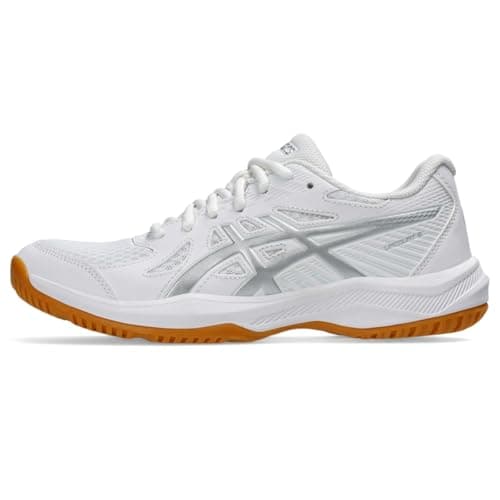
- Upcourt 6, men's and women's — states non-marking. These are the volleyball models, built for exactly the indoor floor the rule exists to protect.
- Game FF Pickleball — no non-marking claim. Not on the Amazon listing and not on the two retailer spec pages we checked. This is the model with the pickleball badge on it.
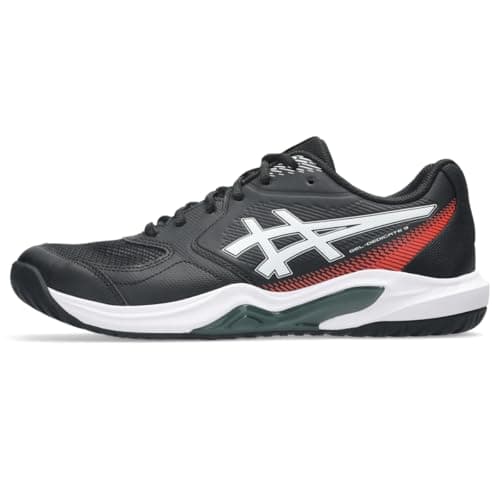
- Gel-Dedicate 9 — no non-marking claim. A hard-court tennis shoe; the only non-marking reference we found in the Gel-Dedicate line attaches to the carpet version, which is a different shoe.
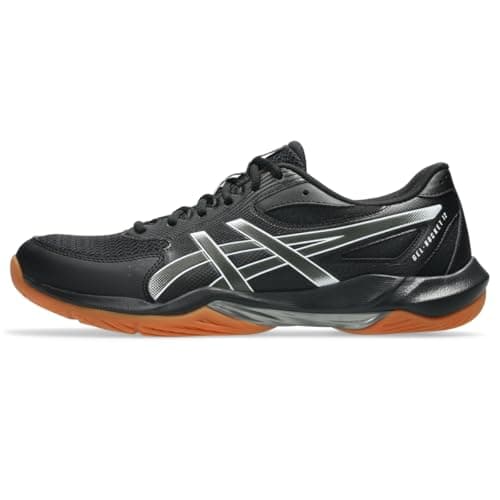
- Gel-Rocket 12 — states non-marking. Volleyball again.
So the rule for an indoor player is simple and it is the reverse of what the marketing implies: buy the volleyball shoes. The absence of a claim is not proof a sole marks — it may well be fine — but we are not going to tell you a venue will admit you on a spec no one has published. We treat this the same way across the site; the men's Fila Volley Zone has the identical gap, which we flag in best pickleball shoes for beginners.
The four criteria, in order
1. Which surface will destroy the sole
This is the first question in the ASICS range because the range splits cleanly down it.Soft gum rubber grips a smooth gym floor better than anything and is consumed by outdoor concrete. AHAR — ASICS High Abrasion Rubber, the compound on the Game FF and the Gel-Dedicate — gives up a little indoor bite and survives abrasive outdoor surfaces.
The Upcourt 6 and the Gel-Rocket 12 are the gum-soled indoor shoes. The Game FF and the Gel-Dedicate 9 are the hard-wearing outdoor ones. Buy for the surface you actually play on, and if you genuinely split your time and can only buy one pair, buy the harder compound — the loss indoors is small, while a gum sole outdoors gets eaten. Full breakdown in indoor vs outdoor pickleball shoes.
2. A named lateral-support component
Every court shoe listing claims support; the ones worth paying for name the part. In this range only the Game FF does. ASICS publishes a two-piece split sole with a midfoot shank sitting between the two outsole pieces, and it states the shank's job in those words: adding stability on lateral movements. It also publishes TRUSSTIC in the midsole alongside FLYTEFOAM cushioning.
The Gel-Dedicate 9 publishes a Trusstic system too, plus GEL cushioning in an EVA midsole. The two Upcourt 6 variants and the Gel-Rocket 12 publish no shank and no midsole name — which is not a claim that they lack midfoot structure, only that ASICS has not told us about it. A shank is the single property that separates a court shoe from a running shoe, and what is a court shoe includes a thirty-second twist test you can run on a shoe you already own.
3. Fit, and the two shoes that rule themselves out
Court lasts run narrow deliberately: a hard lateral push loads the side of the shoe, and a foot that can slide inside it is a foot that rolls. Lockdown is the design brief. Two specifics in this range are published and worth acting on.
Retailers describe the Game FF as a snug medium width with a low arch, which makes it the wrong shoe for a wide or high-volume foot. The Gel-Rocket 12 is narrow through the midfoot — it is a volleyball last, and volleyball lasts are snug. Neither is a flaw; both are reasons to buy elsewhere if your foot does not match. ASICS publishes no width fittings anywhere in this range, so if you measure wide, the honest answer is that this is not your brand — see best pickleball shoes for wide feet, and K-Swiss pickleball shoes, ranked, which is the brand here that publishes real Wide and 2E fittings.
4. What you are getting for the money — and what is not published
The honest headline on the whole range: ASICS publishes no outsole durability warranty on any of these, and the weight picture is a mess. The closest thing to a durability commitment anywhere is a line on the Game FF's retailer page about an improved outsole promising traction and ensuring longevity through durability — which is an adjective, not a warranty. The only shoe we rank whose maker publishes a real one is the Selkirk CourtStrike Pro 3.0.
On weight: a retailer lists the Game FF at roughly 10.7 oz in a size 10.5, which is the one usable figure in the range. For the Gel-Dedicate 9 the retailer listings contradict each other — 12.5 oz for a men's 10.5 on one, 354 g for the same size on another, 10.3 oz for a women's 8.5 on a third. We are not going to pick one and present it as fact. ASICS publishes no weight for the Upcourt 6 or the Gel-Rocket 12 at all.
The five, ranked
1 and 2. ASICS Upcourt 6, men's and women's — the ones to buy
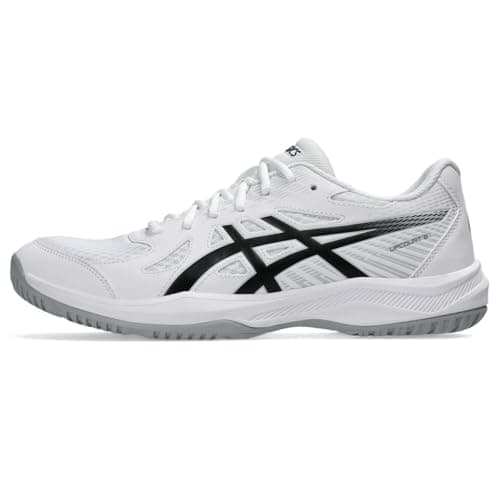
Same shoe, two cuts, and the right default for most people reading this. It is the cheapest ASICS here, the gum outsole is the correct compound for a varnished or sprung gym floor, the sole is non-marking so it clears the venue rule, and it is light and low — which matters for the constant small adjustments the kitchen line demands. ASICS court lasts are proven across volleyball, so the fit is a known quantity.
The cons are the flip side of the pros and you should take them seriously. The gum sole wears fast if you take it outside onto concrete, and cushioning is minimal compared with a dedicated comfort shoe. ASICS publishes no shank, no midsole name and no weight for it. If you play mostly outdoors, this is the wrong shoe in the range and the Game FF is the right one. We put it head to head with the Fila Volley Zone in Upcourt 6 vs Volley Zone, and there is a full ASICS Upcourt 6 review as well.
3. ASICS Game FF Pickleball — the best-specified, and not the top pick
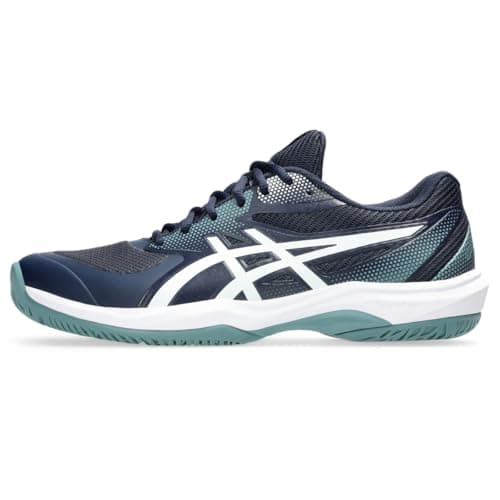
This is the only shoe in the range ASICS badges for pickleball, and on paper it is clearly the most shoe: AHAR outsole in a two-piece split-sole design, a midfoot shank between the two pieces, FLYTEFOAM cushioning, TRUSSTIC, an open mesh upper with synthetic leather and PU overlays, and a published weight. If you play outdoors on concrete, buy this one.
It is ranked third because of the gap in criterion one: no non-marking claim, which is the spec that decides whether an indoor venue lets you in, and the Upcourt 6 states it for less money. On top of that there is no outsole guarantee, the fit is a snug medium with a low arch, and it is the most expensive way into the range. A pickleball badge is a marketing decision; a published spec is information. We rank on the second one.
4. ASICS Gel-Rocket 12 — more forefoot cushioning, same indoor brief
The long-running indoor budget shoe, now in its twelfth generation, and a sensible step up from the Upcourt 6 if a hard gym floor leaves your feet sore after two or three hours — it has more forefoot cushioning on a low, stable platform, and the sole is non-marking.
Two honest cons. Like the Upcourt it is built for indoor courts, so outdoor use wears the outsole quickly. And it is narrow through the midfoot; wide feet should size carefully or buy elsewhere entirely. One note on the name: this entry used to be the Gel-Rocket 11 on this site. ASICS has moved the model on, the 11 is no longer purchasable, and we renamed the entry rather than quietly pointing a "Gel-Rocket 11" buy button at a 12.
5. ASICS Gel-Dedicate 9 — the tennis platform, and the least documented
A legitimate choice and last on merit. It is ASICS's entry hard-court tennis shoe with an AHAR multi-directional tread, GEL cushioning in an EVA midsole and a Trusstic system — genuinely the most forgiving ride here for someone stepping off a cushioned running shoe, and tennis movement is close to identical to pickleball movement.
It ranks last because of what is missing rather than what is wrong. No non-marking claim, so indoor access is unconfirmed. Published weights that contradict each other across retailers, which means we cannot tell you what it weighs. And as a pure tennis shoe it carries no pickleball-specific reinforcement over the medial toe, which is where pickleball players drag on lunges — more of an issue in this sport than in tennis. See pickleball vs tennis shoes for the whole comparison.
Which ASICS, by player
- Indoor gym floors, any budget: Upcourt 6. Gum sole, non-marking, cheapest in the range.
- Outdoor concrete: Game FF. AHAR compound and the only published shank — but confirm your venue does not need non-marking.
- Sore feet after long indoor sessions: Gel-Rocket 12, for the extra forefoot cushioning.
- Coming off cushioned running shoes: Gel-Dedicate 9, the softest ride here.
- Wide feet: none of them. ASICS publishes no width fittings in this range.
- You wear through outsoles every few months: none of them. Nothing here carries a durability warranty.
What we are not claiming
We have not worn these shoes, worn through an outsole, or weighed one. ASICS's own product pages were not reachable to us, so everything above comes from the live Amazon listings for the exact ASINs our buy buttons point at and from the retailer spec pages named in Sources — labeled as retailer figures, because that is what they are. Where the retailers disagree with each other we have said so and quoted neither as authoritative. Where nothing is published we have left the gap visible. Our methodology sets out the approach in full.
The honest bottom line
ASICS is a safe brand to buy from and a confusing one to shop. It has decades of court-shoe engineering behind it and the cheapest genuinely good indoor court shoe in our whole lineup — and it reaches pickleball by relabeling, which means the badge on the box is the least reliable guide to which shoe you want.
Sort it by surface and the range becomes easy. Indoors, buy a volleyball model: the Upcourt 6 by default, the Gel-Rocket 12 if you want more cushioning, and both of them state the non-marking sole your venue may insist on. Outdoors, buy the Game FF, which is the only one with a published shank and the abrasion-resistant compound to survive concrete. Then ignore the word "pickleball" entirely, because in this range it is on the wrong shoe.
Shoes are the second-largest line in a first setup and the one we would not economize on below a real court shoe. The rest of the list — and what you can safely skip — is in the complete pickleball equipment list.