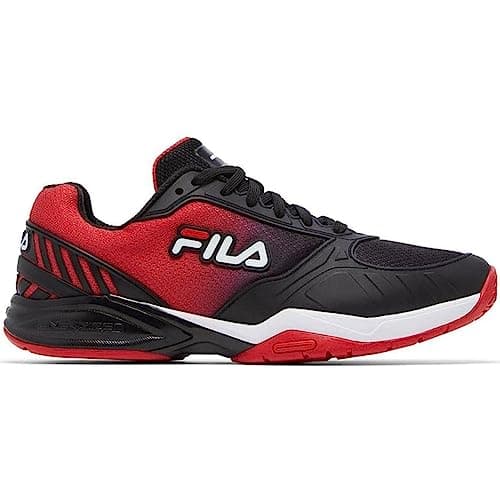
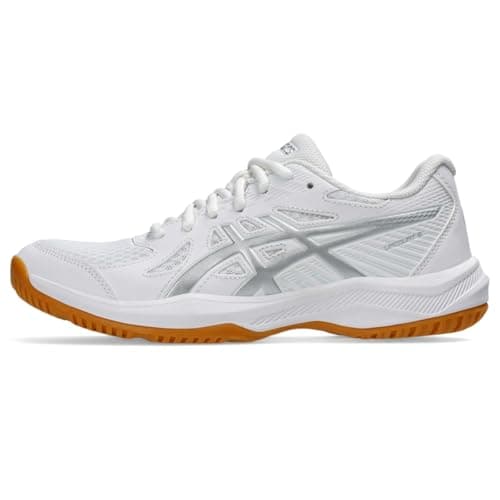
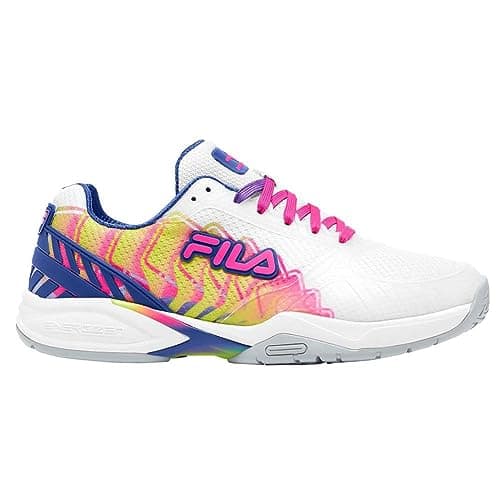
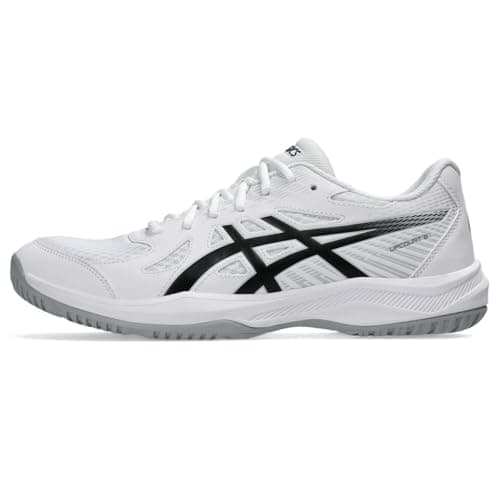
Play indoors on a gym floor: buy the ASICS Upcourt 6 (or the women's Upcourt 6). Its gum rubber outsole is the compound made for varnished wood and sprung sport-court surfaces, and nothing else at this price grips one better. Play outdoors on concrete or asphalt, or split your time between the two: buy the Fila Volley Zone (or the women's Volley Zone), whose herringbone rubber outsole and published TPU midfoot shank survive a rough surface that eats gum soles.
That is the whole answer, and it is worth saying plainly because almost every comparison of these two shoes tries to crown a winner. There is no winner here. There is a surface, and the outsole either matches it or wears out. Both are real court shoes with real lateral support from brands with decades of court experience, and both cost less than most people expect to pay.
Our standing disclosure: we have not tested these. We do not run a lab, and we have not worn a pair of either. Every outsole compound, tread pattern, shank material, midsole and non-marking claim below was read off the live listing our buy button points at, with sources named in Sources. Where a listing is silent — and on one of these four, the non-marking claim is exactly that — we say so. Scores are judgments from that research against our published rubric.
03The buyer's guide
The comparison table
Every row is a published claim from that shoe's own listing. The two pairs are not identical across genders, which is the part most comparisons miss:
| Spec | Upcourt 6 (M) | Volley Zone (M) | Upcourt 6 (W) | Volley Zone (W) |
|---|
| Outsole | Gum court rubber | Herringbone rubber | Gum court rubber | Court rubber |
| Primary surface | Indoor | All-court | Indoor | All-court |
| Midsole | Not published | Energized EVA | Not published | Not published |
| Torsion control | Not published | TPU midfoot shank | Not published | Not published |
| Non-marking | Stated | Not stated | Stated | Stated |
| Last | Men's court last | Men's cut | Women's court last | Women's-specific last |
| Upper | Lightweight | Synthetic | Lightweight | Breathable mesh |
Two rows in that table will decide your purchase, and neither is the brand name.
Row one: gum rubber versus herringbone, and why it is not a preference
Outsole rubber is formulated for a surface. Gum rubber is soft and sticky, which is exactly what you want on a clean, smooth indoor floor: it holds when you push off sideways and releases cleanly when you pivot. Put that same soft compound on outdoor concrete or asphalt — which is sandpaper by comparison — and it abrades away in a fraction of the time. Both Upcourt listings say so in their own way, and we repeat it in every shoe page because it is the mistake that costs people a pair of shoes.
Herringboneis the traditional court tread — the interlocking V pattern you see on tennis shoes — moulded in a harder, more abrasion-resistant rubber. It grips a little less eagerly than gum on a gym floor and it lasts dramatically longer on a rough outdoor court. That is the Volley Zone's advantage, and it is a durability advantage rather than a performance one.
So the honest rule: match the outsole to the surface you play on most, and if you genuinely split your time, buy the harder compound and accept slightly less indoor bite. Our indoor vs outdoor pickleball shoes page covers the full mechanism, and best indoor court shoes and best outdoor court shoes are the surface-split rankings.
Row two: the TPU shank, the only published support component here
The men's Volley Zone is the only one of these four shoes whose listing names the part that resists twisting. A TPU midfoot shank is a stiff plate moulded into the waist of the shoe between heel and forefoot, and its job is to stop the shoe wringing out like a towel when you load the outside edge of your foot on a hard lateral push.
That is worth understanding because torsional stiffness is the specific property that separates a court shoe from a running shoe, and it is almost never printed on a listing. A running shoe is deliberately soft through the midfoot so it can roll forward through a stride; that same softness lets your foot roll over the edge of the sole in a sideways cut, which is how new players turn ankles. Our do you need pickleball shoes page makes the full argument, and pickleball vs tennis shoes explains why a tennis shoe is a perfectly good answer too.
The ASICS listings do not publish a shank, which does not mean the shoe lacks midfoot structure — ASICS court lasts are long proven across volleyball and indoor sport. It means we will not claim a component nobody printed, and that is why the Volley Zone takes the stability credit on published evidence while the Upcourt takes the grip credit.
The non-marking catch on exactly one of the four
This is small and it matters to a specific reader. The men's Volley Zone listing states the outsole compound but makes no non-marking claim, where the women's Volley Zone and both Upcourt listings do state non-marking.
Most indoor venues require non-marking soles, and some enforce it at the door. If you play in a school gym, a church hall or a leisure centre with that rule, buy a shoe whose listing says the word — that is the women's Volley Zone or either Upcourt. If you play outdoors or at a venue that does not care, the men's Volley Zone is unaffected and remains the better all-court buy. We are not claiming the shoe marks floors; we are saying its listing does not promise it does not.
Men's and women's are not the same shoe
Both brands build these on gender-specific lasts, and in Fila's case the two versions differ in more than sizing: the women's Volley Zone publishes a breathable mesh upper, the men's a synthetic one. A women's-specific last is not marketing — it is a narrower heel and a different forefoot volume, and it produces a better midfoot lock than a scaled-down unisex shoe for most women.
The practical note that applies to all four: court lasts run narrow by design, because the whole point is to stop your foot sliding inside the shoe during a hard cut. If you have a wide foot, none of these four publish width options and you are buying on returns policy — start at best pickleball shoes for wide feet, which ranks the models that do offer widths. Our gender rankings are best men's pickleball shoes and best women's pickleball shoes.
Who should buy neither
In one line: the Upcourt 6 is the better indoor shoe and the Volley Zone is the better all-court shoe, both are honest buys at their price, and the badge on the side is the least informative thing about either of them. If you want the whole field rather than this pair, start at best pickleball shoes or best pickleball shoes under $100, and our full Upcourt 6 review and Fila Volley Zone review go deeper on each shoe individually.