03The buyer's guide
What "dedicated pickleball shoe" buys you here
Most shoes sold for pickleball are tennis or indoor-volleyball shoes with a different sticker, and that is usually fine — the movement patterns overlap heavily. The Volley Zone is one of the smaller number of models a court brand actually built and badged for pickleball, and Fila has been making court shoes for decades, which is a different thing from a fashion brand adding a pickleball line last season.
In practice that shows up as a herringbone rubber outsole. Herringbone is the oldest tread pattern in court sport for a reason: the zig-zag bites in every direction and, more importantly, it releases cleanly. A tread that grips but does not release is how knees get hurt on a hard pivot. It is a conservative, proven choice rather than a clever one, and on a court shoe that is what you want.
The midfoot shank is the spec that matters
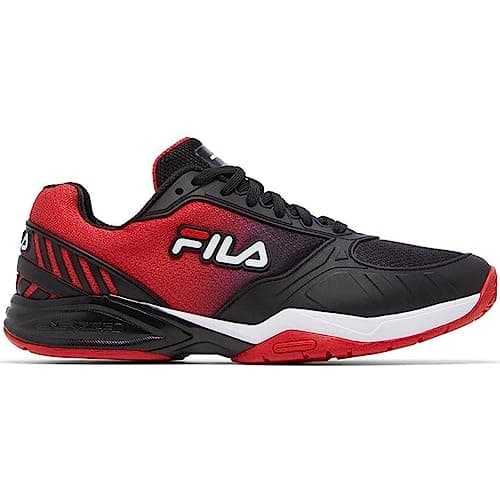
Fila publishes a thermoplastic polyurethane midfoot shankon the men's Volley Zone. A shank is a stiff plate buried between the outsole and the insole under your arch, and its job is to stop the shoe twisting along its length.
That matters more in pickleball than most beginners expect. When you push hard sideways to cover a ball, the forefoot wants to rotate one way and the heel the other; a shoe with no torsional stiffness lets that happen, and your foot rolls inside it. It is the specific property a running shoe lacks and the specific reason we keep telling people not to play in one — covered at length in do you need pickleball shoes.
Alongside it Fila lists an Energized EVA midsole for cushioning and a removable molded sockliner. The removable sockliner is quietly useful: if you wear orthotics, a fixed insole is a dealbreaker and a removable one is not.
Women's and men's are not the same shoe
They share a name and a tread pattern, and Fila's listings describe them differently in two ways worth knowing before you buy.
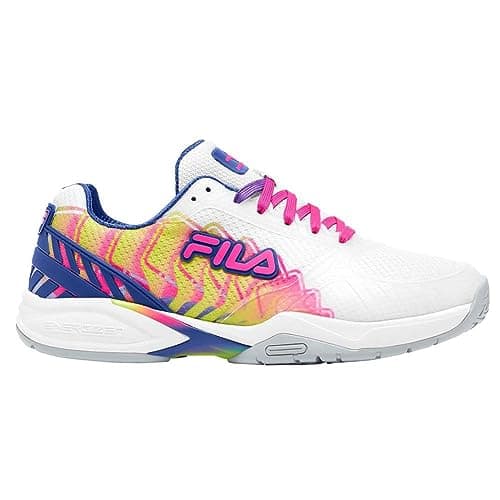
The women's version is listed with a breathable mesh upper and tongue, and its outsole is described as non-marking, with Ever Grind rubber. The men's version is listed with a synthetic upper, and its outsole is described as herringbone rubber — Fila does not make a non-marking claim on that listing.
Neither difference is a defect, but both are decisions. Mesh breathes better than synthetic over a long summer session. And non-marking is not a comfort feature, it is an access requirement: most indoor venues will turn away a sole that leaves black scuffs on their floor, and it is a separate property from grip. If you are buying the men's version specifically for indoor play at a gym that enforces the rule, confirm it with the seller first rather than assuming it inherits the women's spec.
Where it sits on price
The women's Volley Zone lands in the high-$60s bracket and the men's around $50, which puts the men's below every shoe on our best men's pickleball shoes list and near the floor of what we would call a proper court shoe at all. Live prices for both are on the cards above; shoe listings on Amazon are per-size and per-colorway, so the exact figure moves with the size you pick.
Below roughly $45 the category stops being trustworthy — you start getting court-styled sneakers with a flat sole and no torsional structure, which is the failure mode this whole category exists to avoid. The Volley Zone sits just above that line with published specs behind it, which is why it earns a place rather than merely being cheap. Our best pickleball shoes under $100 covers the rest of that bracket.
Indoor, outdoor, or both?
Herringbone rubber is a general court compound rather than a soft indoor gum. That makes it the more flexible choice if you do not yet know where you will end up playing: it survives outdoor hard courts far better than a gum sole, and it still works on a gym floor even though a gum sole would grip a varnished surface better.
If you already know you play exclusively indoors on wood, a gum-soled indoor shoe is the better tool and usually cheaper — see best indoor court shoes. If you are exclusively outdoors on concrete, durability becomes the deciding spec and the harder outdoor-rated options in best outdoor court shoes are worth the extra.
Fit
Court shoes are cut narrower than running shoes on purpose, because internal foot movement becomes instability the moment you change direction. The Volley Zone is a court last and behaves like one. Fila's own size guidance for the men's Volley Zone describes it as true to size, slightly wide in the forefoot, and slightly low in the arch.
Practically: if you have a wide foot, the men's cut is friendlier than most court shoes. If you have a high arch, the removable sockliner means you can swap in your own support rather than fighting the shoe. If you are between sizes, do not size up for comfort — a shoe you slide around in has given away the lockdown you paid for.
Who should buy it
- A first-time court-shoe buyer who wants something purpose-built without spending over $100.
- Anyone who does not yet know whether they will play mostly indoors or outdoors.
- Orthotic wearers, because the sockliner comes out.
- Men looking for the cheapest dedicated pickleball shoe we are willing to recommend.
Who should not
- Players whose limiting factor is already comfort. This is a budget court platform, not a plush one — the most comfortable pickleball shoes list is the right page for you.
- Fast, aggressive singles players who want the most locked-down upper available. The support here is solid rather than aggressive; our best pickleball shoes list has the firmer options.
- Anyone who needs a confirmed non-marking sole and is buying the men's version, for the reason above.
What we did not test
We have not worn either version, timed the outsole's wear on abrasive concrete, or measured the stack height or the shank's actual stiffness. Everything above is read from Fila's published specifications for these two listings and from how herringbone court outsoles and TPU shanks behave as a category, with the inferences flagged as inferences. Where the two listings disagree — the upper material and the non-marking claim — we have reported the disagreement rather than resolving it in the shoe's favor. Our methodology explains the approach and the scoring rubric.
The verdict
A sensible, unglamorous court shoe that does the structural things a pickleball shoe has to do and does not charge for much beyond them. The women's version stays our top women's pick because the combination of a women's last, a stated non-marking outsole and a high-$60s price is genuinely hard to beat. The men's version is the more interesting buy on pure value — a dedicated pickleball shoe around $50 with a published midfoot shank — with the one caveat that Fila does not claim a non-marking sole on it.
If you are buying your first pair and want the wider context before you commit, start with how to choose pickleball shoes.