A court shoe is a shoe built to stop your foot sideways. Four pieces of construction define one: a hard, flat, non-marking outsole; a stiffener through the midfoot that resists twisting; a low stack height; and a reinforced upper that cages the foot over the sole. A running shoe has none of the four, because it is built to roll your foot forward through a stride — and that same engineering is what lets your foot tip over the edge of the sole when you push off sideways. That is the whole difference, and every other claim in this category is downstream of it.
This page is about the mechanism rather than the purchase. If you want the ranked shopping list, go to best pickleball shoes or how to choose a pickleball shoe. If you want to know whether you need one at all, do you need pickleball shoes answers that directly. Stay here if you want to be able to look at a shoe and tell.
Part one: the outsole, and the two words that matter
A court outsole is flat, hard and non-marking, and those are three separate properties.
Flat means a continuous contact patch rather than the lugs and gaps of a trail sole, because a court is already smooth and a lug just reduces the rubber touching it. Court treads are usually herringbone — the interlocking V pattern — which grips in every direction and releases cleanly on a pivot instead of catching, and catching is how knees get hurt.
Hard is about where you play. A soft, sticky gum rubber compound grips a varnished indoor floor beautifully and abrades away quickly on outdoor concrete; a harder all-court rubber grips a little less on wood and lasts far longer outside. Neither is better — they are formulated for different surfaces, which is the entire content of indoor vs outdoor pickleball shoes, and the mistake of taking gum soles outdoors is the most expensive one in this category.
Non-marking is a venue requirement, not a performance feature. Most indoor halls insist on it and some check at the door. It is usually stated on a listing in those words, and if your venue enforces it you should buy a shoe that says so rather than assume.
Part two: torsional stiffness, the part nobody prints
Pick up a running shoe and wring it like a towel: it twists easily, by design, because a runner's foot needs to pronate and roll through a stride. Try the same thing with a court shoe and the waist of the shoe fights you. That resistance is torsional stiffness, and it is the single most important thing a court shoe does that a running shoe does not.
It comes from a shank — a stiff plate moulded into the midfoot between heel and forefoot, usually TPU or nylon. When you plant your outside edge and push hard sideways, the shank stops the forefoot and heel rotating independently, which keeps the sole flat under you instead of letting your ankle roll over the edge of it.
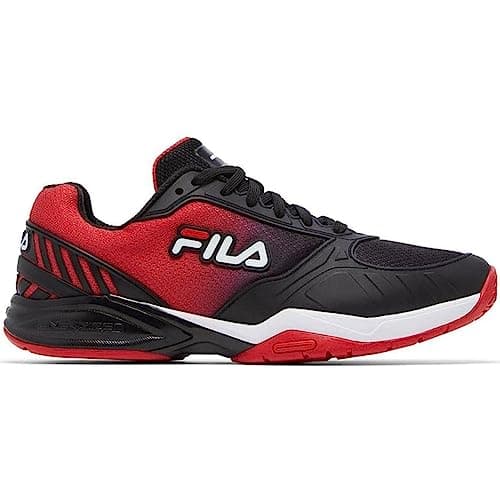
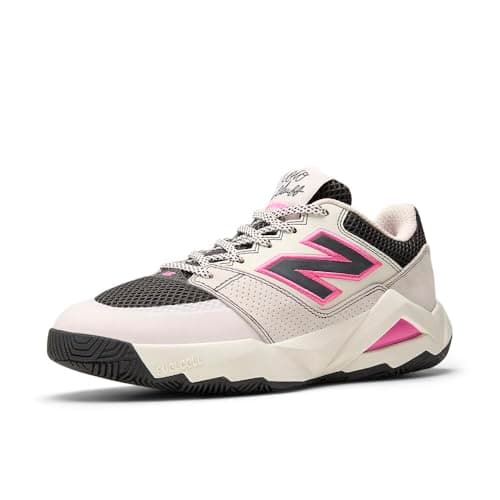
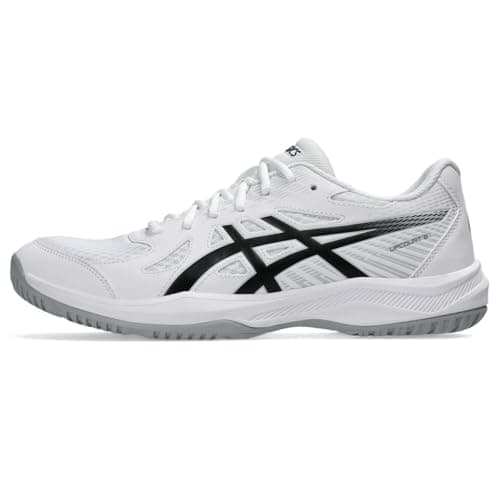
The frustrating part is that most listings do not mention it. Of the three shoes on this page, two name the component — a TPU midfoot shank on the Fila and a nylon shank on the New Balance — and the ASICS does not, even though ASICS court lasts are long proven. So the practical test is the one you can do in your hands when the box arrives: hold heel and toe and twist. A court shoe resists. If it wrings out easily, it is not one, whatever the badge says.
03The buyer's guide
Part three: stack height, and why lower is safer sideways
Stack height is how far your foot sits above the ground. Running shoes have grown taller and softer for years, because foam under a heel strike is comfortable in a straight line. On a court that height is a lever: the higher your foot sits, the more your body weight can tip the platform when you load its outside edge.
A court shoe sits low and wide for that reason. It is also why the comfort decision in this category is a genuine trade rather than a free upgrade — more cushioning means more height, and more height means a little less lateral precision. Shoes like the New Balance Coco Delray manage both by pairing real foam with a shank and a hard outsole, which is the right way to buy comfort; a tall soft shoe with no shank is the wrong way. The cushioned end of our rankings is most comfortable pickleball shoes.
Part four: the lateral cage
The fourth part is in the upper. A court shoe has reinforced overlays along the sides of the forefoot and around the heel, and often an outrigger — a flared shelf of sole sticking out past the upper on the outside edge of the forefoot. The overlays stop your foot sliding sideways inside the shoe; the outrigger widens the base exactly where the tipping happens.
You can see both in a listing photo. Look at the shoe from the front: if the sole flares out wider than the upper on the little-toe side, that is an outrigger. Look at the side: if there are stitched or welded panels over the mesh rather than plain mesh, those are the overlays. The shoe we rank with the most explicit version of both is the Selkirk CourtStrike Pro 3.0, whose listing names the outrigger directly.
This is also why court shoes feel narrower than your running shoes, and why that is a feature rather than a defect — a cage only works if it is snug. If your foot genuinely measures wide, you need a wide fitting rather than a loose standard width; best shoes for wide feet covers the difference.
The four-part check, in order
| Part | What it does | How to check it |
|---|
| Outsole | Grips and releases on a smooth surface | Flat herringbone tread; listing says gum (indoor) or all-court; non-marking stated |
| Shank | Resists twisting on a lateral push | Listing names a TPU or nylon shank; or twist the shoe heel-to-toe in your hands |
| Stack height | Keeps your foot close to the floor | Side-on photo: a low, flat profile, not a tall soft wedge |
| Lateral cage | Stops the foot sliding and the shoe tipping | Front-on photo: sole flares past the upper; side panels over the mesh |
Three of those four you can verify from the product page before you spend anything, and the fourth you can verify in thirty seconds when the box arrives. That is a better basis for buying than any brand's marketing copy.
Are court shoes different from running shoes? Yes, in every one of the four
This is the question people actually type, so here is the direct answer. A running shoe is built with a soft high stack, a deliberately flexible midfoot, a rounded heel that encourages a forward roll, and a soft upper with no side reinforcement — four decisions that all serve forward motion and all work against you sideways. The result is not a slight disadvantage: on a hard cut your foot rolls over the edge of a soft high sole, and that is the mechanism behind the ankle sprains new pickleball players pick up in their first month.
Three things follow. First, any court shoe counts — tennis, volleyball, squash, badminton and pickleball-branded shoes all share the four parts, which is why we say repeatedly that you do not need a pickleball-branded pair. Second, a cross-trainer is not a court shoe; it is usually a running platform with a flatter sole and no shank. Third, walking shoes are the worst of all, because they add a soft, rolling midsole with no reinforcement anywhere. Our pickleball vs tennis shoes page covers the one genuinely close call.
What a court shoe does not do
Two honest limits, because this page could easily oversell its subject.
It does not last. The outsole is the wear part, and when the tread goes smooth the grip goes with it — which is a slip risk rather than a cosmetic problem. Only one shoe we rank publishes a durability commitment at all. See how long pickleball shoes last for realistic intervals, and replace on tread rather than on looks.
It does not substitute for the rest of your kit or your technique. Shoes solve a stability problem; they do not solve a grip, paddle weight or warm-up problem. If your arm hurts, the answer is in grip size and paddle weight, not in footwear. If you are new, the highest-value five minutes you can spend is warming up properly — and what to wear to play pickleball covers the rest of the kit.
Three shoes on this page show the four parts in three different balances: the ASICS leans on outsole compound for indoor grip, the Fila publishes the shank and takes the all-court outsole, and the New Balance buys comfort without giving up either. Any of them is a court shoe. Which one is yours is a question about surface, fit and session length, answered in how to choose a pickleball shoe and ranked in best pickleball shoes.