03The buyer's guide
The generation trap: the lineup on K-Swiss's site is not the lineup on Amazon
K-Swiss's own pickleball collection lists an Express Light Pickleball 2 and an Ultrashot Light 2. The shoes you can buy through this page are the first generation of each: the Express Light Pickleball and the Ultrashot Light. Both are real, current, in-stock shoes and neither is a counterfeit or a cast-off — but they are not the models on the brand's homepage, and the names are one digit apart.
This matters in two directions. If you read a review of the "Express Light 2" and then buy an "Express Light", the review does not describe your shoe. And if you find the original at a lower price than the brand's current-generation listing, that is usually a genuine saving on a shoe that was well regarded rather than a trap — superseded is not the same as bad. Check the exact model name in the listing title against the review you are relying on, every time.
We do the same thing with paddles, for the same reason: a brand quietly replacing a model while the old name keeps circulating is one of the most common ways a buyer ends up disappointed. See Selkirk paddles, ranked for the version of this problem on the paddle side.
The four criteria, in order
Three shoes is a small field, which is useful: it means the decision comes down to four questions rather than a spec table. They are in priority order for a pickleball player.
1. Pickleball-specific, or tennis-derived?
This is the real split in the lineup and it is not marketing. The Express Light is sold as a pickleball shoe, and K-Swiss lists it inside its pickleball collection. The Hypercourt Express 3 is a hard-court tennis shoe; its own Amazon listing title names tennis first and adds "Pickleball, Hard Court, Athletic" after, and the model does not appear in K-Swiss's published pickleball collection at all.
The practical difference is where the material goes. Pickleball players drag the front foot on lunges far more than tennis players do, which is why pickleball-specific shoes add reinforcement over the medial toe. A borrowed tennis platform gives you excellent lateral support — tennis is also a sideways game — and may not give you that toe material. Neither choice is wrong; it is a question of whether you are the player who scuffs the inside of their toe box. Our pickleball vs tennis shoes guide covers the whole comparison.
2. Width — the one place K-Swiss is genuinely unusual
Court shoes are built narrow on purpose. A hard lateral push loads the side of the shoe, and a foot that can slide inside it is a foot that rolls, so lockdown is the design brief and a narrow last is how it is achieved. That is why "court shoes run narrow" is advice and not a complaint.
K-Swiss is one of the few brands here that does something about it. Its published Express Light range includes a Wide variant in women's and a 2E variant in men's — a real width fitting rather than the usual advice to size up half a size. The Ultrashot Light 2 is published in standard sizes only on that same collection page, with no wide option visible.
That is a concrete reason to prefer the Express Light family if your feet are wide, and it is worth saying plainly because almost nothing in this category offers it. Sizing up adds length more than width and leaves your foot sitting on the edge of the platform, which costs you the lockdown you bought the shoe for. The full method — including the insole test you can do in a store — is in best pickleball shoes for wide feet. Note that the specific wide and 2E variants are listed on K-Swiss's own site; the ASINs our buy buttons point at are standard widths, so check the width in the listing before you order.
3. Break-in and forefoot room
K-Swiss states that the Hypercourt Express 3 is comfortable out of the box with no break-in period, and that it has a roomier forefoot. Those are the two claims that matter if your first outing in the shoe is a long day rather than a gentle Tuesday evening — feet swell over hours, and a shoe that fits at 9am can hurt by mid-afternoon.
The trade is real and we will not hide it: room in the forefoot is movement inside the shoe, and movement inside the shoe is lost lockdown on a hard cut. If you have a narrow foot, the generous forefoot is a downgrade, not a feature. A roomier forefoot on a standard width is also a different thing from a published width fitting — it is the second-best answer to a wide foot, not the first.
4. Which surface will destroy it
None of the three uses a soft gum indoor outsole, which is the compound that grips a gym floor best and dies fastest on outdoor concrete. All three are harder, more durable all-court rubbers, and the Express Light and Ultrashot Light both publish a non-marking outsole — the spec that gets you through the door at indoor venues that require it.
That makes this a lineup for the player who splits surfaces or plays mainly outdoors. If you only ever play on a varnished gym floor, a gum-soled indoor shoe will grip better than anything here; best indoor court shoes is the right list for you. If concrete is eating your soles, go to best outdoor court shoes.
The three, ranked
1. Express Light Pickleball — the pickleball shoe
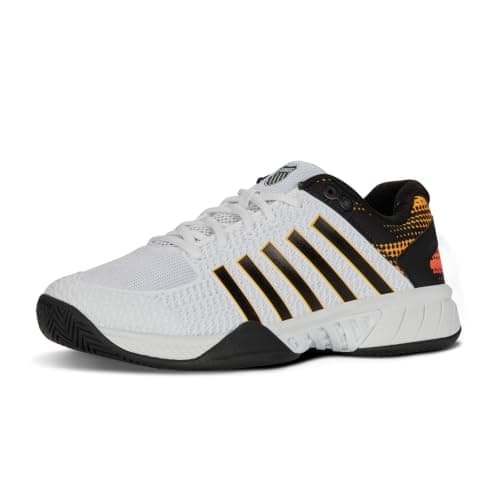
This is the one to buy by default, and it is rank 1 on our main list for the same reason: it is a purpose-built pickleball shoe from a company that has made court shoes for decades, with a court outsole, a lateral support cage, a non-marking sole and a durable toe drag guard. Those four things are the entire argument for buying a court shoe instead of playing in running shoes, and this shoe has all four without a premium price.
The honest cons: it is firmer and less plush than a cushioned running shoe on your first wear, and the styling is functional rather than fashionable. Neither is a reason not to buy it. The real caveat is the generation question above — confirm whether the listing in front of you is the Express Light or the Express Light 2.
2. Ultrashot Light — the cheapest honest court shoe K-Swiss sells
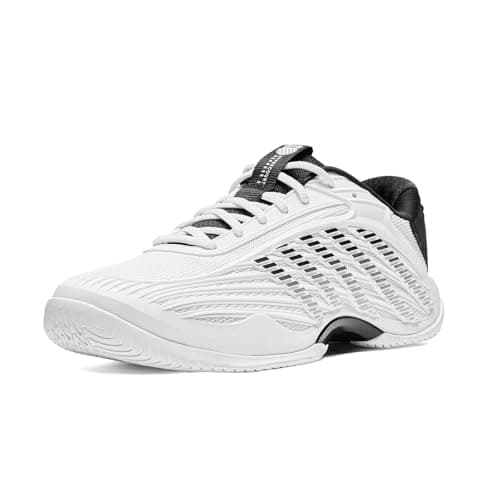
The Ultrashot Light is a tennis-platform court shoe that lands under the line most pickleball-branded shoes clear easily, which is why it tops our under-$100 list. You are buying real hard-court engineering rather than a running shoe with a logo, and it is light for a support-focused shoe.
The catch is simple and it rules the shoe out for a lot of people: it is narrow, and K-Swiss's own spec notes that wide-footed players often need the next half size. It also has less forefoot cushioning than the heavier flagship court shoes. If either of those describes you, the Express Light family or the Hypercourt is the better K-Swiss. The full examination is in our K-Swiss Ultrashot Light review.
3. Hypercourt Express 3 — the tournament-day tennis shoe
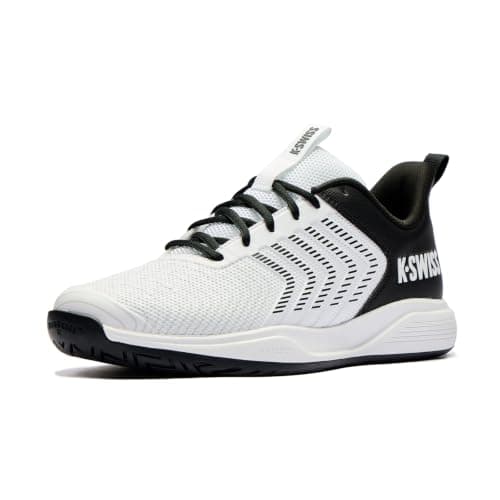
Ranked third here, and that ranking is about fit for the category rather than quality. It is a hard-court tennis shoe with a Surgelite+ midsole, a durable rubber outsole, no break-in period and a roomier forefoot, and it is the shoe to buy if your problem is a long tournament day and feet that swell. It is also the most expensive of the three.
The honest cons: a roomier forefoot is less locked-down than a narrow performance last, and like every other shoe in this lineup it carries no outsole durability guarantee — worth knowing, because a published warranty is the one hard commitment available in this category and at least one competitor makes it. If you are on court three-plus times a week, best shoes for club and tournament play ranks the field on exactly that.
What K-Swiss does not publish — and the warranty it explicitly does not offer
On the collection page for its pickleball range, K-Swiss publishes no shoe weight, no stack height, no drop and no outsole warranty for any of these models. It names technologies — Surgelite+ on the Hypercourt, a non-marking outsole, a drag guard, a support cage — without putting numbers on them. That is normal for the category rather than a K-Swiss failing; most court-shoe brands publish the same nothing.
On one point, though, the absence is a definite answer rather than a gap. There is no outsole durability warranty on these shoes. Pickleball Central's published spec table for the men's Express Light states "Outsole Guarantee: No" in as many words. We say this plainly because an earlier version of our own Express Light review claimed a six-month K-Swiss outsole warranty; that was wrong, and we corrected it on the same day we published this page. The only shoe we cover whose maker does publish one is the Selkirk CourtStrike Pro 3.0.
Where numbers for these shoes do exist, they come from retailers rather than K-Swiss. The same Pickleball Central table gives the men's Express Light a 12.7 oz weight, a slightly narrow 68mm heel and 77mm midsole with a standard 97mm toe box, a removable insole, a true-to-size fit and a 2020 model year — which independently confirms the generation point above. It also names the durability construction K-Swiss itself does not detail: Durawrap over the upper against toe dragging, a 180-degree plantar support chassis, a Strobel board, drag guards at toe and heel, and a high-density modified herringbone outsole over a special EVA midsole. Good construction, no guarantee — and those are different things.
Which one, by player
- Your first proper court shoe: Express Light. It is the pickleball-specific one, the price is reasonable, and it is rank 1 on our main list on merit — though if spending as little as possible is the point, best pickleball shoes for beginners ranks cheaper models that still publish a named support component.
- Spending as little as possible on a real court shoe: Ultrashot Light, unless your feet are wide.
- Wide feet: the Express Light family, because K-Swiss publishes an actual Wide and 2E fitting for it — check the width in the listing you order.
- Long tournament days, or feet that swell: Hypercourt Express 3, for the no-break-in claim and the roomier forefoot.
- Indoor gym floors only: none of these. Buy a gum-soled indoor shoe.
What we are not claiming
We have not worn these shoes, worn through an outsole, or measured a single one of them. Everything above is read from K-Swiss's published product pages and the live Amazon listings for the exact ASINs our buy buttons point at, with the trade-offs reasoned from how these constructions behave as a category. Where a figure is not published we have said so rather than estimating it. Our methodology sets out the approach in full.
The honest bottom line
K-Swiss is the safest brand to buy blind in this category, because it has more pickleball-specific product than anyone and a court-shoe history that long predates the sport. Buy the Express Light unless you have a specific reason not to; buy the Ultrashot Light if money is the constraint and your feet are not wide; buy the Hypercourt if you are facing a long day on a hard court.
The one thing to be careful about is not quality but naming. The brand sells second generations of two of these models on its own site, and the first generations are what you will mostly find elsewhere. Match the model name in the listing to the model name in whatever review convinced you, and the rest of this decision is easy.