03The buyer's guide
The spec that made us correct our own pages
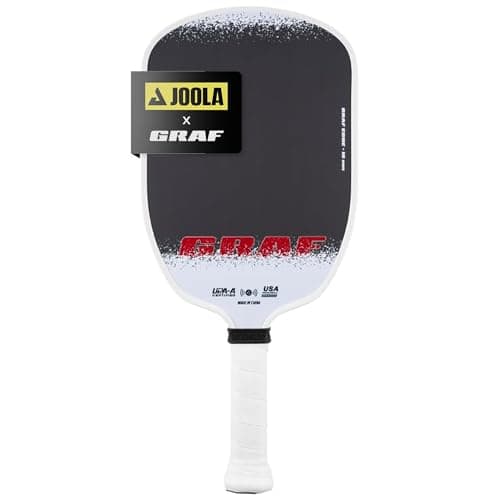
JOOLA publishes the GRAF Edge at 16.5 in long by 7.5 in wide. Until this review, two of our pages described it as a standard shape. That was wrong, and we have fixed it rather than quietly leaving it.
Add those two numbers and you get 24.0 in, which is exactly the ceiling USA Pickleball sets: combined length plus width may not exceed 24 in, with length capped at 17. Every paddle at that ceiling has made a choice about how to spend the allowance, and this one spent it on length. A classic widebody sits at roughly 16 x 8. The GRAF Edge trades half an inch of face width for half an inch of reach.
It makes a useful contrast with the other JOOLA we rank. The Scorpeus Heat Vision sits at 16 x 8 — the same 24-inch budget spent entirely the other way, on width. Two paddles, one brand, identical legal footprint, opposite philosophies. Our elongated vs widebody guide works through what each end of that trade does to your game.
How elongated is it, honestly?
Mildly. This matters, because "elongated" is a word that scares beginners off paddles they would be perfectly happy with.
Specialist retailers list the shape as elongated. By our own definition it sits at the very top of the hybrid band — paddles around 16.3 to 16.5 in that buy a little reach for a little width. A true power-shape elongated paddle pushes toward the 17 in limit and comes down to 7.0 or 7.2 in of width. At 7.5 in the GRAF Edge is half an inch narrower than a widebody, not two inches.
That is why we still score it 8 out of 10 for forgiveness rather than dropping it to the bottom of the field. The face is narrower than the one you learned on and off-center contact will punish you a little more, but this is not the unforgiving slab the word "elongated" conjures. If you are genuinely brand new and still finding your contact point, a widebody from our beginner picks is still the safer first paddle. If you can already rally, the extra half inch of reach is more help than hindrance.
The GRAF Edge and the Agassi Edge are the same paddle
This is the part that is genuinely hard to work out as a shopper, so here is the evidence rather than the assertion.
- Consecutive part numbers. JOOLA lists the Agassi Edge as model 300701 and the GRAF Edge as model 300702.
- Same release date. Both listings carry a release date of January 28, 2025.
- Identical published dimensions. 16.5 in long, 7.5 in wide, 5.5 in grip length, 7.8 oz average weight, a 16mm polypropylene honeycomb core and a textured carbon fiber face — on both.
- Word-for-word identical feature copy. The GRAF Edge listing describes its own shape as the "Agassi paddle shape," which is the tell.
- Same certifications and the same price. USA Pickleball approved and UPA-A certified, both sitting in the same sub-$50 bracket on Amazon.
One published spec differs, and it is the one that should decide which you buy: grip circumference. The GRAF Edge is 4-1/8 in, listed as small. The Agassi Edge is 4-1/4 in, listed as medium. Everything else is cosmetics and a name.
So which grip is yours?
Most adult players land between 4 and 4-1/2 in, which means the medium Agassi Edge fits more hands than the small GRAF Edge does. Neither listing mentions the other, so a shopper who searches the name they happened to see is choosing a grip size by accident.
Take the sixty seconds to check. Open your dominant hand, line a ruler up with the bottom crease of your palm and measure to the tip of your ring finger; that distance in inches is roughly your grip size. Our paddle grip size guide has the full method and the finger test that confirms it.
Then apply the rule that makes this asymmetric: a grip can be built up, but it can never be shrunk. If your measurement is borderline, the small-grip GRAF Edge is the recoverable mistake — one overgrip adds roughly 1/16 in and costs a few dollars. A 4-1/4 in handle on a 4 in hand is not fixable, and a handle you have to squeeze is one of the most common causes of the forearm pain people blame on their technique.
The 5.5 inch handle is one of the longest we recommend
Grip length is listed at 5.5 in on both versions. For comparison the Scorpeus — already unusual for a widebody — is 5.25 in. Only the XL shape of the Selkirk SLK Evo Control, at 5.75 in, is longer among the paddles we rank.
Total length is 16.5 in, so a 5.5 in handle leaves roughly 11 in of face. That is the cost, and it is real: a long handle eats face length, so this is a slightly short face on a long frame rather than a genuinely long hitting surface.
What you get back is room for a two-handed backhand without cramping, which is exactly the buyer JOOLA is aiming at. If you came from tennis, this combination — longer frame, long handle, mid-weight — is the closest thing on our tennis-player list to the swing you already own, at the lowest price we can point you at. If you play one-handed, that half inch of handle is face area you would probably rather have had.
7.8 oz, and why that reads differently on a longer frame
The listed average weight is 7.8 oz, with retailers publishing a range of 7.6 to 8.0 oz — paddle weights vary unit to unit, which is normal and worth knowing before you weigh yours and worry.
7.8 oz sits at the bottom edge of the mid-weight band we recommend to most players. On a widebody that means fast hands and an arm that survives three hours. On a longer frame the same static number behaves a little differently, because mass sitting further from your hand takes more effort to swing. Manufacturers call that swingweight, and JOOLA does not publish it for this paddle, so we are flagging this as category behavior rather than a measured claim about this model.
The practical version: expect a paddle that feels light to carry and slightly more substantial to swing than its number suggests. If you have a sensitive elbow that is a point against it, and our paddle weight guide explains why weight outranks almost every other spec for arm comfort.
What the core and the face are doing
The 16mm polypropylene honeycomb core is the spec that puts this in the improver tier rather than the beginner one. A thicker core absorbs more of the ball's energy, so the ball leaves slower and lands shorter — the difference between a dink that drops into the kitchen and one that floats up to be attacked. You give up free power in exchange, which is the trade you are consciously making. Our core thickness guide has the full reasoning.
The textured carbon fiber face is what produces spin: the ball dwells fractionally longer on a rough surface while your swing brushes up the back of it, and a slick fiberglass face cannot do that. Be honest with yourself about whether you have that stroke yet — see graphite vs fiberglass — and know that a textured face is a consumable. The grit polishes smooth with use, the spin fades, and no manufacturer publishes a wear rate. When to replace your paddle covers the signs.
One thing this paddle is not: thermoformed. That construction method, and the foam-injected perimeters that usually come with it, is what the tier above buys. At this price you get the materials, not the build.
UPA-A certified — real, and probably irrelevant to you
Both listings advertise UPA-A certification alongside USA Pickleball approval. Two acronyms on a fifty-dollar paddle looks like badge stacking, so here is what the second one actually is.
UPA-A is the United Pickleball Association of America, the body behind the PPA Tour and Major League Pickleball. Its certification runs two tests: average deflection force, where both faces must measure 46 lb or more at 70-75 degrees F, and a spin test capping the paddle at 2200 RPM at any angle. Those are stiffness and spin ceilings, aimed at paddles that play hotter or grip harder than the rest of the field.
Here is the part the badge does not tell you: UPA-A certification is required only for professional divisions at PPA and MLP events. Amateur competition accepts USA Pickleball approval on its own. Unless you are entering a pro draw, this certification will never once be checked.
It is not meaningless, though, and the reason is money. UPA-A publishes its fees: a $10,000 annual brand fee plus $3,000 per paddle submitted. A brand does not spend that on a model it plans to abandon. Its presence here tells you JOOLA intends to keep this paddle in the catalog — useful if you care about warranty support or about replacing a face you have worn smooth. It tells you nothing whatsoever about how the paddle plays, and the caution we make at length on USA Pickleball approved paddles, explained applies double here: certification is a compliance check, not a quality rating.
The warranty says two different things
Go in with your eyes open on this. The Amazon listing's warranty field reads "180 Days." The feature copy on the same listing promotes a 12 month warranty unlocked by registering the paddle through the embedded NFC chip.
Unlike some JOOLA listings, this one is at least explicit that the longer term is tied to registration, so the likeliest reading is that 180 days is the default and registering doubles it. That is still an inference and we are labeling it as one. If warranty length matters to your purchase, confirm it with JOOLA before you buy rather than after — and register the paddle either way, because the upside costs you nothing but a phone tap.
The NFC chip is a registration and app-content feature. It changes nothing about how the paddle plays and should not move your decision.
On the names: endorsement is not evidence
Andre Agassi and Steffi Graf are two of the greatest tennis players who ever lived. Neither is a professional pickleball player, and a signature line tells you a brand paid for a name, not that a champion validated a paddle.
That is not a knock on the paddle — the specs stand on their own and they are good specs for the money. It is a warning about the shopping logic. If the Agassi name is what draws you to the Agassi Edge, remember what we established above: you would be choosing a 4-1/4 in grip on the strength of a tennis career. Choose it because your hand measures 4-1/4 in.
What it costs, and where
Both versions sit in the sub-$50 bracket on Amazon as we write this, and the live price is on the cards above. Worth knowing: specialist pickleball retailers list the same two paddles at close to double that. We are not going to pretend to know why one channel is so much cheaper, and prices move — but it does mean the sub-$50 figure is a genuine outlier rather than this paddle's natural price, and it is the single biggest reason it tops a list it would not otherwise reach.
Who should buy it
- Players ready for a first real upgrade who want a 16mm carbon paddle from a brand with stock, warranty and resale behind it, without spending a hundred dollars.
- Anyone with a two-handed backhand. The 5.5 in handle is one of the two longest we rank, and it fits.
- Tennis converts. A longer frame, a long handle and a mid-weight head is the closest thing here to the swing you already have.
- Small hands specifically — and that means the GRAF Edge, not the Agassi Edge. If your ruler says 4 to 4-1/8 in, this is the version.
Who should not
- Complete beginners still working out where the middle of the paddle is. A 7.5 in face is narrower than what you should be learning on — start at best paddles for beginners.
- Anyone with a medium or large hand who buys this version because they saw the name first. Buy the Agassi Edge instead; it is the same paddle.
- Players who want easy put-away power. A 16mm control core and a build that is not thermoformed mean you supply the pace — look at the power end of control vs power.
- Anyone with an active elbow problem. A light-but-longer paddle is not the arm-friendliest shape available; our comfort-first picks are built around that constraint.
What we did not test
We have not played with either version, weighed one, measured the face texture or its wear rate, or checked the grip circumferences with calipers. Everything above is read from JOOLA's published specifications, from the spec sheets specialist retailers publish for both models, and from UPA-A's own published testing standards — with the arithmetic shown so you can check it, and with category behavior flagged as inference rather than measurement. Where a listing contradicts itself we have reported the contradiction rather than resolving it. Our methodology explains the approach and the scoring rubric, including the fact that we do not run a lab.
The verdict
Still the paddle we would put in front of someone whose budget stops at fifty dollars, and the specs support that rather than merely decorating it. A 16mm polypropylene core, a textured carbon face and USA Pickleball approval at this price is a genuine anomaly, and the long handle is a real bonus for anyone hitting with two hands.
Buy it knowing the two things the listings will not tell you. It is a mildly elongated paddle, not the widebody a beginner should learn on — close enough that most improving players will never notice, far enough that a first-timer might. And it has a twin. Measure your hand, pick the version that matches, and the choice that looked like two paddles turns out to be one paddle and a ruler.
Where this pair sits in the wider line, and how it compares with the Astral Perseus, the Scorpeus and the Ben Johns Hyperion on published specs, is laid out in best JOOLA pickleball paddles.