Short answer: if you are new, buy control. A control paddle keeps the ball on the court while you are still learning where the court is, and pickleball at every level below advanced is lost on unforced errors far more often than it is won on winners. Power is the upgrade you buy later, once your shots land where you aimed them.
The longer answer is that "control" and "power" are not two product lines. They are the two ends of one trade-off, and every paddle sits somewhere along it. What moves a paddle toward one end is a small set of physical properties, and once you can read those off a spec sheet you stop needing the marketing words at all.
03The buyer's guide
The trade-off in one table
| Property | Pushes toward control | Pushes toward power |
|---|
| Core thickness | Thicker, around 16mm | Thinner, around 13-14mm |
| Face material | Raw or textured carbon | Fiberglass or composite |
| Weight | Lighter to mid | Heavier, especially head-heavy |
| Shape | Widebody — bigger, more forgiving face | Elongated — more reach and leverage |
| Feel off the face | Muted, soft, damped | Poppy, lively, springy |
Core thickness is the biggest lever
The honeycomb core is most of what you feel. A thicker core of around 16mm absorbs more of the ball's energy, so the ball comes off slower and lands shorter — which is exactly what you want on a dink or a reset. A thinner core of 13 to 14mm gives the ball more of its energy back, so the same swing produces a faster shot. Thin cores feel exciting for about a week and then start putting balls past the baseline. Our core thickness guide goes deeper on the 14mm versus 16mm question.
Face material changes spin more than speed
A raw or textured carbon face grips the ball for a fraction longer, which is where spin comes from, and its stiffness tends to read as control. Fiberglass and composite faces flex more and give the ball a livelier bounce — free pop, less bite. Neither is cheating; they suit different games. Our graphite vs fiberglass comparison covers the feel difference, and best carbon fiber paddles covers the tier where carbon becomes affordable.
Why beginners should buy control anyway
Here is the uncomfortable arithmetic of recreational pickleball: most points end because somebody hit the ball into the net or past the baseline, not because somebody hit a winner. A power paddle multiplies the pace of every shot you hit, including the ones you mis-hit. When your contact point is still inconsistent — and for a new player it is, by definition — more pace mostly means the errors travel further out.
A control paddle does the opposite. It shortens your mistakes, keeps the ball in play, and lets you develop the soft game that actually decides games at the kitchen line. You will hear experienced players say the third shot drop wins games. That shot is much easier on a control paddle, and close to unlearnable on a springy one.
When power is the right buy
Power is not a trap. It is just a later purchase for most people. Buy toward the power end when:
- You come from tennis or another racquet sport, already own a repeatable swing, and find control paddles frustratingly dead. See best paddles for tennis players.
- Your shots land where you aimed but you cannot finish a point when someone gives you a floater at the net.
- You play mostly singles, where you cover the whole court and driving the ball genuinely pays.
If two of those describe you, look at the intermediate paddle tier rather than the beginner one.
The marketing words to ignore
Listings say "the perfect balance of control and power" because it costs nothing to say and cannot be disproved. Ignore it. Look for the numbers instead: core thickness in millimeters, face material, static weight in ounces, and shape. Those four tell you where a paddle sits far more reliably than any sentence on the box, and every paddle we recommend publishes them.
Three paddles that show the difference
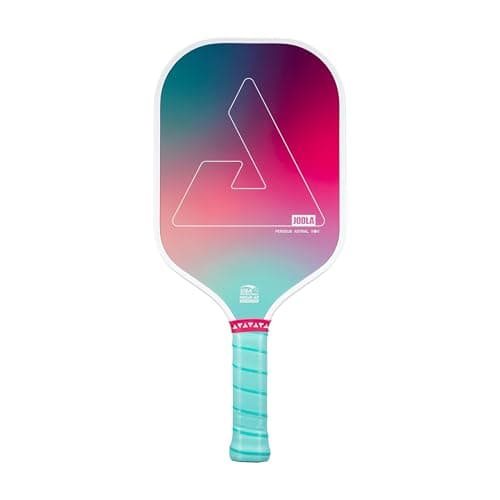
The picks above are chosen to make the trade-off concrete rather than to be the three best paddles on the site. The Selkirk SLK Evo Control is what control feels like: a thick core and a carbon face that mute the ball — our Evo Control review reads its two shapes off the spec sheet and explains which one to buy. The JOOLA Astral Perseus sits in the sensible middle and is our standing recommendation for a first paddle. The Selkirk SLK ERA Power is the power end — genuinely fun, genuinely more paddle than a beginner needs, and priced accordingly. If you are choosing your very first paddle, start with the beginner roundup instead.
How we picked
Everyone in this category says they tested twenty paddles. We haven't tested these in a lab, and we say so. Instead we compile the published manufacturer specs, do the math, weight everything toward what a beginner actually needs — forgiveness, a large sweet spot, sane weight and a fair price — and score each product against a published rubric. The scores are judgments from that research, not measurements we took. Where a fact came from someone else, we name it in Sources.