03The buyer's guide
Max vs XL: what the two shapes actually are
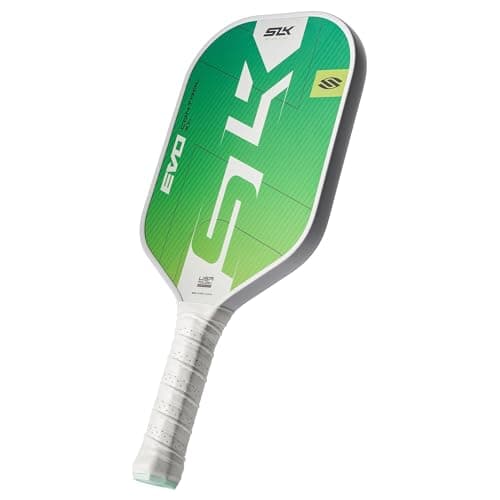
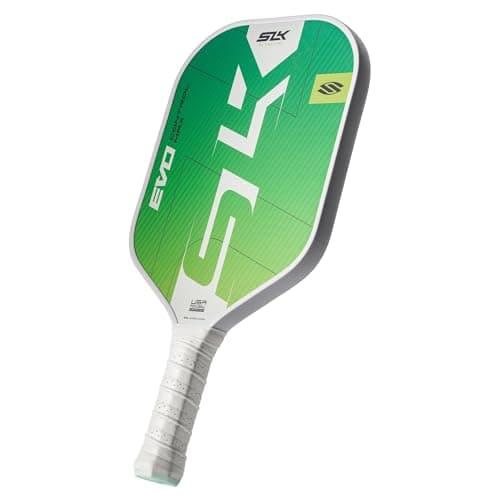
Selkirk publishes the same face, core, core thickness, weight range and grip circumference for both shapes. Only the outline changes, so the outline is the entire comparison.
| Published spec | Evo Control Max | Evo Control XL |
|---|
| Paddle length | 16 in | 16.4 in |
| Paddle width | 7.85 in | 7.4 in |
| Length + width (24 in legal max) | 23.85 in | 23.8 in |
| Handle length | 4.85 in | 5.75 in |
| Face length (length minus handle) | about 11.15 in | about 10.65 in |
| Grip circumference | 4.25 in | 4.25 in |
| Weight range | 7.6 to 8.1 oz | 7.6 to 8.1 oz |
| Core | 16mm Rev-Control polymer honeycomb | 16mm Rev-Control polymer honeycomb |
| Face | T700 CarbonFusion carbon fiber | T700 CarbonFusion carbon fiber |
Two things fall out of that table once you do the subtraction. The first is that the XL is only 0.4 in longer than the Max, but its handle is 0.9 in longer. Length that goes into the handle cannot also be face, so the XL's hitting surface is roughly half an inch shorter than the Max's, as well as 0.45 in narrower. Treat each face as a simple rectangle — which overstates both, since paddle faces are rounded, but keeps the ratio honest — and the Max comes to about 87 square inches against the XL's 79. Call it a tenth less hitting area on the shape that is sold as the bigger paddle.
The second is that neither shape spends its full legal allowance. USA Pickleball caps combined length plus width at 24 in, and both the JOOLA GRAF Edge and the JOOLA Scorpeus sit exactly on that line. The Max leaves 0.15 in unused and the XL 0.2 in. That is not a flaw, but it does mean the Max is not quite the widest face a 16 in paddle can legally have — the JOOLA Scorpeus is, at 8 in even, and that fifteen hundredths is part of why the Scorpeus stays ahead of this paddle on our intermediate list.
One more note on names. Selkirk labels the XL an elongated shape. By the definition we use across this site, 16.4 in falls inside the hybrid band — roughly 16.3 to 16.5 in long, between a true widebody and a full 16.5-plus elongated frame. That is not a contradiction so much as a reminder that shape words are marketing categories, and the numbers are what you are actually buying. Our elongated vs widebody guide covers what each inch of the trade buys and costs.
The handle is the real decision
Strip the marketing away and the choice between these two shapes is a choice between a 4.85 in handle and a 5.75 in handle.
A 4.85 in handle is short. It is shorter than the 5.25 in on the Scorpeus and well short of the 5.5 in on the JOOLA GRAF Edge. For a one-handed player that is good news: every inch not spent on handle is spent on face, and a beginner's contact point wanders enough that face is what they need. For anyone with a two-handed backhand, though, 4.85 in is simply not enough handle — the second hand ends up on the face, or the first hand ends up choked down onto the butt cap. An independent review of the Max published in 2023 and updated this year makes the same point from the court, flagging the handle as too short for two-handed players.
The XL's 5.75 in handle is the longest we have published for any paddle we rank, a quarter inch past the GRAF Edge. It exists to solve exactly that problem, and it does — at the cost of the face area described above. So the rule is simple. Two hands on the backhand: XL. One hand: Max, and take the extra face. Choosing the XL for "reach" without a two-handed stroke buys you four tenths of an inch of paddle and costs you half an inch of face, which is a bad trade for almost everyone this site is written for.
The 16mm core, and what Selkirk is claiming
Both shapes carry a 16mm Rev-Control polymer honeycomb core. Selkirk's description says the thicker core "provides a soft feel for enhanced touch while delivering added power for deep, controlled drives." The first half of that is what a 16mm core does; the second half is the sentence every control paddle's listing includes so as not to sound slow.
What a thick core actually does is absorb more of the ball's energy before returning it, so the ball leaves the face slower and lands shorter for a given swing. That is the mechanism behind a dink that drops instead of floating, and behind a third-shot drop that lands in the kitchen instead of at the opponent's hip. It is also why our tennis elbow ranking puts core thickness first: energy the core absorbs is energy your forearm does not. The cost is free power, which this paddle has less of than a 13mm or 14mm face — we score it a 6 for power and mean it. Our core thickness guide walks through the trade in full.
Selkirk's own skill-level field for both shapes reads "Beginner - Intermediate," which is unusually candid for a brand whose flagship paddles cost more than twice as much, and it matches what the specs say.
One name, three spec sheets: which face are you buying?
This is the part of the review that took the longest to pin down, and it is worth your attention if the face material matters to you.
- May 2023. Selkirk's press release for the EVO 2.0 series describes the EVO Control 2.0 with a G8-Flex Control Carbon Fiber face, a 16mm Rev-Control core, a new SpinFlex spin surface and the EdgeSentry edge guard, in Max and XL shapes at a $100 list price.
- Today, at a specialist retailer. Pickleball Central still lists both shapes as the "Evo Control Max 2.0" and "Evo Control XL 2.0," with the G8-Flex face, and notes the line was designed to replace the earlier Evo Soft.
- Today, on Selkirk's site. The product pages carry no version number at all. The face is now listed as T700 CarbonFusion Carbon Fiber, the construction as a thermoformed UniBody, and the spin surface as SpinFlex+. Selkirk's own EVO 2.0 collection page is empty.
The Amazon listings for both ASINs we link carry the current Selkirk copy — T700 CarbonFusion, SpinFlex+, 16mm Rev-Control core — so the listing is describing the newest revision. What we cannot tell you is which revision is physically in the box a given seller ships, because the model name did not change when the face did, and neither Selkirk nor any retailer we found publishes a way to tell them apart short of the packaging. If you care, buy from a seller who can answer the question, and check the box when it arrives.
For most readers this matters less than it sounds. The core, thickness, shape, weight range, grip and warranty are identical across every published sheet. The face material is what changed, and a face is a face: both are carbon fiber over a 16mm polymer core, and the difference between two carbon weaves is not something a beginner's game can detect. We flag it because a spec sheet that quietly changes under a fixed name is the kind of thing a review should tell you, not because it should change your decision.
Weight: Selkirk publishes a range, and the range is honest
Selkirk lists the weight of both shapes as 7.6 to 8.1 oz, and the retailer spec sheet puts the average at 7.8 oz. A half-ounce range is a manufacturer telling the truth about how paddles come off a line, and it is more useful than the single tidy number most listings give. It also means two Evo Controls bought a month apart can feel slightly different in the hand, and neither is defective.
Amazon's own listing data records the item weight for both ASINs at 0.51 lb, which works out to about 8.1 oz — the top of Selkirk's range. Item-weight fields on Amazon are frequently shipping weights rather than playing weights, so we do not put much on that number, but it is a reason not to assume you are getting a 7.6 oz paddle. At 7.8 oz on average the paddle sits at the light end of the mid-weight band we recommend to most players; our paddle weight guide explains what that half ounce either way does to your arm and your drives.
Grip: 4.25 in, one size, no small option
Both shapes come in a single grip circumference of 4.25 in, which the retailer sheet labels medium. That suits the average adult hand, and it is the size we would steer a tennis-elbow reader toward if they had to choose between medium and large. But there is no small version. Where JOOLA sells the GRAF Edge in 4-1/8 in and the Agassi Edge in 4-1/4 in, Selkirk offers this paddle at 4-1/4 in only.
That matters because a grip can be built up with an overgrip and never shrunk. If our 60-second ruler test puts your hand at 4 to 4-1/8 in, this paddle will be a little too big to hold loosely, and a handle you have to squeeze is where forearm strain begins. For smaller hands the GRAF Edge remains the better fit at this price — and grip circumference is the first thing our best paddles for women list ranks on, for exactly this reason.
Warranty, approval, and where it is made
Three facts that are usually buried, all of them from Selkirk's own pages.
Warranty. SLK paddles are guaranteed against workmanship and manufacturing defects for one year from purchase. The Amazon listing's warranty field reads the same — a 1-year limited warranty — which we note because it is not always so: the Scorpeus listing contradicts itself on this exact point, and this one does not. Normal wear, abuse and ground damage are excluded, as with every paddle warranty we have read.
Approval. Selkirk states the paddle is USA Pickleball approved, and the mark appears on the paddle face in its product photography. As we say on every page, approval attaches to a specific model and version, brands reuse names across revisions — this paddle being a live example — so check the live approved list by exact model before entering a sanctioned event.
Origin. Selkirk's product page states "Designed and Quality Controlled in the USA" and lists the country of origin as China. Selkirk is an Idaho company; SLK is the sub-brand where it competes on price, and Selkirk's own listing says it is built abroad. If a US-made paddle is part of why you were drawn to the brand, this is not that paddle — the brands guide explains where the line falls.
Where it sits: GRAF Edge below, Scorpeus above
Readers of our beginner and intermediate lists usually end up choosing between this paddle and two other 16mm carbon paddles from tier-one brands: the GRAF Edge below it and the Scorpeus above it. The published numbers make the choice clearer than the prices do.
| Published spec | JOOLA GRAF Edge | Selkirk Evo Control Max | JOOLA Scorpeus |
|---|
| Length x width | 16.5 x 7.5 in | 16 x 7.85 in | 16 x 8 in |
| Handle length | 5.5 in | 4.85 in | 5.25 in |
| Core | 16mm polypropylene | 16mm polymer honeycomb | 16mm, thermoformed |
| Price band | under $50 | $50 to $100, nearer the top | around $100 |
Read across and the pattern is a staircase. The GRAF Edge is the cheapest way into a 16mm carbon paddle and has the long handle, but the narrowest face and the smallest grip. The Scorpeus has the widest legal face, a mid-length handle and the current PBCoR certification, at the top of the bracket. The Evo Control sits between them on price and, in most respects, on spec: wider than the GRAF Edge, narrower than the Scorpeus, the shortest handle of the three, and the only one of the three from a brand whose reputation was built on paddles costing twice as much.
That last point is what you are paying the difference over the GRAF Edge for, and it is a legitimate thing to pay for — Selkirk's warranty handling and resale value are the best in the category, as we say on the brands guide. It is not a spec-sheet advantage, and we do not pretend it is. If the extra money is real to you, the GRAF Edge is the honest recommendation; if the brand is part of what you want, this is the cheapest Selkirk we would hand a new player.
Who should buy it
- Players whose game is being lost on unforced errors, which is every player below advanced. A 16mm core that mutes the ball is the fastest equipment fix for that, and it is why this paddle tops our control vs power comparison.
- Anyone managing a sore elbow or forearm. The thick core, medium grip and moderate weight are the three things our tennis-elbow ranking weighs, in that order, and this paddle scores on all three — with the usual caveat that a paddle is not a treatment.
- Improving players who want a Selkirk without paying flagship money for one, and who would rather have the warranty department than an extra weave of carbon.
- Two-handed backhand players — in the XL, and only in the XL. The Max cannot fit a second hand.
Who should not
- Anyone who wants power from the paddle rather than from their swing. This is a control paddle by design and a 6 for power by our rubric. The power end of control vs power is where to look.
- Small hands. There is no 4-1/8 in option, and an overgrip only makes a grip bigger. The GRAF Edge is the better fit under 4-1/8 in.
- One-handed players considering the XL for reach. Four tenths of an inch of length is not reach; half an inch less face is a real loss. Buy the Max.
- Buyers who specifically want a US-made paddle. SLK is Selkirk's imported line, and Selkirk says so.
- Complete beginners on a tight budget. At this price it is a very good first paddle, but a fiberglass paddle at a third of the money teaches the same game, and we would rather you found out whether the sport sticks first. Start at best paddles for beginners or how much to spend on a first paddle.
What we did not test
We have not played with either shape, weighed one, measured a face, or compared the G8-Flex and T700 faces against each other. Everything above is read from Selkirk's published specifications for both shapes, Selkirk's May 2023 press release, the spec sheets Pickleball Central publishes for each shape, and the Amazon listing data for both ASINs, with the arithmetic shown so you can check it. Where we describe how a 16mm core or a narrower face behaves, that is category behavior, flagged as inference rather than measurement. Where we quote an outside reviewer, it is one published opinion and we say whose. Our methodology explains the approach and the scoring rubric, including the fact that we do not run a lab.
The verdict
Still our first pick for control and for sore elbows, and the spec sheet backs the ranking: a 16mm core, a carbon face, a sane weight range and a medium grip from a brand that stands behind its paddles, at a price a step below the Scorpeus. The Max is the version for almost everyone reading this site. It gives you the most face for the money and the outline a beginner's contact point needs.
Buy the XL only if you hit a two-handed backhand, and buy it for the handle, not the reach. Go in knowing there is no small grip, that the paddle is imported, and that the face material has changed under the same name — and that none of those three things changes what the paddle is for.