03The buyer's guide
The face is at the legal maximum, and that is the point
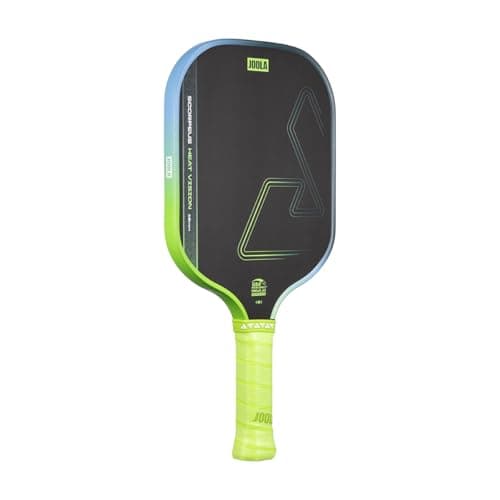
JOOLA publishes the dimensions as 16 in long by 8 in wide. Put those together and you get 24 inches, which happens to be exactly the ceiling USA Pickleball sets: combined length plus width may not exceed 24 in, with length capped at 17.
That is not a coincidence, it is the design. Every extra inch of length has to come out of width, so a paddle sitting at 16 x 8 has spent its entire allowance on being wide. Eight inches is about as broad as a pickleball face gets, and face width is what forgiveness actually is — the margin you have when contact lands off-center. Where an elongated paddle trades that margin for reach, this one refuses the trade. Our elongated vs widebody guide covers the full trade-off.
JOOLA describes the shape as suiting "defensive players seeking quick reactions in fast kitchen exchanges," which is consistent with the numbers. A wide face and a short swing are what hands battles at the net reward.
The handle is the spec nobody mentions
Grip length is listed at 5.25 in. On an elongated paddle that would be unremarkable. On a widebody it is unusual, and it has a consequence worth understanding before you buy.
Total length is 16 in, so a 5.25 in handle leaves roughly 10.75 in of face. A longer handle normally costs you face length, and here it does — this is a wide, slightly short face rather than a wide, long one. What you get back is room for a two-handed backhand, which most widebody paddles cannot accommodate because the handle runs out before your second hand does.
So if you came from tennis with a two-handed backhand and have been told you need an elongated paddle to keep it, that is not quite true, and this is the counter-example. If you play one-handed, the long handle costs you a little face length you would probably rather have had.
7.8 oz: the light end of mid-weight
The listed weight is 7.8 oz, which sits right at the bottom edge of the mid-weight band we recommend to most players (roughly 7.8 to 8.4 oz). In practice that means fast hands and a paddle that does not tire your arm over three hours, at the cost of plow-through — the mass that carries a drive through the ball without you swinging harder.
This is coherent with everything else about the paddle. A light, maximum-width, control-cored paddle is built for the kitchen, not the baseline. If your game is driving from the back, you will find yourself supplying pace the paddle is not giving you. Our paddle weight guide works through the trade-off, and it is also good news for anyone with a sensitive elbow, for whom a lighter paddle is usually the right call regardless of style.
16mm core and a textured carbon face
These two specs are why the paddle belongs in the improver tier rather than the beginner one.
A 16mm core absorbs more of the ball's energy than the thinner cores that entry paddles use, so the ball leaves slower and lands shorter. That is the difference between a dink that drops into the kitchen and one that floats up to be attacked. It also means the paddle gives you less free power, which is the trade you are consciously making — the full reasoning is in our core thickness guide.
The textured carbon fiber surface is what produces spin. Spin comes from the ball dwelling fractionally longer on a rough surface while your swing brushes up the back of it, and a slick fiberglass face cannot do that. It is worth being honest about the limit: a textured carbon surface is a consumable. The texture polishes smooth with use and the spin fades, and no manufacturer publishes a wear rate. See graphite vs fiberglass for how the face materials differ, and when to replace your paddle for the signs a face has gone.
Thermoformed, and what the SK film is doing
JOOLA lists the paddle as thermoformed and describes a bonded SK film layer between the honeycomb core and the carbon face, "to help reduce vibration and provide better response."
Thermoforming is a construction method rather than a material: the shell is heat-pressed as one piece instead of glued together from separate parts, which makes the paddle stiffer and more consistent across the face. It is frequently confused with the face material in listings, and the two are unrelated.
The vibration-damping claim is the sort of thing we cannot verify and will not pretend to. What we can say is that a stiffer, thermoformed paddle transmits more shock than a flexible one by default, so a damping layer is a sensible thing for JOOLA to have included rather than a gimmick. Whether you feel it is not something a spec sheet can answer.
PBCoR certified — which now means more than it used to
The listing states the paddle is USAP PBCoR .43 certified for tournament play. That is worth more than a generic approval badge as of the current rules.
PBCoR is the power test USA Pickleball added to certification: it caps how much energy the face returns to the ball at a coefficient of .43. It is the newest part of the standard and it has teeth — several well-known premium paddles lost their place in sanctioned play when it came in. A paddle that carries the PBCoR mark today is one that passed the strictest version of the test rather than one that was approved under the older, looser standard.
The usual caveat still applies, and we make it at length on USA Pickleball approved paddles, explained: certification is a compliance check, not a quality rating. It tells you the paddle is legal. It does not tell you it is good. Approval also attaches to a specific model and version, and brands reuse names across generations, so check the live list by exact model if you are entering a sanctioned event.
The warranty claim contradicts itself
One thing to go in with your eyes open about. JOOLA's feature copy on this listing promotes a "12 month warranty" unlocked by registering the paddle through the embedded NFC chip. The listing's own warranty field, meanwhile, reads "180 Day Limited Warranty."
We do not know which governs, and we are not going to guess in the brand's favor. The most likely reading is that the shorter term is the default and the longer one is conditional on registering, but that is an inference and we are labeling it as one. If the warranty length matters to your purchase, confirm it with JOOLA before you buy rather than after — and if you buy it, register the paddle, because the upside case costs you nothing but a phone tap.
The NFC chip itself is a registration and app-content feature. It changes nothing about how the paddle plays and should not move your decision either way.
Who should buy it
- Improving players who want spin and a controllable soft game without giving up the wide, forgiving face they learned on.
- Doubles players who live at the kitchen line and win points in hands battles.
- Anyone with a two-handed backhand who does not want to move to an elongated shape to keep it.
- Players who might enter sanctioned events and want the current, strictest certification rather than a legacy approval.
Who should not
- Baseline drivers and singles players. A light, wide, 16mm control paddle is the wrong tool for a game built on pace — look at the power end of control vs power instead.
- Anyone who wants reach. Every inch this paddle spends on width is an inch it does not have in length, by rule.
- Complete beginners. At around a hundred dollars this is a second paddle, and the control core can feel dead before you have a stroke to put behind it. Start at best paddles for beginners, or read paddles for beginners moving to intermediate if you would rather buy once.
What we did not test
We have not played with this paddle, weighed one, measured the face texture or its wear rate, or assessed whether the SK film damping is perceptible. Everything above is read from JOOLA's published specifications for this listing, with the dimensional arithmetic shown so you can check it, and with category behavior flagged as inference rather than measurement. Where the listing contradicts itself on the warranty we have reported the contradiction rather than resolving it. Our methodology explains the approach and the scoring rubric, including the fact that we do not run a lab.
The verdict
Still our first pick for the improver tier, and the numbers support the recommendation rather than merely decorating it. A face at the legal maximum width, a 16mm core and a textured carbon surface is the combination that lets someone keep the forgiveness they need while gaining the spin and touch they are starting to want. The long handle is a genuine bonus for two-handed players and a small cost for everyone else.
Buy it understanding what it is not: it is not a power paddle, and at 7.8 oz on a wide face it never will be. Go in knowing the face texture is a consumable, and get the warranty term confirmed before you commit.