03The buyer's guide
The real question: one paddle or two?
Strip away the marketing and there are only two strategies available to you, and they cost roughly the same amount of money.
Buy twice.Start on something forgiving in the $40–$80 bracket, play for a season, learn what you actually dislike about it, then buy a second paddle with real preferences. Total outlay across both is usually somewhere between $120 and $180.
Buy once.Skip the disposable first paddle and go straight to a 16mm carbon paddle in the $50–$100 bracket that a beginner can still hit with. Total outlay: whatever that one paddle costs.
Buying once is cheaper. It is not automatically better, and the reason is not price — it is that the second strategy asks you to make a decision before you have the information that would let you make it well. A season of play teaches you whether you want reach or forgiveness, whether your elbow tolerates a mid-weight paddle, and whether you are a driver or a dinker. Buying once means guessing at those.
What makes the guess survivable is that the properties which age worst on a cheap paddle are the ones you can identify without playing a single game.
What a paddle needs to still be right in a year
Four properties decide whether a paddle gets outgrown. Get these right and the paddle stops being the thing holding you back; get them wrong and you will be shopping again by spring.
1. A 16mm core — the single most important line on the spec sheet
Most cheap paddles use a thinner core, commonly around 13mm, because thin cores are poppy: the ball springs off the face and a tentative beginner swing still produces a shot that clears the net. That feels like help for about a month. Then you start trying to play the soft game, and the same springiness that rescued your early drives starts floating your dinks up into your opponent's strike zone.
A 16mm core absorbs energy instead of returning it. You give up some free power and you get back the ability to drop a ball short on purpose. Nearly every paddle sold to improving players is 16mm for exactly this reason, and it is the property most likely to make a beginner paddle feel wrong at 3.5. Our core thickness guide works through the 14mm versus 16mm trade-off properly.
2. A textured or raw carbon face — for spin you cannot use yet
A fiberglass face is a perfectly good learning surface: forgiving, lively, cheap. What it cannot do is grip the ball. Spin comes from the ball dwelling on a rough surface for a fraction longer while your swing brushes up the back of it, and fiberglass is too slick for much of that.
You will not hit meaningful topspin in your first month, which is why our beginner page treats carbon as a nice-to-have. But a topspin drive and a roll volley are the shots that separate 3.0 from 3.5, and if your paddle cannot produce them you will replace it precisely when you start needing them. On a buy-once paddle, a textured or raw carbon face is not a luxury — it is the whole point. See graphite vs fiberglass for how the materials differ in the hand.
3. A shape you can hit with today, not one you will grow into
This is where buy-once plans usually fail. It is tempting to buy the elongated paddle the good players use, on the theory that you will grow into the smaller sweet spot. In practice you spend a season mis-hitting, get discouraged, and blame yourself rather than the paddle.
A standard (widebody) shape has the largest, most forgiving face, and there is no rule that says you must abandon it as you improve — plenty of strong players never do. Elongated paddles add reach and leverage at the cost of forgiveness, which is a trade you should make deliberately, later, when you know you want it. Elongated vs widebody covers the choice in detail. The short version for this page: if you are buying one paddle to cover both ends of your first year, bias toward the forgiving shape.
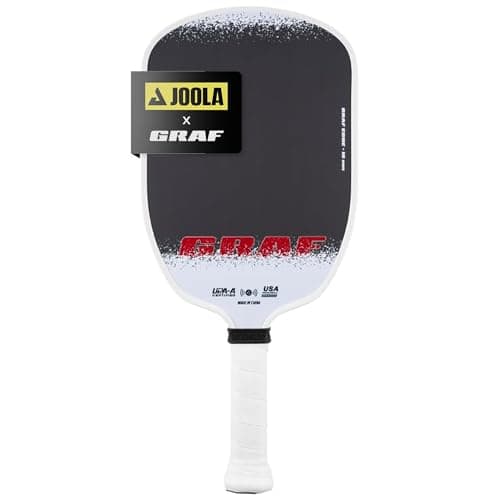
In fairness to our own top pick, this is the one criterion the GRAF Edge does not fully satisfy. JOOLA publishes it at 16.5 x 7.5 in, which is mildly elongated rather than a full widebody — half an inch narrower than the classic 16 x 8, not two inches. We still rank it first because the gap is small enough that most players moving up will never feel it, and because nothing else at the price offers the other three properties together. If you are brand new rather than improving, that half inch is a reason to start on a widebody instead. Our GRAF Edge review shows the arithmetic.
4. USA Pickleball approval — free insurance
Approval certifies that a paddle's dimensions, surface and construction fall inside the official equipment standards. It is not a quality rating, and we say so at length in USA Pickleball approved paddles, explained. It matters here for one narrow reason: a buy-once paddle is meant to last into the phase where you might join a league or enter a local tournament, and unapproved equipment is not legal in sanctioned play. It costs nothing to prefer an approved paddle, so prefer one.
What you are allowed to skip
A buy-once paddle does not need to be an expensive paddle, and the things that push a paddle past about $130 are mostly things a developing player cannot use.
- Thermoformed construction and foam-injected walls. Genuinely stiffer and more powerful, and genuinely harder to control. Welcome at 4.0; punishing at 2.5.
- Pro-signature branding. You are paying for an endorsement and, usually, for a paddle tuned around an advanced stroke.
- Extra-long handles.Useful if you hit a two-handed backhand. If you don't, the length comes out of your face area.
The corollary is the good news: the specification that actually protects your purchase — 16mm core, textured carbon face, USA Pickleball approved — is available for around fifty dollars. That is the entire argument for the GRAF Edge sitting at the top of this page. Its one caveat is shape: JOOLA publishes it at 16.5 x 7.5 in, which is a mildly elongated frame rather than the widebody most beginners learn on. We work through what that costs you in our JOOLA GRAF Edge review.
When buying once is the wrong call
We would rather lose the sale than have you buy the wrong thing, so here is the honest counter-case. Buy the cheap paddle first if any of these are true.
- You are not certain you will keep playing. Plenty of people who buy a first paddle play a handful of times and stop. If that might be you, spend the smallest amount that still gets you a decent paddle and be pleased if you are wrong.
- You have never held a paddle.Two of the picks below say so in their own "skip this if" line. A control-tuned 16mm paddle asks you to supply pace that a brand-new player has not developed, and it can feel dead and discouraging in week one.
- You have an arm history. If tennis elbow or wrist trouble is in your past, weight and grip size matter more than face material, and those are things you learn by playing. Start light, read our paddle weight guide, and buy the good paddle once you know what your arm tolerates.
- You are borrowing paddles now and enjoying it.Keep borrowing. The best paddle research available to you is hitting with other people's.
If two or more of those describe you, close this page and start at the beginner roundup instead. It is the cheaper, lower-regret path and it is the one we recommend to most first-time buyers.
How we chose these five
The picks are not the five best paddles on this site — they are the five that make the decision concrete. Three are built to be kept and two are built to be outgrown cheaply.
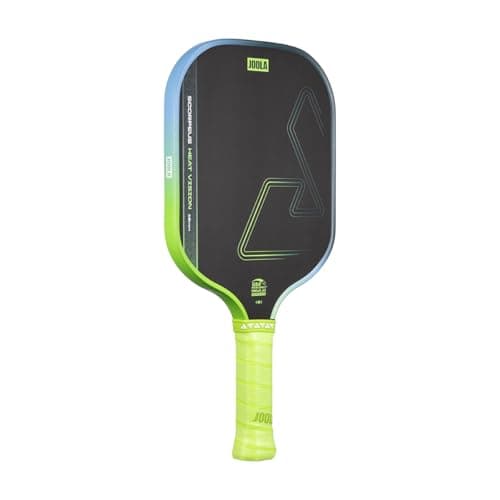
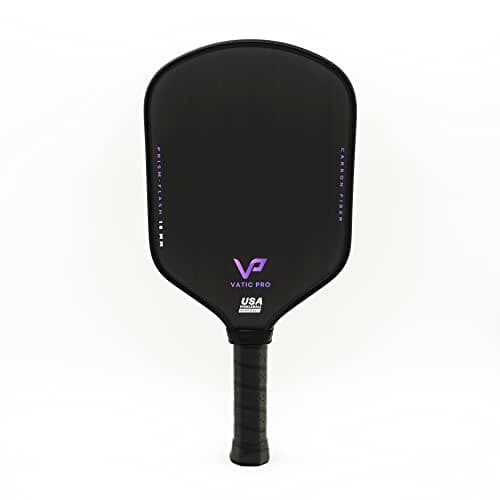
The JOOLA GRAF Edge 16mmis the answer to the page's actual question: carbon face, 16mm core, major brand, priced like a beginner paddle. Read the specs closely and it is mildly elongated at 16.5 x 7.5 in rather than a widebody, which is the one thing about it a beginner should go in knowing — our GRAF Edge review spells out the trade. The JOOLA Scorpeus Heat Vision is the same idea with a wider, properly textured face and more headroom, for close to twice the money. The Vatic Pro Prism Flash is the most upgrade-proof paddle here and the least forgiving — it is elongated and thermoformed, so it suits someone who will practice deliberately rather than someone still finding their contact point.
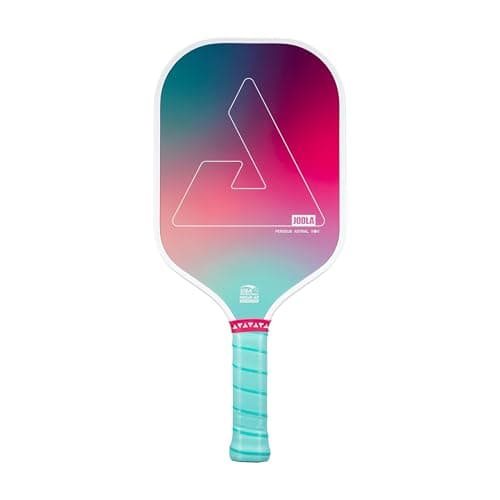
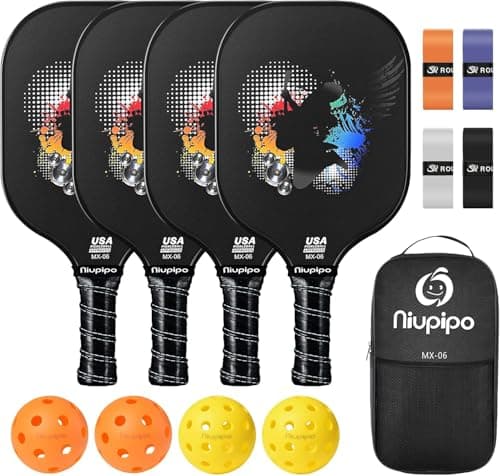
On the other side, the JOOLA Astral Perseus is our standing recommendation for a genuine first paddle and the one to buy if you are unsure about any of this, and the niupipo Pro Graphiteis the least expensive pick on the page — the sensible choice when the honest answer is "I don't know yet."
Three of the five are JOOLA, which is less brand preference than an artifact of who currently sells a 16mm carbon paddle at a beginner price. Every pick is a paddle we verified as currently purchasable, every price shown is live from Amazon, and every one carries an honest "skip this if" line. Our methodology explains how the scores are formed and what we do and do not test.