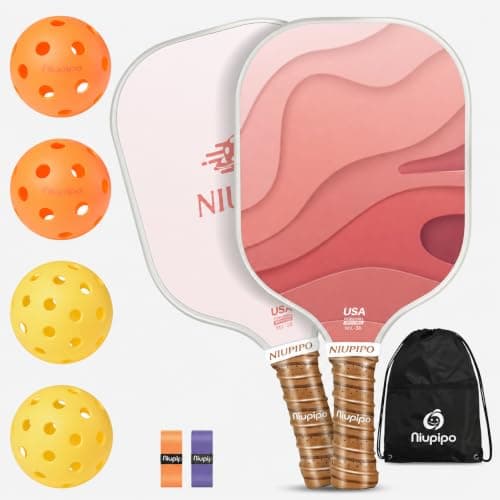
If you want the short version: buy something light with a wide face and a cushioned grip, and ignore every claim about power. The niupipo Lightweight is the least demanding paddle on this list and the one we would hand to someone whose shoulder is the reason they are reading this page.
Pickleball's biggest demographic is players over fifty, and almost none of the paddle marketing is written for them. The specs that sell paddles — thermoformed carbon, elongated shapes, "maximum power" — are the specs that make a paddle harder on an older arm, not easier. What actually matters after fifty is the same thing that matters on day one, only more so: a paddle that is light enough to swing for two hours, forgiving enough that a slightly late hit still goes over the net, and comfortable enough in the hand that you are not squeezing it.
Nothing on this page is medical advice, and we are not going to pretend a paddle treats anything. What a paddle can do is change how much load your arm takes on every one of the few hundred swings in a session, and that is a real, measurable difference in equipment, not a health claim. If a sore elbow specifically is what brought you here rather than general comfort, our paddles for tennis elbow list ranks the same shortlist differently — on core thickness and grip pressure rather than on weight.
03The buyer's guide
What actually matters after fifty
1. Weight is the whole ball game
Every other spec is a rounding error next to weight. A paddle at 7.3 ounces and a paddle at 8.5 ounces are separated by about a third of a pound in the hand, but you swing it somewhere between three and six hundred times in a session. That difference accumulates in the shoulder, the elbow and the wrist in exactly the order you would expect.
For most players over fifty, lightweight — under roughly 7.8 ounces — is the right starting point. Go up into mid-weight only if you find yourself having to swing hard to get the ball deep, which is the honest trade: a lighter paddle asks you to supply more of the pace. Our paddle weight guide has the full breakdown of where the lines sit.
2. A wide face means fewer jarring mishits
A mishit does not just lose the point — it sends a shock up the arm. A wide-body paddle has the largest sweet spot available, so more of your contact lands where the paddle is designed to absorb it. An elongated paddle trades face width for reach, and that trade gets worse as reaction time shortens. Start wide. We compare the two shapes properly in elongated vs widebody.
3. Core thickness: thicker is softer
A thicker core — 16mm rather than 14mm — flexes more on impact and transmits less shock to the hand. It also has less pop, which is a fair trade if comfort is the priority. Full detail in our core thickness guide.
This is the one criterion our top pick loses on, and we are not going to hide it. USA Pickleball's certification record for the niupipo Lightweight publishes a 9.8mm core— the thinnest of any paddle we rank, and a figure neither its Amazon listing nor niupipo's own page states. It still leads this list because weight is the criterion that matters most here, but it is a paddle for a tired shoulder rather than a jarred elbow. We lay the whole thing out in our niupipo Lightweight review, which also explains why the box holds two paddles rather than one.
4. Grip size and grip comfort
A grip that is too large forces you to squeeze, and squeezing is the fastest route to a sore forearm. When you are between sizes, take the smaller one — you can build a handle up with an overgrip, but you cannot shrink one. If your hands are dry or arthritic, a cushioned replacement grip is a cheap and genuinely effective upgrade; see our overgrip guide. Measure yours with the grip size guide. If arthritis rather than age is the reason you are on this page, the ranking changes — grip comes first and core thickness second, which we work through in the best paddles for arthritic hands.
5. Do not overspend
The premium tier is sold on power and spin — the two things a comfort-first player is deliberately not chasing. Everything on this page is in the sensible range, and the top pick is among the cheapest. Spending more here would buy you a paddle that is harder to use.
What about paddle noise and vibration?
Two related but separate things. Vibration is what reaches your hand, and it is reduced by a thicker polymer core, a cushioned grip and clean contact. Some players add a dampening overgrip or a heavier grip for the same reason. Noise is what the neighbors hear, and it is mostly a function of the ball and the court, not your paddle — the "quiet paddle" category is largely marketing, and USA Pickleball has only recently begun formally addressing acoustic testing. We would not buy a paddle for quietness alone.
The one accessory worth adding
If your elbow has ever complained, a forearm strap costs about as much as a sleeve of balls and is worth trying before you spend more on paddles — see our elbow support roundup. And if you are playing on outdoor courts, footwear matters at least as much as the paddle for joint load: the best pickleball shoes covers that.