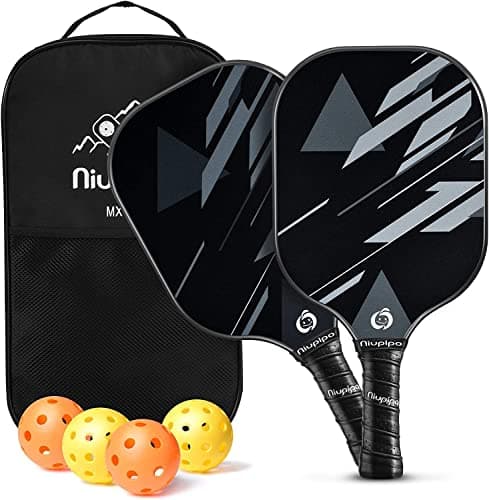
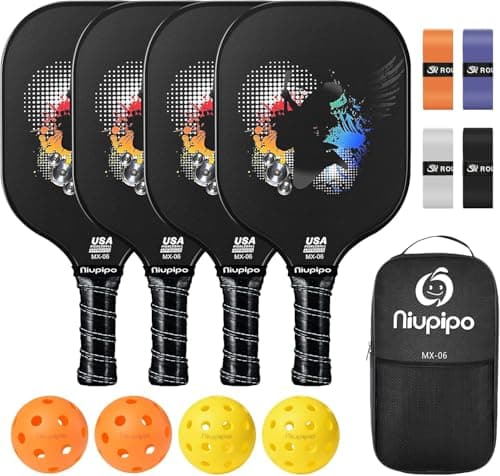
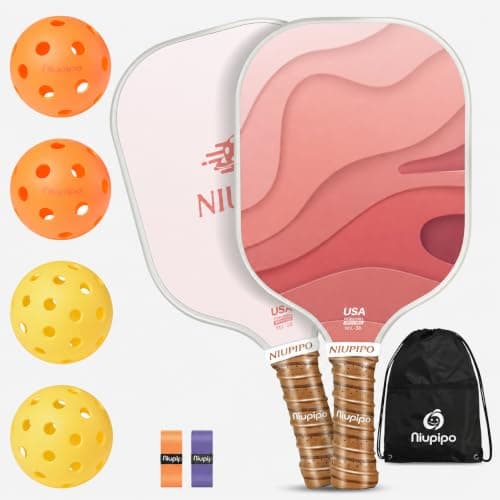
Buy the MX-38 set. It is the only niupipo we can match to a record on USA Pickleball's own approved list, and nothing niupipo sells is meaningfully cheaper. The niupipo Pickleball Paddle Set is the alternative if you want a widebody fiberglass paddle instead of a round one, and the Pro Graphite is the most expensive of the three and the hardest to verify. Live prices for all three are below.
That ranking is going to look wrong, so here is the reason up front. Every niupipo listing we can buy says USAPA approved in its title. USA Pickleball's approved paddle list is a public database, and when you search it for niupipo you find two records: Explorer Pro, model N-01 Pro, added May 15, 2021, and MX-38, added July 2, 2023. Neither of those names is "Pro Graphite", and neither matches the set. Only one model name on the official list is also a model name you can put in a basket, and that is the MX-38 — which also sits in the cheapest tier niupipo sells, within a dollar or two of its own entry-level set.
None of this makes the other two paddles fakes, and we are not accusing anyone of anything. Approval records are filed per model, brands rename models constantly, and a paddle can be a perfectly good paddle without a certificate. But if you are buying partly because the title says "approved", you should know which one of these you can actually check. The detail is in the approval question.
Our standing disclosure: we have not played with any of these paddles. We do not run a lab and we have not hit a ball with one. Every figure below is read off the live Amazon listing our buy button points at, off niupipo's own published pages, or off USA Pickleball's certification records, with each source named in Sources. Where niupipo publishes nothing — and on these paddles that is most of the numbers you would want — we say so instead of inventing one. The scores are judgments from that research against our published rubric, weighted for a beginner.
03The buyer's guide
The approval question, and why it inverts the price order
USA Pickleball approval is the one claim in this price bracket that can be checked by a stranger. It is not a quality rating — it says a paddle's surface roughness, deflection and dimensions were submitted and passed, nothing more, which is the point our USA Pickleball approved guide makes at length. What it does mean is that the paddle is legal in sanctioned play, so a club ladder in six months does not force you to buy again.
niupipo leans on it hard. The brand keeps a page titled "USAPA Approved Paddles" which claims every niupipo paddle is approved — and then, further down the same page, says that only its professional-series paddles qualify for sanctioned tournaments. Those two statements cannot both be the whole truth, and the brand has published them next to each other.
So we went to the list itself. The two niupipo records we could find read like this:
| Official record | Model no. | Added | What the record says |
|---|
| Niupipo MX-38 | — | 07/02/2023 | Pass. Core depth 9.8mm, polypropylene honeycomb, 6mm cell, glass fiber with a matte surface, round. |
| Niupipo Explorer Pro | N-01 Pro | 05/15/2021 | Pass. Depth 12.8mm, 8mm cell, round, UV print finish, two unlabeled material fields reading "pp" and "carbon fiber". |
The MX-38 record matches a paddle you can buy today, by name and by construction — the listing sells a fiberglass-faced round paddle and the record describes a glass-fiber round paddle. That is a complete, checkable chain from a buy button to a certificate, and it is the only one of the three on this page that has one.
The Explorer Pro record is more interesting than useful. "Explorer Pro" is not the name on any niupipo listing we can point a buy button at, and its two material fields are not labeled, so the database itself does not tell you which of "pp" and "carbon fiber" is the core and which is the face. If the paddle sold as "Pro Graphite" is the Explorer Pro under a different retail name, that is plausible and we cannot prove it. The honest statement is the narrow one: the Pro Graphite listing claims approval and we could not find a record under that name.
One more thing that is easy to miss. Certification is not permanent — USA Pickleball decertifies equipment when it stops meeting the conditions it was approved under, and decertification applies to sanctioned play rather than to the paddle in your garage. If you are buying specifically to be tournament-legal, check the record on the day you buy rather than trusting a page like this one, including ours.
The four criteria, in order
Three listings is a small field, so this comes down to four questions rather than a spec table. They are in priority order for someone buying their first paddle.
1. Can you verify the approval claim?
Covered above, and it is first because it is the only criterion here where a reader can check our work. If the answer matters to you, the MX-38 is the paddle. If you are buying a paddle to hit with friends in a park and will never enter anything, this criterion is worth nothing to you and you should skip to the next one.
2. How many paddles does the price actually buy?
This is the niupipo trap, and it cuts in the buyer's favor as often as against. Two of these three listings are boxes of two paddles, not one:
- MX-38: niupipo's own product page lists the box as one bag, two paddles, two outdoor balls, two indoor balls and two grip tapes. The price you see is for all of it.
- niupipo Pickleball Paddle Set: two paddles, four balls and a bag, which the listing title says plainly.
- Pro Graphite: the title reads "Pro Graphite Pickleball Paddle/Paddles Set" and "Portable Bag/Paddle Cover". Those slashes are doing a lot of work. We cannot tell from the title whether the price in front of you is one paddle or two, and that is a fair thing to hold against a listing rather than against us.
The practical consequence: on a per-paddle basis the two cheap sets are dramatically cheaper than the Pro Graphite, not slightly cheaper. If you are kitting out two people, that is the whole decision, and our starter set vs buying separately guide works through the arithmetic for every kit we cover. Always read what is in the box before you compare two prices.
3. Core thickness, and what a thin core does to your arm
Paddle cores are honeycomb polymer and thickness decides feel: thicker flexes more and holds the ball a fraction longer, which reads as touch; thinner is stiffer, poppier and sends more of the impact into your hand. Most of the market sits at 16mm for control and 13-14mm for power, as our core thickness guide sets out.
niupipo sits below all of that. The official MX-38 record gives a core depth of 9.8mm, which is the thinnest core on any paddle we rank, and the Explorer Pro record gives 12.8mm. For the Pro Graphite and the set, no core thickness is published anywhere we could find. A 9.8mm core is not a defect — it is cheap to make and it gives you easy pop without a big swing, which is genuinely helpful when you are learning. But it is the wrong tool if impact shock is what hurts you, and that is the single most important sentence on this page for an older player. If your elbow or wrist is the constraint, go to paddles for tennis elbow or paddles for arthritic hands instead and spend more.
4. Fiberglass or graphite face
Two of these are fiberglass and one is graphite, and the difference is real but smaller than the price gap suggests. Fiberglass flexes more and gives you free pop; graphite is stiffer and returns less of its own spring, which reads as slightly more control and more honest feedback about where on the face you made contact. Our graphite vs fiberglass comparison covers it properly.
What you are not getting at this price, in any of the three, is the raw textured carbon and thermoformed construction that the premium end sells — see thermoformed paddles for what that actually adds. A graphite face on a sub-10mm core is still a budget paddle with a better face, not a mid-tier paddle in disguise.
The three, ranked
1. MX-38 set — the only one you can check, at the cheapest money
Rank 1 on verifiability and value together. It is the niupipo whose name appears on USA Pickleball's list, it has been on that list since July 2023, and the record's glass-fiber round description matches the paddle the listing sells, at a price that tracks the brand's entry-level set to within a couple of dollars — so the record costs you nothing. The box holds two paddles, four balls, two grip tapes and a bag, so the sticker price kits out two people. It is light — niupipo publishes 7.6-7.8 oz and 15.6 x 7.79 in — which is why it is our pick for a shoulder or forearm that tires early.
The honest cons, and there are two that matter. A light paddle gets pushed around at the net by a hard-hit ball, so you will feel under-gunned in a fast exchange. And the 9.8mm core on the certification record is the thinnest we rank: more pop, and more of every impact arriving at your hand. Our full niupipo MX-38 review works through both.
2. niupipo Pickleball Paddle Set — the widebody alternative at the same money
Nearly the same price as the MX-38 and a different paddle: a widebody fiberglass face over a polypropylene honeycomb core, two paddles, four balls — two indoor, two outdoor — and a bag. Two balls of each type is a genuinely thoughtful inclusion for someone who does not yet know which they will be playing with; our indoor vs outdoor ball guide explains why the two are not interchangeable.
The cons are the approval wording and the specs. The title says "USAPA Approved" with no qualifier, and we could not find a record matching this set; our longer niupipo set review establishes that niupipo elsewhere describes these as USAPA standard size, which is a dimensional claim rather than a certification, and that the brand keeps a separate approved collection this set is not in. The paddle figures also only exist on third-party listings and those listings disagree with each other. Good value, weak paperwork.
3. Pro Graphite — the most expensive niupipo, and the least verifiable
Ranked third, and the ranking is about what we can confirm rather than about how it plays. It is the only graphite face in the range, the face material is a real upgrade over fiberglass, and our niupipo Pro Graphite review still recommends it as a low-risk first paddle. It is also roughly double the price of the other two listings while the listing title does not make clear how many paddles that buys, publishes no core thickness, no weight and no dimensions, and claims an approval we could not match to a record. We are revising our position on the approval line in that review rather than leaving two pages on this site saying different things: the claim is the listing's, not USA Pickleball's, and we should have said so the first time.
If what you want is a graphite face from a budget brand, this is the one niupipo sells and it is a reasonable buy at the price. If what you want is the least you can spend on a competent paddle, buy the MX-38 and spend the difference on balls.
What niupipo does not publish — and the grip number to ignore
Across these three listings there is no published paddle weight for two of the three, no core thickness for two of the three, and no dimensions for the Pro Graphite at all. That is normal at this price rather than a niupipo failing; almost nobody in the budget bracket publishes a full spec sheet.
One figure is worse than missing, though, and it is worth a paragraph. The Pro Graphite title advertises a "Cushion 4.72In Grip". A pickleball grip has two measurements that could be quoted in inches: circumference, which is the one that matters and which runs roughly 4 to 4.5 in across the whole market, and handle length, which runs roughly 4.5 to 5.5 in. At 4.72 in, the number is implausible as a circumference and unremarkable as a handle length, and the listing does not say which it is. The set has the same problem in a different form: its grip is given as "4.57 inch" on one listing and "small" on another, and those two cannot both describe a circumference.
We are not going to guess. Treat niupipo's grip figures as unusable, assume the handle runs small — which is what owners of the Pro Graphite consistently report — and plan on adding an overgrip if your hands are large. An overgrip adds roughly 1/16 in of circumference per wrap, costs very little, and is the standard fix; our grip size guide has the ruler test, and best overgrips ranks the wraps. Budget for one with any of these paddles.
Which one, by player
- Your first paddle, spending as little as possible: MX-38 set. As cheap as anything niupipo sells, checkable, and it comes with balls so you can play the day it arrives.
- Getting two people playing: either of the two sets. Both are two paddles plus balls plus a bag at close to the same money; pick the MX-38 if you want the lighter round paddle and the verifiable record, the set if you want the widebody face and a mix of indoor and outdoor balls.
- You want a graphite face and you know why: Pro Graphite. Just read the listing carefully for how many paddles you are buying.
- A shoulder or forearm that tires in hour two: MX-38, the lightest thing here.
- An elbow or wrist that hurts from impact: none of these. A sub-10mm core is the wrong direction entirely — buy a thick-core paddle from paddles for tennis elbow.
- You already know the sport has stuck and you want to improve: spend more. paddles for beginners moving to intermediate is the right list, and how much to spend explains where the money stops buying anything.
What we are not claiming
We have not played with these paddles, weighed one, or put a caliper on a core. Everything above is read from niupipo's published pages, the live Amazon listings for the exact ASINs our buy buttons point at, and USA Pickleball's own certification records, with the trade-offs reasoned from how these constructions behave as a category. The approval finding is a statement about what we could and could not locate on a public database on the day we published, not an accusation — and we have said exactly where our own earlier wording was looser than it should have been. Our methodology sets out the approach in full.
The honest bottom line
niupipo is a good brand to buy from when the budget is the brief, and a frustrating one to research. The paddles are real paddles with real cores and real faces at prices that make a first purchase low-risk. The paperwork around them — a self-contradicting approval page, grip figures that cannot mean what they say, a title that will not commit to how many paddles is in the box — is where the money was saved just as much as in the construction.
Buy the MX-38 set. It sits in the cheapest tier, it is the lightest, it comes with balls, and it is the one whose approval you can confirm yourself in about thirty seconds. Then spend what you saved on a tube of the balls your group actually plays with and an overgrip, and come back for a better paddle when you know the sport has stuck.