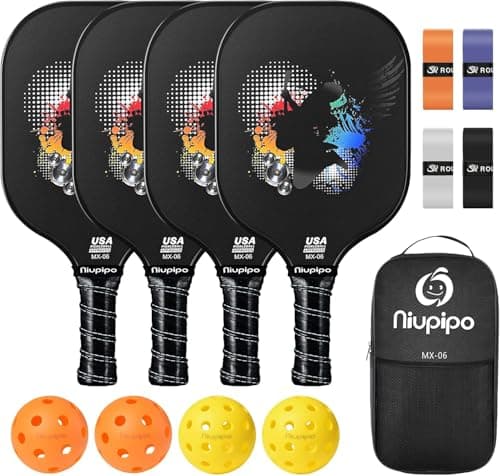
The niupipo Pro Graphite is the answer to a specific, very common question: what is the least I can spend on a paddle that is not a toy? It is USA Pickleball approved, it has a graphite face over a polypropylene honeycomb core, and it costs a fraction of what a mid-tier paddle costs. For a first paddle bought by someone genuinely unsure whether the sport will stick, it is hard to argue with.
It is also not a secret weapon, and the listings that imply otherwise are overselling. Below is what the specs mean on court, where the money was saved, and the two kinds of player who should spend more.
03The buyer's guide
What you are actually buying
Three things separate this paddle from the wooden slabs sold in supermarket sports aisles, and they are the three that matter at this price.
A graphite face. Graphite is stiffer than the fiberglass used on most budget paddles. A stiffer face returns less of its own flex to the ball, which reads as a slightly more controlled, less springy shot. At this price you are not getting the raw, textured carbon of a premium paddle — but you are getting a face that behaves predictably instead of one that flings the ball. Our graphite vs fiberglass comparison covers the difference in detail.
A polypropylene honeycomb core. The same family of core used in paddles many times the price. What differs is thickness: budget paddles run thinner cores, which is where the firmer feel comes from. See core thickness for what that changes.
USA Pickleball approval. Legal for sanctioned play from day one. Most paddles at this price are never submitted, so this is a genuine point of difference — and it means that if you join a club ladder in six months you are not immediately buying again. More on what that certification does and does not mean in our USA Pickleball approved guide.
How it plays, based on what the specs imply
We do not run a lab and have not measured this paddle. What we can do honestly is read the published specs, say what that construction typically produces, and tell you where we are inferring rather than reporting.
A stiff graphite face over a thinner honeycomb core is a firm combination. Expect the ball to come off quickly and expect to feel the hit in your hand more than you would with a thick 16mm core. That firmness is not a defect — it is the paddle telling you where on the face you made contact, which is genuinely useful feedback while you are learning. It also means the sweet spot feels smaller than on a thick-core paddle, because the drop-off outside it is more noticeable.
On touch shots, a firm paddle is less forgiving. Dinks and resets ask you to absorb pace, and a thin core gives more of it back. You can absolutely learn the soft game on this paddle; you will just find it easier on a thicker one. That is the honest trade at this price.
Where the money was saved
- Core thickness. The single biggest cost lever in a paddle, and the one trimmed here.
- Face texture. A smooth graphite face rather than a grit-textured carbon one, so spin generation is modest.
- Grip. The handle runs on the thin side. That is fixable for a few dollars with an overgrip, and thin-then-built-up is the right direction to be wrong in.
- Brand support. niupipo is a real brand with real listings, but you are not getting the warranty depth or resale value of a Selkirk or a JOOLA.
Who should buy it
Buy it if you are unsure the sport will stick, if you need a second paddle so a friend can play, or if you want an approved spare to keep in the car. It also works well as the paddle you hand to a visiting relative who has never played, which comes up more often than you would think.
Who should not
Skip it if you have any elbow or wrist sensitivity. A firm, thin-core paddle transmits more shock than a thick-core one, and if your arm already complains after racquet sports this is the wrong direction — look at a thicker, softer paddle, and read our elbow support picks while you are at it.
Skip it also if you already know you are committed. If you are going to play twice a week you will out-grow this within a season, and the money is better spent once. Our best paddles under $100 list covers the tier that lasts longer, and the beginner roundup has the safe default.
What we did not test
We have not hit with this paddle, measured its swing weight, put it on a scale, or tested how the face wears over a season. Every claim above is read off published specifications and the physics of that construction, and where we are inferring we have said so. That is the whole method, and it is written up on our methodology page.
The verdict
As a cheap, legal, competent first paddle it is genuinely good, and it is the paddle we would buy if budget were the constraint. As a paddle to grow into, it is not — it is a paddle to find out on. Buy it with that expectation and it is excellent value; buy it expecting to keep it for three years and you will be shopping again by spring.