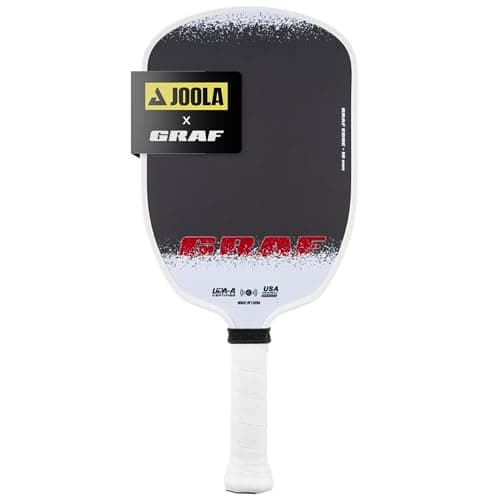
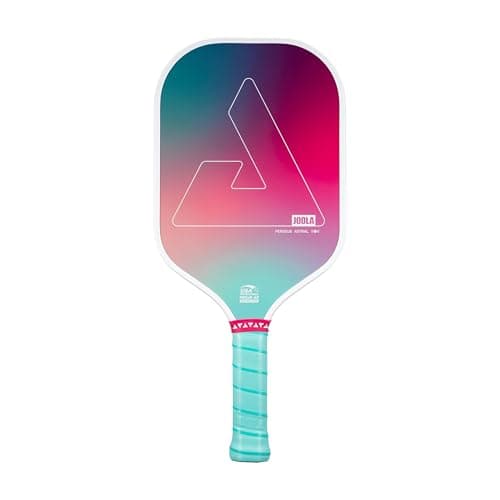
If you have never played, buy the Astral Perseus. It is lighter, more forgiving, and cheaper, and it is the paddle we rank first in best paddles for beginners for exactly those reasons. If you have played a season, know you are staying, and want the control a thicker core gives you, buy the GRAF Edge 16mm — the paddle we rank first in best paddles under $50.
These two are not really rivals. They are consecutive steps, and the mistake worth avoiding is buying the second one first. JOOLA publishes a 16mm polypropylene core and a textured carbon face on the GRAF Edge, and both of those specs reward a stroke that already exists. On a brand-new swing, a control paddle feels dead rather than controlled.
There is one genuine spec trap here, and it is the reason we would not let someone buy the GRAF Edge blind: its published grip is 4-1/8 in, which is the small circumference. An average adult hand usually wants the next size, and JOOLA sells an identically specced sibling — the Agassi Edge — with a larger handle. Measure first in the grip size guide.
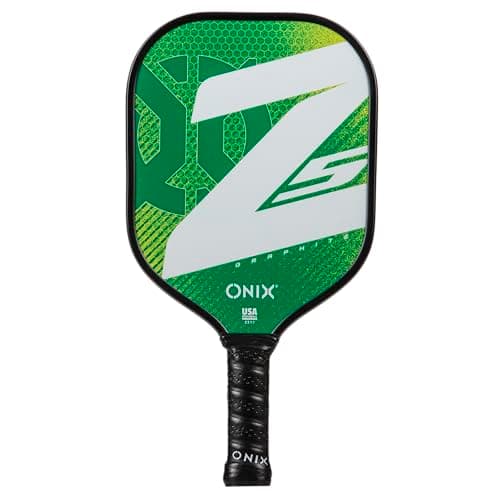
If forgiveness is your absolute priority and you are not loyal to either, the Onix Graphite MOD Z5 is the widebody answer and it has the biggest sweet spot of the three.
03The buyer's guide
The published specs, side by side
Every figure below is a manufacturer or named-retailer published spec, not a measurement we took. The scores are judgments from the rubric on how we evaluate gear.
| Astral Perseus | GRAF Edge 16mm | Onix Graphite MOD Z5 |
|---|
| Face | Sandblasted carbon fiber | Textured carbon fiber | Carbon fiber |
| Core | Polymer honeycomb | 16mm polypropylene | Nomex / polymer |
| Shape | Standard | Elongated, 16.5 x 7.5 in | Widebody |
| Published grip | Cushion grip | 4-1/8 in (small) | Cushion grip |
| Our forgiveness score | 9 / 10 | 8 / 10 | 10 / 10 |
| Our control score | 8 / 10 | 9 / 10 | 8 / 10 |
| Who it is for | The safe default first paddle | The first proper upgrade | The biggest sweet spot |
Sandblasted versus textured carbon
Both faces are carbon, and the words in front of "carbon" are doing the work. A sandblasted surface is lightly roughened; a textured one bites the ball harder and generates more spin. More bite sounds strictly better and is not, because spin is a stroke you build rather than a feature you buy. A beginner brushing up the back of the ball inconsistently gets inconsistent spin from a grippier face, which reads as unpredictability rather than improvement.
Carbon faces are also the part of a paddle that wears, and a textured face wears faster because the texture is the thing doing the gripping. We cover that lifecycle in when to replace your paddle, and face materials generally in graphite vs fiberglass.
The 16mm core is the real difference
A thicker core is softer and quieter and it absorbs more of the ball before the ball leaves the face. That is what "control" means in paddle marketing: the ball sits on the paddle a fraction longer and goes where you aimed, with less pop. Improving players settle on 16mm for exactly that reason, and it is also the arm-friendly direction — more damping means less shock into the elbow. The full breakdown is in the core thickness guide.
The catch is that control is only useful once you can aim. Give a thick, muted core to somebody still learning where the middle of the face is and the paddle feels like it has no life in it. The Astral's thinner, livelier core does more of the work for you, which is the correct trade on day one.
Shape: 16.5 x 7.5 in is the legal maximum
Add the GRAF Edge's published dimensions together and you get exactly 24 in, which is the ceiling USA Pickleball sets: combined length plus width may not exceed 24 in, with length capped at 17 in. That tells you what kind of paddle it is — it has spent its entire allowance on length, which buys reach and costs width.
Width is forgiveness. A widebody face gives you the biggest sweet spot and the smallest penalty for an off-center hit, which is why the Onix sits in this comparison at all and why it scores highest of the three on forgiveness. An elongated paddle rewards a player who knows where contact is happening. The trade-off in full is in elongated vs widebody.
The grip circumference caveat, stated plainly
The GRAF Edge publishes a 4-1/8 in grip. That is small. A handle that is too small is fixable — an overgrip adds a layer, and a replacement grip adds more — but it is a thing to know before the box arrives rather than after. JOOLA's Agassi Edge is specced identically with a larger handle, and we say so in the GRAF Edge review. Measure your hand first; that single step prevents the most common paddle return there is.
So which one, in one line each
- Never played, or playing a few times a month: Astral Perseus. Lighter, more forgiving, cheaper, same brand.
- One season in and the paddle is the limit, not you: GRAF Edge 16mm, with the grip measured first.
- Mis-hits are your main problem: Onix Graphite MOD Z5, for the widest face here.
- Sensitive elbow: the thicker core helps, but weight and grip matter more — best paddles for tennis elbow ranks for that specifically.
If you would rather see both of these against the whole field instead of each other, that is best pickleball paddles, and the one-paddle-instead-of-two question is answered in best paddles for beginners to intermediate.
And if the real question is which JOOLA to buy rather than which of these two, the whole range is ranked in best JOOLA pickleball paddles — five paddles, one published spec table, and the badges that are not the same badge.