Pickleball is a paddle sport played on a badminton-sized court — 20 feet wide by 44 feet long — with a solid paddle and a hollow, perforated plastic ball, over a net that stands 36 inches at the sidelines and 34 inches at the centre. Games are played to 11 points, you must win by 2, and you can only score when you are serving. Most of it is played as doubles, two against two. It takes about ten minutes to learn well enough to have a genuine game, which is the single biggest reason for its popularity.
If you want the rules themselves, we have them in full on pickleball rules and the step-by-step version on how to play pickleball. This page is the one before those: what the sport actually is, what the equipment is, what it costs, and what it feels like to turn up for the first time.
The court, in numbers you can picture
A pickleball court is 20 ft x 44 ft, the same footprint as a doubles badminton court. That is small — about a third of the area of a tennis court — and the size is the point. Nobody is running down lobs from forty feet away; most of a rally happens with all four players standing within a few feet of the net.
The one feature that makes the game what it is sits on either side of that net: the non-volley zone, a 7 ft deep strip across the full width of the court, universally called the kitchen. You may not hit the ball out of the air while standing in it. That single restriction is what stops pickleball being a smashing contest — you cannot stand at the net and swat everything downward, so the game develops into patient, soft exchanges punctuated by hard drives. Our the kitchen rule page explains it properly, and pickleball court dimensions has every measurement including the service boxes and the net posts.
The net height is worth getting right because almost every secondhand source rounds it. It is 36 inches at the sidelines and 34 inches at the centre — a correctly tensioned net sags in the middle on purpose. If you are setting one up at home, our net sizing guide and portable net setup guide cover it, and you can play on a tennis court with a few adjustments — can you play pickleball on a tennis court.
The ball is the strangest thing about the sport
A pickleball is a hollow plastic sphere with holes drilled through it, roughly 74 mm across and 26 grams depending on the model. It is not a wiffle ball, although it looks like one — a tournament-grade pickleball is moulded to a tight weight, diameter, bounce and hardness standard, and USA Pickleball maintains an approved list of the balls that meet it.
There are two kinds and the difference is real. Outdoor balls have around 40 small holes and a heavier, harder shell so they cut through wind; indoor balls have around 26 larger holes and a lighter, softer shell so they fly more slowly and quietly on a gym floor. Using the wrong one is the most common beginner equipment mistake, and it is why we keep a whole page on indoor vs outdoor pickleballs and another on types of pickleball balls.
The holes are also why the sport sounds the way it does. A solid paddle face striking a hard hollow ball produces a sharp crack that carries, which is behind most of the noise complaints you read about in residential areas — an indoor ball is noticeably quieter, which is part of why gyms use them.
The paddle: solid, not strung
A pickleball paddle is a solid rectangle-with-rounded-corners, roughly 16 inches long and 8 inches wide, with no strings. It is built as a sandwich: a honeycomb polymer core, usually 13mm or 16mm thick, with a face of fiberglass, graphite or carbon fiber bonded to each side. A typical paddle weighs between about 7.5 and 8.5 ounces.
You do not need to understand any of that to start. The only two things that matter on day one are that the paddle is not too heavy for your arm and that the handle fits your hand — and of those two, grip is the one you cannot fix afterwards, because a handle can be built up with an overgrip and can never be shaved down. Our grip size guide has a twenty-second ruler test, and paddle weight guide explains the bands. Everything else — core thickness, face material, shape — becomes interesting in your second season, and how to choose a pickleball paddle is there when it does.
01The short answer
#ad · Live prices from the Amazon Product API, as of October 24, 2026. Where we have no verified live price, we show none — we would rather leave a gap than print a number that has rotted.
02In detail
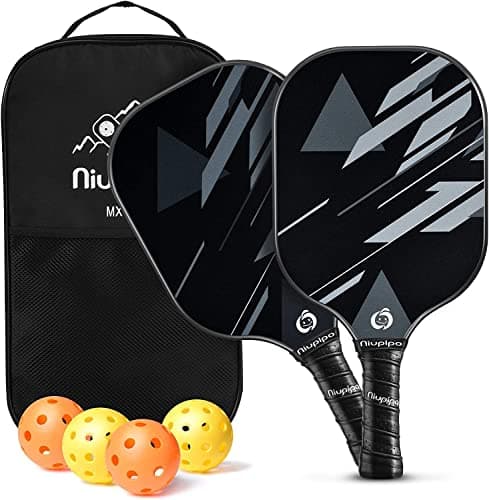
Best beginner set
2 paddles2 indoor + 2 outdoor ballsCarry bagUSAPA standard dimensions
The best-value way to get two people playing today: two paddles, balls and a bag in one box.
- Paddle quality
- Completeness
- Durability
- Value
Pros
- +Everything two people need to start a game the day it arrives
- +Real 8 oz mid-weight paddles on a widebody face — a proper starter paddle, not a toy
- +Cheaper than buying two paddles and balls separately
Cons
- −Fiberglass beginner paddles you'll eventually out-grow
- −niupipo lists these as USAPA standard size, not on the approved equipment list
Don't buy this if…
…you already own a paddle and just need a partner's. Buy a single paddle and a tube of balls — you'll waste the duplicate here.
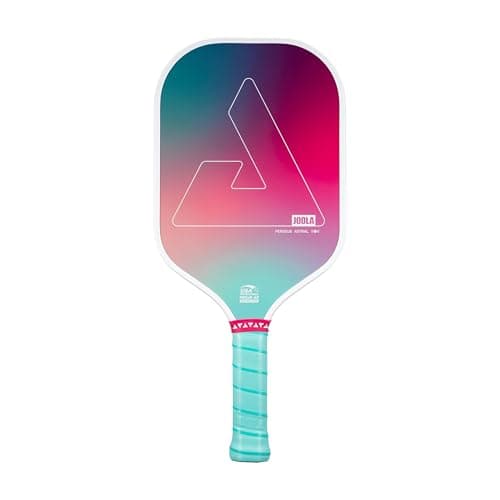
The safe default first paddle
Sandblasted carbon fiber facePolymer honeycomb coreLightweightCushion grip
The one we'd hand a friend on day one: forgiving, light, from a brand you can trust, at a fair beginner price.
- Forgiveness
- Control
- Power
- Comfort
- Value
Pros
- +Light and easy to swing, so a new player's wrist and elbow aren't fighting the paddle
- +JOOLA is a real, established pickleball brand — parts, warranty and resale all exist
- +Big, friendly sweet spot that forgives an off-center hit, which is most of your hits at first
Cons
- −A committed player will out-grow the lower-end power in a season
- −The sandblasted face has less bite than the raw, heavily textured carbon on premium spin paddles
Don't buy this if…
…you already know you want to play competitively within months. You'll want a 16mm control paddle sooner than this can take you — start one tier up.
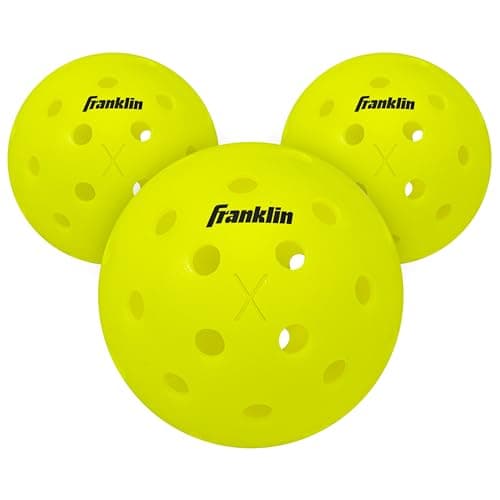
Best outdoor ball
Outdoor (40 holes)USA Pickleball approvedOfficial tournament ballOne-piece construction
The official ball of USA Pickleball and most rec play — if you play outdoors, this is the default.
- Durability
- Consistency
- Visibility
- Value
Pros
- +The USA Pickleball national-championship ball, so it's what your league likely uses
- +Consistent bounce and flight straight out of the tube
- +Widely stocked and cheap by the dozen
Cons
- −Like all hard outdoor balls, it can crack in cold weather
- −Harder and louder than an indoor ball
Don't buy this if…
…you play inside on a gym floor. Outdoor balls are harder with smaller holes — indoor balls fly better in still air and are quieter.
03The buyer's guide
What it actually costs to start
This is the question behind most searches for what pickleball is, and the honest answer is that it is one of the cheapest sports to try that exists. There are three sensible routes:
- Borrow one first. Free. Nearly every public court and club has spare paddles, and most groups will hand one to a newcomer without being asked. If you can do this, do it before you buy anything.
- Buy a set for two. The starter set above is two paddles and balls in one box, and it is cheaper than buying two paddles separately. This is the right answer for a household or a pair of friends — see best pickleball starter sets and starter set vs buying separately.
- Buy one paddle you will keep. If you already know you are going to play regularly, a single good beginner paddle like the JOOLA Astral Perseus skips the stage where you replace a set paddle after a month. Our best paddles for beginners ranks them, and best paddles under $50 is the budget tier.
Add a tube of outdoor balls — the one above is the official ball of USA Pickleball and the cheapest decision you will make — and that is a complete setup. The full budget breakdown, including the things people forget, is in how much pickleball equipment costs and what you need to start playing pickleball.
One thing worth spending on sooner than people expect: shoes. Pickleball is played in short sideways bursts, and running shoes are built to roll your foot forward, not to stop it sideways — which is the mechanism behind the ankle sprains new players collect in their first month. You do not need pickleball-branded shoes; any court shoe works, including tennis or volleyball. See what is a court shoe and do you need pickleball shoes.
The sport in numbers
Every figure below is an official dimension or a published manufacturer specification for a ball or paddle we rank. None of it is measured by us:
| Thing | Number | Why it matters |
|---|
| Court | 20 x 44 ft | Same as doubles badminton; about a third of a tennis court |
| Net height | 36 in sidelines / 34 in centre | A correctly tensioned net sags in the middle on purpose |
| Non-volley zone | 7 ft deep, full width | No volleys from inside it — the rule that makes the game |
| Ball | ~74 mm, ~26 g | Outdoor ~40 small holes; indoor ~26 larger holes |
| Paddle | ~16 x 8 in, 7.5–8.5 oz | Solid, unstrung; 13mm or 16mm honeycomb core |
| Game | 11 points, win by 2 | Only the serving side can score |
How the scoring works, in two sentences
Games go to 11 and you must win by 2. You can only score points while your side is serving, which means a rally you win as the receiver gets you the serve rather than a point.
In doubles the server calls three numbers before each serve — their own score, the opponents' score, and whether they are the first or second server of that turn — so "4-2-1" is a complete statement of where the game stands. That third number is the part that confuses everyone for the first week and then becomes automatic. We walk through it with examples on pickleball scoring, and the serve itself has its own rules worth knowing before you turn up — pickleball serving rules and pickleball faults.
One more rule that shapes every rally you will play: the two-bounce rule. The serve must bounce before the receiver hits it, and the return must bounce before the serving side hits it. That stops the serving team rushing the net behind a serve, and it is why pickleball rallies start slowly and then speed up.
Why it grew so fast
Pickleball was invented in 1965 on Bainbridge Island, Washington, by three fathers improvising a game for bored children with ping-pong paddles and a perforated ball over a lowered badminton net. The name has a disputed origin story we cover separately in why is it called pickleball.
Its growth is not mysterious, and it is not really about the sport being fun — plenty of sports are fun. Four structural things explain it:
- The learning curve is almost flat at the start. A solid paddle and a slow ball mean a complete beginner can sustain a rally in their first session, which is not true of tennis, squash or badminton. People come back to things they were not bad at.
- The court is small, so the physical demand is adjustable. Doubles on a 20 x 44 ft court can be a gentle social hour or a brutal workout, depending entirely on the four people playing. Very few sports stretch that far.
- It is cheap and it fits existing space. One tennis court holds up to four pickleball courts, and a driveway holds one. The conversion economics are why facilities adopted it so quickly.
- It is sociable by construction. Doubles is the default, the kitchen rule keeps everyone within talking distance, and the scoring call means somebody is speaking before every point.
If you want to see how it compares with the sports it is most often confused with, we have direct comparisons: pickleball vs tennis, pickleball vs padel, pickleball vs badminton and pickleball vs ping pong.
What your first session is actually like
You will be put in a doubles game with three people who already play, and they will not mind. That is the normal entry route to this sport and it is why it spreads — open play at most clubs rotates players through courts continuously, so you are never waiting long and never stuck with the same partner.
Three things will surprise you. The ball is slower than you expect, which means you have more time than your instincts believe and will rush anyway. The kitchen line is where the game lives, not the baseline, and you will instinctively stand too far back for the first hour. And soft shots win more points than hard ones, which takes most people considerably longer than an hour to accept.
The shortest route to not being the weakest player on court is not equipment. It is learning how to dink, knowing the handful of common beginner mistakes, understanding pickleball etiquette before you walk on, and doing five minutes of warm-up so your first lateral push is not your last. When people start describing themselves to you with numbers like 3.0 or 3.5, pickleball skill levels explains the scale, and the glossary translates the rest of the vocabulary.
And wear something you can move sideways in, with court shoes on your feet — what to wear to play pickleball is the short version, and it is the only piece of gear advice that matters on day one.
How we picked
Everyone in this category says they tested twenty paddles. We haven't tested these in a lab, and we say so. Instead we compile the published manufacturer specs, do the math, weight everything toward what a beginner actually needs — forgiveness, a large sweet spot, sane weight and a fair price — and score each product against a published rubric. The scores are judgments from that research, not measurements we took. Where a fact came from someone else, we name it in Sources.