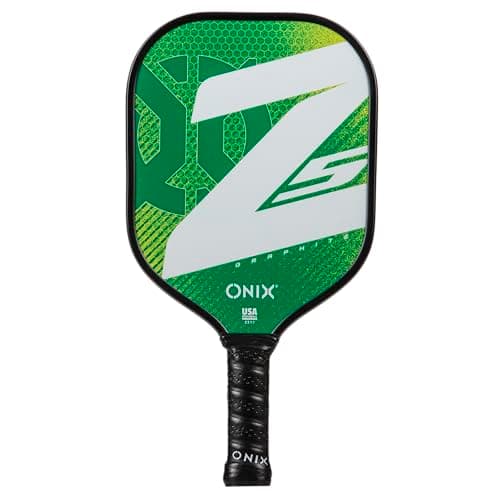
Buy the Graphite MOD Z5 if you want one Onix paddle, and the Z1 starter kit if you are buying for two people. Those are the two products in the range that are both genuinely good and genuinely documented. Live prices for the whole lineup are in the table below.
Onix earned its place in this sport with one thing: the widebody shape. The Z5 face is enormous, which makes it the most forgiving paddle for a new player still learning where the middle is, and the original has been a first paddle for a decade. That is why the modern carbon version sits in our beginner picks and tops this page.
The complication — and the reason this page is organized the way it is — is that Onix is the worst documenter in our registry. Several of its Amazon listings publish nothing beyond what is in the box. One paddle will not tell you which of three weights you are being sent. One ball publishes no hole count, diameter or weight. And on one product, Onix's own page contradicts itself about what the paddles are made of. None of that makes the gear bad. It does mean a buyer has to be told where the gaps are, which is this page's job.
Our standing disclosure: we have not tested any of this.We do not run a lab, we have not bounced a ball or swung any of these paddles. Every dimension, ounce, circumference and inclusion below was read off Onix's own published product pages, a retailer spec table, or the live Amazon listing for the exact ASIN our buy button points at — each named in Sources. Where Onix publishes nothing we say so rather than filling the gap. The scores are judgments from that research against our published rubric, weighted for a beginner.
03The buyer's guide
First, the only criterion that sorts this range: what has Onix actually documented?
Brand pages usually pretend a company is equally good at everything it sells. With Onix the useful split is not quality — most of this gear is fine — but how much the brand is willing to tell you before you spend. Sorted that way, the range falls into three clear tiers:
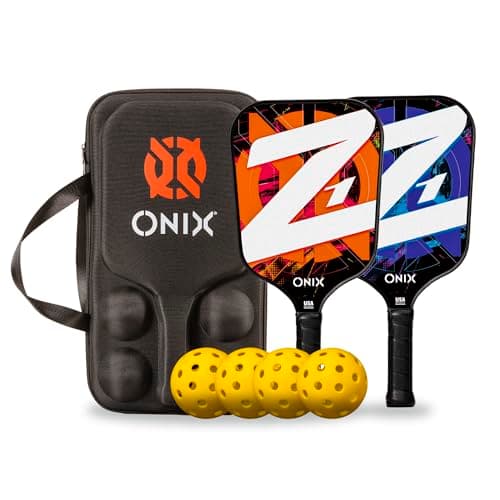
- Fully documented, buy with confidence. The Z1 starter kit is the standout: Onix publishes the paddle length, face width, handle length, grip circumference and weight band, names the face and core materials, describes the shape, lists exactly what is in the box, and states that the paddles meet USAPA requirements. That is a complete spec sheet and almost nothing else in the range matches it.
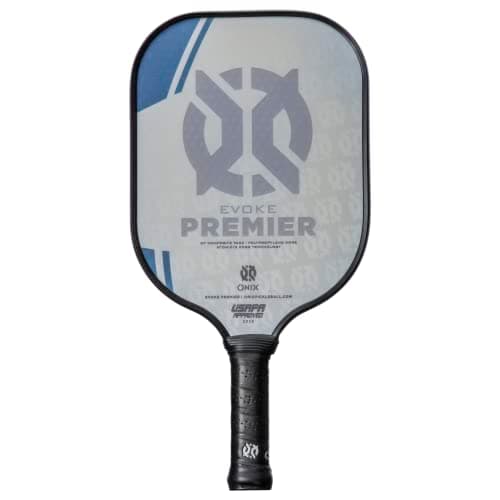
- Documented by someone else. The Evoke Premier has a full published spec table — at a retailer. Onix's own Amazon listing title for it says essentially nothing, including the one thing you most need to know.
- Barely documented at all. The Recruit set and the Recruit indoor balls. Both are cheap, both are real, and between them they publish no weight, no dimensions, no grip circumference, no hole count and no approval claim.
That tiering is the ranking. A beginner buying blind is far better served by a cheaper product whose specs are published than a nicer one whose specs are not, because the published numbers are the only thing that tells you whether the paddle suits your arm.
The widebody shape — what Onix is genuinely best at
Before the caveats, credit where it is due. A widebody paddle is shorter and wider than an elongated one, and the practical effect is the largest, most forgiving sweet spot available. For a new player, whose hits are mostly off-center, that is the single most valuable property a paddle can have — it converts shanks into playable balls.
The trade is reach. A widebody gives up length, so you cover slightly less court and drive with slightly less leverage from the baseline. That is a real cost for a singles player and almost irrelevant for a beginner playing doubles, which is what most beginners play. The full comparison is in elongated vs widebody paddles, and the Z5 itself is examined in our Onix Graphite MOD Z5 review.
Onix applies the shape across its range. The published Z1 is a wide body with a tennis-style handle, and the Evoke Premier's published 16 x 8 in face is wide rather than elongated. If the forgiving shape is what you came for, every paddle here gives it to you.
The trap on the Evoke Premier: three weights, one listing, no label
This is the most expensive mistake available in the Onix range and it is worth a section of its own. The Evoke Premier is sold in three weight bands. Pickleball Central's spec table lists them as 7.5-7.8 oz light, 7.8-8.2 oz standard and 8.2-8.4 oz heavy — and notes a contradiction inside its own page, where the description gives the heavyweight range as 8.2-8.5 oz instead.
The Amazon listing title our buy button points at does not say which band it ships. That is not a trivial gap. Six tenths of an ounce is the difference between a quick, arm-friendly paddle and a stable, powerful one, and it is the first spec we tell beginners to decide on — see the pickleball paddle weight guide. Buying a paddle whose weight you cannot confirm is buying a coin flip on the spec that matters most.
Two further gaps on the same paddle, both worth knowing. Core thickness is not published anywhere we could find, which is the spec that decides how soft and arm-friendly a paddle feels — our core thickness guide explains what 14mm versus 16mm actually changes. And neither the listing nor the retailer spec table states USA Pickleball approval, so do not assume it is legal for sanctioned play; check the official list, which we explain how to use in USA Pickleball approved paddles.
What the Evoke Premier does publish is good: a DF Composite fiberglass face, a polypropylene core, a 16 x 8 in head with a 5 in handle, a 4-1/8 in grip on the standard weight (4 in on the light), and a named Atomic13 edge guard. It is a real paddle with a real spec sheet. It just is not a paddle you can buy on this listing knowing what will arrive.
The Recruit set, and a brand page that cannot agree with itself
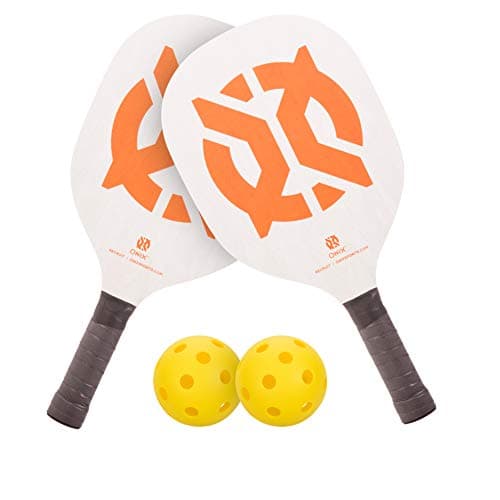
The Recruit starter set is the cheapest thing Onix sells and the clearest example of the documentation problem. Our note on it is not a judgment, it is a quotation: Onix's own product page says both things. The overview describes paddles "made from 6 ply basswood". The bullet list on the same page says "2 poplar wood paddles and 2 yellow pickleball balls". Basswood and poplar are different woods.
We are not going to pick a side on Onix's behalf, and we are not going to quietly drop the detail either. For a $30 introductory set the practical consequence is small — both are light hardwoods and both make a wood paddle — but it tells you how much weight to put on any unverified spec in this part of the range. No weight, dimensions or grip circumference are published at all.
More importantly, be clear about what a wood paddle is. Wood is heavy and dead compared with any composite face; these are the paddles a club keeps in a bin for guests. Buy the Recruit set to find out whether the sport sticks for two people at near-zero risk. Do not buy it if you already know you are going to keep playing — the money is better spent on one decent composite paddle, and starter set vs buying separately works through that arithmetic.
Balls: one league-grade, one practice-bucket
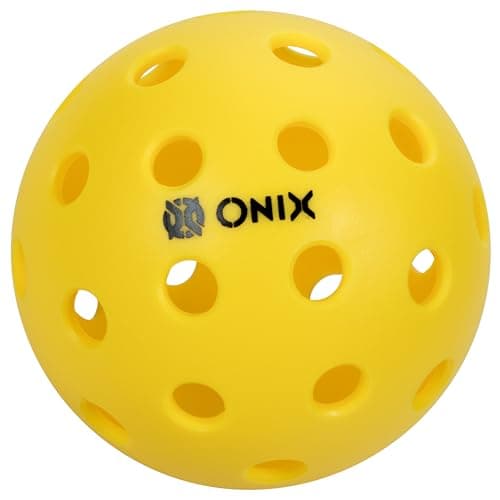
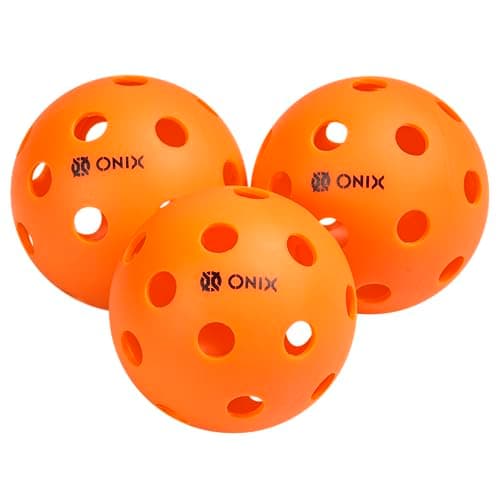
Onix sells at both ends of the ball market and the gap between them is wide. The Pure 2 outdoor ball is the serious one: 40 holes, USA Pickleball approved, with a slightly softer feel than the hardest outdoor balls, which is genuinely kinder to a beginner's elbow. It is not as universally stocked at leagues as the Franklin X-40, so check what your league mandates before stocking up — many run the X-40 for matches.
The Recruit indoor ball is the other end. Its listing names a welded seam, which is the construction that resists splitting, and then stops: no hole count, no diameter, no weight, no pack count and no USA Pickleball approval claim. Those first three numbers are what actually define a pickleball, and the approval claim is what makes a ball usable in organized play. So it ranks last here, and it ranks last honestly — as a cheap practice-bucket ball for a gym floor, which is a real use.
If you want the indoor ball that is properly documented, that is the Franklin X-26, ranked in best indoor pickleball balls. The difference between the two ball types is covered in indoor vs outdoor pickleball balls.
Which Onix, by buyer
- One paddle, you are a beginner: Graphite MOD Z5. The biggest sweet spot in our beginner picks, and the shape is the whole reason to buy Onix.
- Two people starting together, seriously: Z1 starter kit. Composite paddles, four balls, a case, and the only full spec sheet in the range.
- Two people just trying it: Recruit set. Wood, cheap, a loan set rather than a keeper.
- Outdoor balls for a softer feel: Pure 2 — but check your league's mandated ball first.
- The Evoke Premier: only if you can confirm the weight band and do not need certified-legal. Otherwise buy a paddle that publishes both.
- Indoor match balls: not from this range. Nothing here claims indoor approval.
How Onix compares with the rest
Onix is a real brand with a real pedigree and one genuinely category-defining product. What it is not is the best-documented brand available to you, and on paddles that matters more than it sounds — a spec sheet is the only way to tell whether a paddle suits your arm before you own it.
For comparison, the brands that document most thoroughly in our registry are JOOLA and Selkirk, both of which publish weight, dimensions, handle length and grip circumference as standard: see JOOLA pickleball paddles, ranked and Selkirk pickleball paddles, ranked. Franklin is the brand to beat on balls — Franklin pickleball gear, ranked. Our broader take on what a household name is actually worth is in best pickleball paddle brands.
What we are not claiming
We have not swung any of these paddles, bounced any of these balls, or weighed a single item. Every figure above is a published claim from Onix's own product pages, a retailer's spec table or the live Amazon listing for the exact ASIN our buy buttons point at, with the trade-offs reasoned from how these constructions behave as a category. Where Onix publishes nothing, we have said so instead of estimating — and where Onix publishes two different answers, we have printed both. Our methodology sets out the approach in full.
The honest bottom line
Onix is worth buying for the widebody shape, and the Z5 is the cleanest way to get it. If you are kitting out two people and intend to keep playing, the Z1 kit is the best-specified product the brand sells and the one we would choose from this range. Both are easy recommendations. Onix does not make shoes, so the other half of a first setup starts at best pickleball shoes for beginners.
Everything below that needs a condition attached. The Evoke Premier is a good paddle sold on a listing that will not tell you its weight. The Recruit set is honest value sold on a page that cannot name its own wood. The Recruit indoor ball is a practice ball that does not claim to be anything more. None of those is a reason to avoid the brand — they are reasons to know which of its six products you are actually buying.