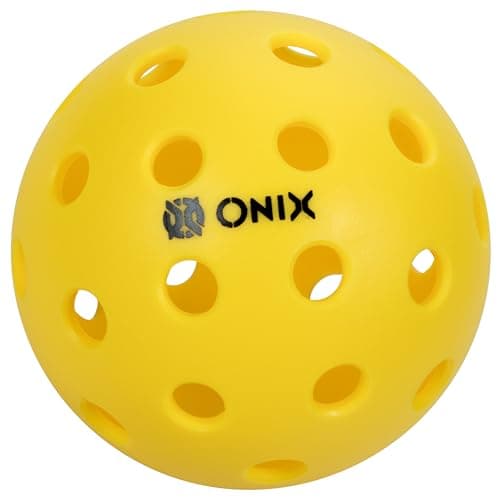
Reviewing a pickleball is a short exercise, because a ball has roughly four properties that matter: how consistently it flies, how long it survives, how easy it is to see, and how hard it hits your arm. The Onix Pure 2 Outdoor is competitive on the first three and genuinely good on the fourth, which is the whole argument for it.
It is USA Pickleball approved, it is a forty-hole outdoor ball, and it sits on the softer side of the approved outdoor range. If your elbow has started making itself known after sessions, that softness is not a marketing angle — it is the reason to consider this ball.
03The buyer's guide
What "softer" actually changes
Outdoor pickleballs are made of a hard plastic, and the hardness is what lets them hold a line in wind. But hardness also determines how much of each impact travels back up the paddle into your forearm and elbow. Within the approved range there is real variation, and this ball sits toward the gentler end.
The trade is liveliness. A slightly softer ball comes off the paddle a fraction less energetically, which power players notice immediately and most recreational players never do. It also means the ball goes out of round a little sooner than the hardest tournament balls, because softer plastic deforms rather than resisting. Neither of those is a defect; they are what you are buying when you buy softer.
Where it stands against the Franklin X-40
| Onix Pure 2 Outdoor | Franklin X-40 |
|---|
| Feel | Softer, gentler on the arm | Harder, livelier off the face |
| League availability | Less commonly the specified ball | The default at most US rec play |
| Durability | Good; softer plastic deforms rather than cracking as cleanly | Good; hard plastic cracks in cold |
| Approval | USA Pickleball approved | USA Pickleball approved |
The honest summary: if your group already plays with X-40s, play with X-40s. Consistency with the people you actually hit against is worth more than a small comfort gain. The Pure 2 earns its place when you are buying for yourself, for practice, or because your arm is the limiting factor. Our Franklin X-40 review makes the other side of the case.
Visibility and color
Visibility is a genuine spec, not a cosmetic one. A ball you pick up late feels like slow reflexes, and new players routinely blame themselves for what is really a contrast problem. Whatever ball you buy, choose the color that stands out against the surface you play on — and if you play on more than one, own two colors. The cost of being wrong is a few dollars; the cost of not noticing is weeks of thinking you are slower than you are.
How long it will last
Every pickleball is consumable. Outdoor balls typically end their lives with a crack along a seam, often triggered by cold weather or a hard hitter, and a cracked ball is finished — it will not bounce true and can split further mid-rally. Softer balls like this one are somewhat more likely to go out of round first instead, which is harder to spot: the ball looks fine and bounces oddly. The rule for both is the same. If the bounce surprises you, replace it. See how long pickleballs last for the detail.
Who should buy it
- Players with early elbow or forearm soreness who want to remove one cause of shock.
- Anyone drilling a lot solo or with a ball machine, where volume of impacts is high.
- Rec groups that do not have a specified ball and just want a good approved outdoor one.
Who should not
Anyone practicing for a tournament, and anyone whose league specifies a different ball. Train on the ball you will compete with — the flight differences between approved outdoor balls are small, but they are exactly the size that shows up under pressure. Also skip it if you are a power player who wants everything the ball has to give.
What we did not test
We have not bounce-tested these, measured hardness, or run them to failure. The assessment here is read from published specifications, the approved-ball standards, and the known behavior of harder and softer outdoor plastics, with the inferences flagged. Our methodology page sets out how we work.
The verdict
A good approved outdoor ball with a specific, real reason to exist: it is kinder to the arm than the hardest tournament balls without leaving the approved range. If that is your problem, it is a sensible buy. If your court already has a ball, buy that one instead — and our best outdoor pickleballs list ranks the full field.
Worth knowing if you are buying more than balls: this is the best-documented product Onix makes, and its cheaper indoor sibling is the worst. We rank the brand's whole lineup on exactly that in Onix pickleball gear, ranked.