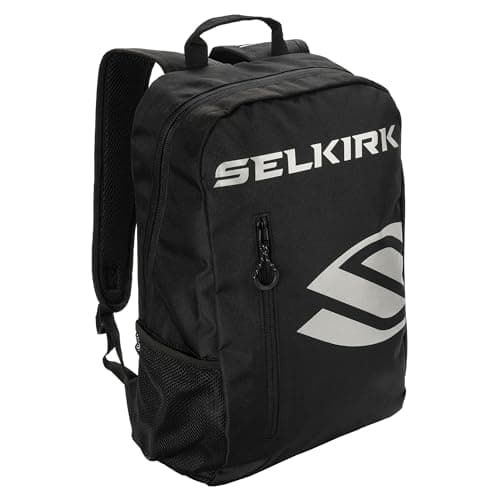
The Selkirk Day Backpack is the bag we recommend most often, and the honest reason is unglamorous: it's the right size for what a recreational player actually carries, and the build quality is a visible step above the generic bags that dominate this category.
Our standing disclosure: we haven't stress-tested this bag ourselves. We don't run a lab. This review works from Selkirk's published specifications and the category norms behind our published rubric, and judgments are labeled as judgments rather than dressed up as measurements.
Who a pickleball bag is actually for
Worth asking before spending anything. If you carry one paddle and a sleeve of balls to a court five minutes away, you do not need a dedicated bag — a sling or even a tote is fine. A backpack like this makes sense when you're carrying two paddles, several balls, a water bottle, a change of shoes and your keys and phone, and walking any real distance with it. That's the brief this bag is built to.
What you're paying for
Two straps, properly padded
The single biggest practical difference between this and a sling. A sling bag puts all the weight on one shoulder, which is fine for a short walk and unpleasant for a long one. If you're carrying shoes and water as well as paddles, two straps stop being a luxury.
The vented compartment
A separate ventilated pocket, intended for damp shoes or wet kit. This sounds like a marketing feature and isn't: the alternative is your shoes sharing an unventilated space with your paddles, which is how bags start to smell permanently. Anyone who plays more than once a week will use this.
Build quality
Selkirk is an established pickleball brand rather than a generic-goods importer, and the difference shows in the parts that fail first on cheap bags — zips, strap anchor points and the base fabric. This is a judgment based on brand positioning and specification rather than a durability test we ran, but it's the consistent pattern in this category.
Organization
Dedicated paddle sleeves stop your paddle faces rubbing against zips and keys — a real consideration if you've bought a textured carbon paddle, where surface wear directly costs you spin.
What it does badly
It costs more than a sling.Considerably more. If your needs are modest, that premium buys you nothing you'll use.
It's mid-sized.This is a day bag and it's named accurately. If you carry four paddles, a change of clothes and gear for a tournament weekend, you want a full tour bag instead — see our bag roundup for larger options.
It's a pickleball bag.Obvious, but worth saying: a generic backpack of similar quality costs less. You're paying for paddle-specific organization, so if you don't care about that, you have cheaper options.
What actually fits, and how to pack it
A realistic recreational load for this bag: two paddles in the sleeves, a sleeve of balls, a water bottle, a change of shoes in the vented pocket, and keys, phone and a walletin the small top compartment. Add a light jacket and you're at the practical limit.
Two packing habits worth adopting. First, put paddles in face-to-face rather than face-to-zip, so the hitting surfaces protect each other — this matters if you own a textured carbon paddle, where surface wear directly costs you spin. Second, keep shoes in the vented compartment even when they're dry. Court shoes pick up grit that scratches paddle faces, and the whole reason for a separate pocket is to keep that grit away from everything else.
How long should a bag like this last?
Bags fail at the zips and the strap anchor points, in that order, and almost never at the fabric. That's the honest argument for spending more here than on a generic bag: better zips and reinforced anchors are exactly where the extra money goes.
For a couple of sessions a week, a bag at this level should comfortably outlast several paddles and several pairs of court shoes. It is genuinely a buy-once item, which is why we'd rather someone spent here than on a paddle upgrade they don't yet need.
Who should buy something else
- Minimal carriers. One paddle and some balls? Buy a sling for a fraction of the price.
- Tournament players. You need the capacity of a full tour bag.
- Anyone whose court is a two-minute walk away.The comfort advantages don't apply on that distance.
The verdict
The Day Backpack is a sensible bag rather than an exciting one, which is exactly what a bag should be. It carries a realistic recreational kit comfortably, keeps damp shoes away from everything else, and is built by a company with a reputation to protect. If you play a couple of times a week and carry more than a paddle, it's an easy recommendation. If you don't, buy the sling and spend the difference on court shoes.