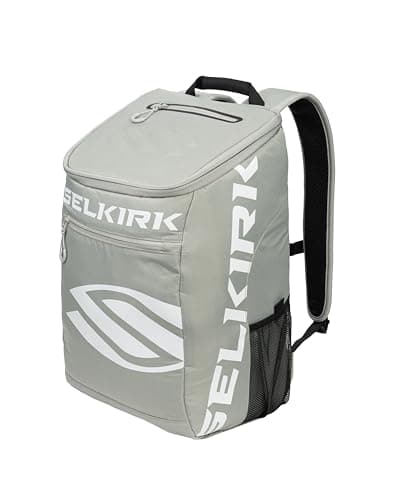
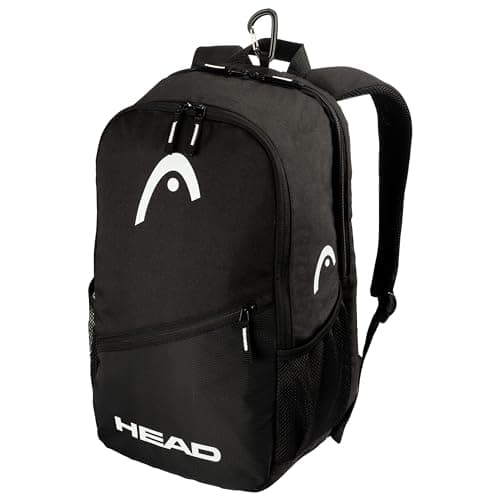
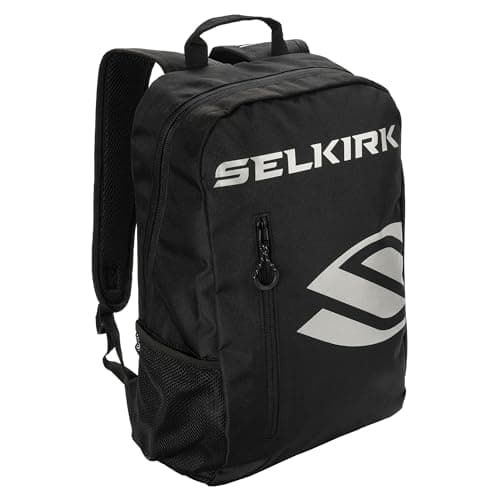
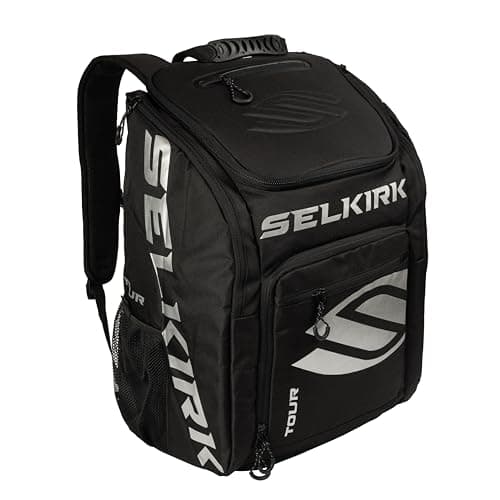
Buy the Selkirk Tour Travel Backpack if you want the premium tier done properly, and the Selkirk Day Backpack if you want the honest answer. Both are in the table below with live prices. The gap between them is roughly a factor of three, and this page is about what that factor of three actually contains.
Premium is a real tier in pickleball bags, not a pure branding exercise. But only three of its features change how a playing day goes, and every listing buries those three among a dozen that do not. Below, the field ranked — then the short version of which is which.
If you are upgrading the bag because you have started entering things, the bag is one of five items that actually change when you begin competing — the rest are in our club and tournament gear guide, along with an explicit list of what does not change.
03The buyer's guide
The three premium features that actually change a day
If you strip the marketing off the premium tier, almost all of the genuine difference sits in three compartments. Everything else is material quality, which is real but slow-acting.
1. A ventilated shoe compartment
The single most useful thing a premium bag adds. Court shoes come off damp, and in a single-compartment bag that damp sits against your paddles, your spare shirt and your keys for the drive home. A vented, separated shoe pocket solves a problem you have every single session, which is why it is the feature we would pay for first.
2. An insulated pocket
Only matters if your sessions are long. For an hour of rec play it is dead weight. For a tournament day, a league night that runs late, or summer outdoor play, having drinks and food that are not warm is a genuine quality-of-life change. Judge it against how you actually play, not how you imagine playing.
3. A dedicated, padded paddle sleeve
A paddle face is a consumable — texture polishes smooth and spin fades, which we cover in when to replace your paddle. A separated sleeve stops your paddle face rubbing against zippers, keys and shoe soles in transit. On a $50 paddle that is a nicety. On a $150 carbon paddle it is cheap insurance, and the more you spent on the paddle the more the sleeve is worth.
What premium does not buy you
Being straight about the other side, because the listings will not be.
- Capacity you will use. Six-paddle capacity is genuinely useful if you own six paddles. Most players own one or two, and a bag sized for a quiver is just a larger, heavier object to carry.
- Better play. Obvious, but worth saying on a page like this. Nothing in a bag improves a single shot. If the budget is finite, it belongs in a paddle or in shoes long before it belongs in a bag.
- A fence hook you will remember to use. Genuinely handy at an outdoor court with no benches. Not a reason to choose one bag over another.
- Longevity you can measure. Premium shells such as Selkirk's +V11 Max Polyfiber are better material than a generic nylon. Nobody publishes a wear rate, so treat "more durable" as a reasonable expectation rather than a specification.
Tour bag, backpack or sling?
The premium tier spans three shapes, and the shape matters more than the price.
Sling
One strap, grab-and-go, holds a couple of paddles and balls. There is essentially no premium sling tier worth the name — a sling is a solved, cheap problem, and if that is your shape you should buy an inexpensive one and stop. Our best pickleball bags list covers those.
Backpack
Two straps, carries a full kit comfortably, fits under a desk or in an overhead bin. This is the right shape for the overwhelming majority of players, premium or not, and it is where the premium tier is genuinely worth shopping — the shoe compartment, thermal pocket and laptop sleeve all live here. Our best pickleball backpacks page ranks the shape as a whole, across prices.
Tour bag / duffel
The largest shape: a quiver of paddles, a change of clothes, shoes, food. Genuinely necessary if you play tournaments and are away from your car all day. Genuinely excessive if you drive to a court, play, and drive home. Buy this shape for a specific logistics problem, not as an upgrade.
How to tell a premium bag from an expensive one
Use the same test we would use on any listing: can you name the component?
"Premium construction" is not a spec. "+V11 Max Polyfiber with a hard EVA top" is — you can look it up, compare it, and hold the brand to it. The Selkirk and JOOLA bags on this page name their materials and compartments; that is the difference between a premium bag and a bag with a premium price. If a listing at this price cannot tell you what it is made of, it is charging you for the logo.
The same principle runs through everything we recommend — it is why our how to choose a pickleball bag guide is built around features rather than brands, and why our methodology is public.
The honest recommendation
Most people reading a page about premium bags should buy a good mid-priced backpack and spend the difference on a paddle. That is the buyer-first answer and we are not going to bury it: the Selkirk Day Backpack at the bottom of this list carries two paddles, balls and a water bottle, is made by the same brand with the same build standards as the bags above it, and costs a fraction of them.
Buy up the list when you have a named problem the extra money solves — damp shoes ruining your kit, a quiver that will not fit, a tournament day away from the car, or a bag that has to work for the office too. Those are all real, and if one of them is yours the premium tier is money well spent. "It looks better" is also allowed. It is just not a spec.