Nobody requires you to wear them, and most recreational players do not. Our answer is still yes for most people, and it comes down to one unglamorous fact: an eye is the one piece of equipment on the court you cannot replace. If you play doubles at the kitchen line — which is where pickleball is played — buy a pair. If you want the simplest version of that decision, the HEAD Impulse costs about what a sleeve of balls costs and ends the question.
The honest counter-argument: pickleball is not squash. The ball is light, hollow plastic rather than hard rubber, it travels slower than a tennis ball, and serious eye injuries are not common. If you play singles from the baseline twice a month, the risk is genuinely low and we are not going to pretend otherwise.
What tips the balance is where the sport is played. At the non-volley line you and your opponent stand about 14 ft apart, trading balls at chest and head height, with a partner swinging a paddle beside you. That geometry — not ball speed — is why eye protection is the cheapest insurance in the bag.
03The buyer's guide
Who should definitely wear eye protection
Four groups, in order of how strongly we would push:
- Anyone with one good eye, a previous eye injury, or recent eye surgery. There is no trade-off to weigh here. This is a conversation with your ophthalmologist, and the answer is almost always yes.
- Doubles players who live at the kitchen line.Hands battles happen at close range and your own partner's paddle is part of the risk.
- Juniors and new players. Both are more likely to be hit by a ball they did not see, for different reasons — one is shorter and closer to paddle height, the other has not learned to read a drive yet.
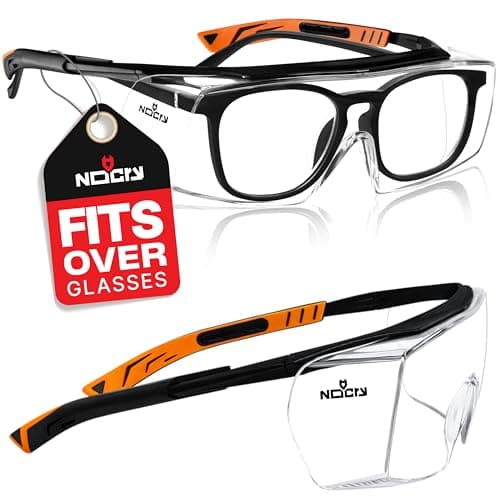
- Anyone who plays in prescription glasses. Not for the eye, for the frames: a ball into ordinary spectacles drives the frame into your face. An over-the-glasses pair solves it without giving up your prescription.
What ANSI Z87.1 actually certifies
A Z87.1 marking means the lens has passed defined impact tests under the ANSI/ISEA occupational eye protection standard. An unrated lens has passed nothing at all, which is the entire reason the rating is worth looking for. Ordinary sunglasses are designed to survive being sat on, not to stop something arriving at your eye.
The caveat we would rather state than hide: Z87.1 is a workplace standard, written for flying debris and grinding sparks, not for a pickleball. It is the best published benchmark available in this category and it is not a pickleball-specific certification, because no such thing is in general use. A racquet-sport goggle from a racquet brand is designed around a ball coming at your face; a Z87.1 safety glass is designed around a workshop. Both are enormously better than nothing.
The three shapes, and which one is yours
| Type | Published rating or design | How it stays on | Buy it if |
|---|
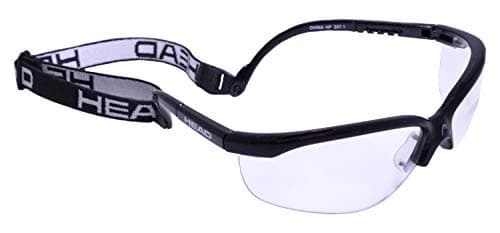
| Racquet-sport goggle (HEAD Pro Elite) | Racquet-sport lens, anti-fog, scratch-resistant, UV | Wraparound frame | You want the purpose-built default and will wear it every session |
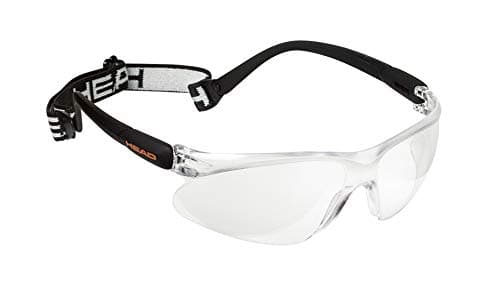
| Strap goggle (HEAD Impulse) | Racquet-sport lens, anti-fog and scratch-resistant | Adjustable head strap | You want the cheapest real protection, or you lunge hard and hate slipping arms |
| Over-the-glasses (NoCry) | ANSI Z87 certified, integrated side shields | Temple arms over your own frames | You wear a prescription you are not taking off |
A fourth case worth naming: a narrow face or a junior player who slides straight out of adult goggles. Most protective eyewear is built on one broad adult frame, and a pair that will not sit still gets left in the bag. Our full ranking, including a genuinely small Z87.1-rated frame, is in best pickleball glasses and eye protection.
The two reasons people stop wearing them
Fogging. This is the real adherence problem, not comfort and not looks. An anti-fog coating is the difference between eyewear you wear and eyewear you own, and it is worth paying for — bargain lenses fog in a sweaty indoor gym within a game. Two lens surfaces fog twice as fast, which is the genuine downside of the over-the-glasses approach.
Slipping. Temple arms move when you lunge and pivot; a strap does not. That is the one functional argument for the cheaper strap goggle over a nicer pair with arms, and it is a better argument than it sounds. Whichever you choose, keep them in a pocket where they will not get scratched — what to pack in your pickleball bag has the rest of the checklist, and the bags we rank all have a pocket for exactly this.
What we are not going to tell you
We have not tested any of these by firing a pickleball at them, and no manufacturer in this category publishes a ball-speed rating. What we can say is which pairs carry a published impact standard, which are designed for racquet sports rather than adapted from industrial safety, and which fit a face that is not a standard adult one. Everything beyond that — how a lens feels in bright outdoor sun, whether a strap pulls your hair — is preference, and we have flagged it as preference. If you want the ranked version of this decision with live prices, that is best pickleball eye protection.
How we picked
Everyone in this category says they tested twenty paddles. We haven't tested these in a lab, and we say so. Instead we compile the published manufacturer specs, do the math, weight everything toward what a beginner actually needs — forgiveness, a large sweet spot, sane weight and a fair price — and score each product against a published rubric. The scores are judgments from that research, not measurements we took. Where a fact came from someone else, we name it in Sources.